



TL;DR:
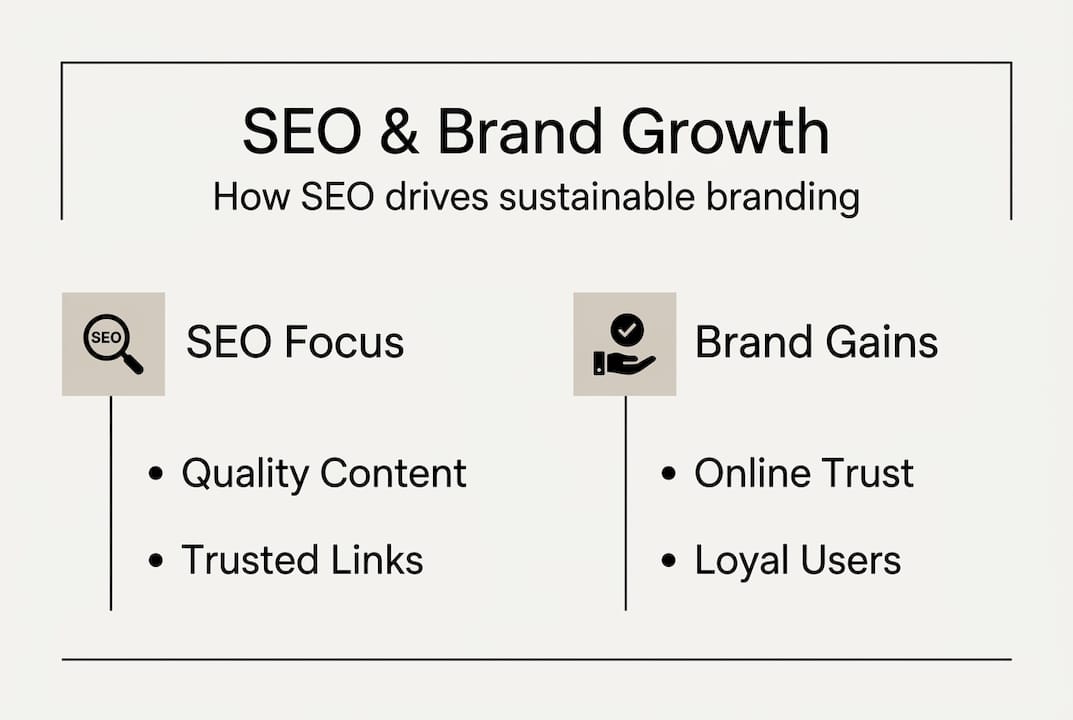
- SEO shapes brand perception, trust, and long-term recognition through consistent online visibility.
- Strategic SEO enhances authority by focusing on quality content, backlinks, and local relevance.
- Integrating branding with SEO planning drives better results and differentiates brands from competitors.
Most marketing managers think of Search Engine Optimisation (SEO) as a traffic tool. Get more clicks, rank higher, done. But SEO’s most powerful effect is often the one least discussed: it shapes how your brand is perceived, remembered, and trusted. When your business appears consistently in search results for the right topics, you’re not just winning clicks. You’re building credibility with every impression. This guide breaks down how strategic SEO drives brand visibility, authority, and long-term growth for Australian businesses, with practical steps you can act on right now.
Table of Contents
- Understanding SEO’s brand-building role
- Why visibility equals brand trust online
- SEO strategies that strengthen brand authority
- Brand differentiation through smart SEO: real examples
- What most brands miss when aligning SEO and branding
- Ready to unlock SEO-driven brand growth?
- Frequently asked questions
Key Takeaways
| Point | Details |
|---|---|
| SEO drives brand trust | Consistent SEO puts your brand at the top of search results, making it more credible in the eyes of customers. |
| Brand authority needs strategy | Purposeful SEO tactics like content quality and backlinks position your brand as a market leader. |
| Visibility means more recognition | The more your brand appears in relevant searches, the faster audiences identify and recall it. |
| Branding and SEO are inseparable | Treating SEO and branding as connected is key to long-term growth. |
Understanding SEO’s brand-building role
SEO, or Search Engine Optimisation, is the practice of improving your website and online presence so search engines like Google rank you higher in results. Branding, on the other hand, is the sum of how your audience perceives your business: your values, your voice, and your reputation. Most businesses treat these as separate concerns. They shouldn’t.
In the Australian marketing context, where competition for attention is fierce across both metro and regional markets, what is SEO becomes inseparable from what your brand stands for online. Every piece of content you publish, every keyword you target, and every backlink you earn sends signals not just to Google but to your potential customers.
Consider the SEO fundamentals that shape brand perception:
- Content consistency: Publishing content that aligns with your brand’s expertise builds recognition over time.
- Search results prominence: Appearing on page one signals legitimacy, even before a user clicks.
- Reputation signals: Reviews, mentions, and backlinks from credible sources reinforce your authority.
- Offline and online synergy: Strong organic rankings support your offline marketing by validating your brand when prospects search after seeing an ad or attending an event.
“A consistent SEO strategy is crucial for brand recall and authority.”
This is not a minor point. Brands that invest in a structured SEO in 2026 guide approach find that their search presence starts to mirror and reinforce their brand identity. When your website consistently answers the questions your audience is asking, you become the go-to source in your niche. SEO and branding are not siloed strategies. They are two sides of the same coin.
Why visibility equals brand trust online
Think about your own search behaviour. When you look up a product or service and see the same brand appearing across multiple searches, you start to associate that brand with authority. That’s not accidental. It’s the cumulative effect of strategic SEO and visibility work done consistently over time.
Research consistently shows that 70% of Australians trust organic search results most when considering a brand. Paid ads are often scrolled past. Organic results carry an implied endorsement from Google, and by extension, from the internet itself. That trust transfers directly to your brand.
Regular exposure through organic search essentials builds both recognition and trust. It’s not a one-off gain. Every time a potential customer sees your brand in results for a relevant query, you earn a small deposit of credibility. Over dozens of impressions, that credibility compounds.
Here are the key steps to improve your online visibility and build that trust:
- Conduct keyword research aligned with your audience’s actual questions, not just high-volume terms.
- Optimise your core pages with clear, on-brand messaging that matches search intent.
- Publish regular content that addresses specific problems your Australian customers face.
- Build local SEO signals through Google Business Profile, local citations, and location-specific pages.
- Earn quality backlinks from Australian industry publications and credible directories.
- Monitor and refine your SEO strategies for visibility using data from Google Search Console.
Pro Tip: Create content that answers commercial-intent queries specific to Australians. For example, if you’re a Melbourne-based accountant, a page targeting “best accounting software for Australian small businesses” will attract highly relevant traffic and reinforce your local expertise.
Trust is not built in a single campaign. It accumulates through consistent, high-quality visibility over time.
SEO strategies that strengthen brand authority
Authority is what separates a brand people remember from one they forget. In SEO terms, authority is measured by the quality of your content, the strength of your backlinks, and your adherence to Google’s E-E-A-T framework: Expertise, Experience, Authoritativeness, and Trustworthiness.
Investment in quality content and backlinks leads to stronger brand positions in search. This is not about publishing more. It’s about publishing better. A single well-researched article that earns links from reputable Australian media outlets will do more for your brand than fifty generic blog posts.

Here’s how SEO-driven authority compares to traditional advertising-driven authority:
| Factor | SEO-driven authority | Traditional advertising authority |
|---|---|---|
| Cost over time | Decreases as rankings hold | Ongoing spend required |
| Credibility signal | Implied by search ranking | Paid placement, lower trust |
| Audience targeting | Intent-based, highly relevant | Demographic-based, broader |
| Longevity | Long-lasting with maintenance | Stops when budget stops |
| Brand recall | Reinforced through repeated exposure | Dependent on ad frequency |
The SEO brand authority builders you should focus on include:
- Thought leadership content: Long-form guides, original research, and expert commentary that showcase your team’s knowledge.
- Media mentions and PR: Getting your brand cited in Australian publications like SmartCompany or the Australian Financial Review builds both links and reputation.
- Credible backlinks: Links from industry associations, government sites, and respected directories signal authority to Google.
- Technical SEO: Fast load times, structured data (schema markup), and mobile optimisation all underpin user trust. Web development and SEO are tightly connected here.
For a practical example, consider real-world SEO results from businesses that invested in structured content strategies. Brands that aligned their content with E-E-A-T principles saw measurable improvements in both rankings and brand perception scores.
Brand differentiation through smart SEO: real examples
So how does this play out in practice? Brands with tailored SEO strategies create measurable separation from competitors. The key word is tailored. Generic SEO produces generic results. Differentiation comes from aligning your SEO approach with what makes your brand genuinely distinct.
Consider an anonymised example from the Australian professional services sector. A mid-sized legal firm in Brisbane was competing against larger national firms for the same broad keywords. Instead of chasing high-volume terms, they focused on hyper-specific queries around niche practice areas and local client concerns. Within 12 months, their organic traffic grew significantly and, more importantly, their brand became the recognised name in that niche.
Here’s a simplified before-and-after view of what a branding-centric SEO strategy can achieve:
| Metric | Before strategy | After 12 months |
|---|---|---|
| Organic monthly traffic | 1,200 visits | 4,800 visits |
| Brand search volume | Low | Increased by 60% |
| Average keyword ranking | Position 18 | Position 5 |
| Bounce rate | 72% | 48% |
| Leads from organic search | 8 per month | 34 per month |
The branding and SEO integration that drives these results is not complicated in concept. It requires discipline in execution.
Pro Tip: Align your SEO keywords with your brand voice and differentiation, not just high-volume terms. If your brand is known for plain-English advice, target queries that reflect that tone. Customers searching for “simple super fund explanation Australia” are a better fit than those searching for generic financial terms.
Avoid the trap of generic content. Focus on unique customer problems, local context, and the specific language your Australian audience uses. That specificity is what builds business growth with SEO that compounds over time.
What most brands miss when aligning SEO and branding
After working with Australian businesses across many industries, we’ve noticed a consistent pattern. Brands that struggle to see results from SEO are usually treating it as a standalone tactic, something the IT team handles or an agency delivers in isolation. The branding team is rarely in the room.
The best results come when branding and SEO are planned and measured together from the start. Your brand pillars should directly inform your keyword strategy. Your tone of voice should shape every piece of content. Your visual identity should be consistent across every landing page that ranks.
Common blind spots we see include neglecting core landing pages in favour of blog content, publishing off-brand articles just to target keywords, and ignoring the search intent behind queries. A page that ranks but doesn’t reflect your brand accurately can actually damage trust.
Our advice: map your brand pillars to your SEO strategy before you do anything else. This simple exercise consistently outperforms chasing trends or copying competitors. If you’re unsure where to start, understanding hiring an SEO pro can help you see what a structured, brand-aligned approach looks like in practice.
Ready to unlock SEO-driven brand growth?
At Design Box Digital, we’ve spent over 20 years helping Australian businesses bridge the gap between technical SEO and powerful brand strategy. We know that rankings matter, but we also know that what those rankings communicate about your brand matters just as much.
Our team works with marketing managers and business owners to build better SEO strategies that align with your brand goals, not just your traffic targets. Whether you’re starting from scratch or refining an existing approach, our SEO services are designed to deliver measurable, lasting results. Get in touch with us today to explore how we can tailor a strategy specifically for your business.
Frequently asked questions
How does SEO help build brand recognition?
SEO puts your brand in front of target audiences when they search for key topics, increasing repeated exposure and credibility. A consistent SEO strategy is essential for building lasting brand recall and authority.
Which SEO strategies are most effective for branding in Australia?
High-quality local content, building authoritative links, and optimising for Australian searches deliver the strongest branding impact. Investment in quality content and backlinks consistently leads to stronger brand positions in search.
What is the difference between branding through SEO and paid advertising?
SEO builds organic credibility over time, while paid ads offer short-term visibility. Both play important roles, but SEO provides longer-lasting brand equity because tailored SEO strategies create measurable separation from competitors that paid placements cannot replicate once the budget stops.
Can SEO improve customer loyalty to a brand?
Yes. By consistently aligning search results with user needs, SEO reinforces trust and keeps your brand top of mind, making customers more likely to return and recommend you to others.
Recommended
- How SEO Boosts Online Visibility for Business Owners • Design Box Digital
- Boost your business growth with effective SEO strategies
- SEO in 2026: A Guide to Visibility & Growth • Design Box Digital
- SEO best practices: Boost your Australian business growth
- Bereik de Top van Google – SEO Services | Deal Webdesign Aalst