



TL;DR:
- Nearly half of Australian Google searches are local, highlighting a major opportunity for small businesses.
- Optimizing Google Business Profile, reviews, and local citations are key to improving local search rankings and attracting nearby customers.
- Most guides overcomplicate local SEO; concentrating on GBP, NAP consistency, reviews, and location-specific content yields quick results.
Nearly half of all Google searches in Australia carry local intent, yet most small business owners are still guessing when it comes to local SEO. That gap between opportunity and action is costing real customers every single day. If you’ve ever wondered why your competitor appears in Google Maps and you don’t, this guide is for you. We’ll break down exactly what local SEO is, how Google decides who ranks, and what practical steps you can take right now to attract more nearby customers. No jargon, no fluff. Just clear, actionable guidance built for Australian business owners ready to grow.
Table of Contents
- What is local SEO and why does it matter?
- How Google ranks local businesses: Core factors explained
- Essential local SEO strategies for Australian businesses
- Advanced and edge-case local SEO: Multi-location, service area, and voice search
- What most guides get wrong about local SEO
- Partner with experts to boost your local SEO results
- Frequently asked questions
Key Takeaways
| Point | Details |
|---|---|
| Local SEO drives results | Optimising for local search significantly increases customer visits and revenue for Australian businesses. |
| GBP matters most | Google Business Profile optimisation influences over 30% of local search rankings and should be your priority. |
| Consistency is critical | Keeping your business name, address, and phone details consistent across web citations boosts local search performance. |
| Edge-case adaptation | Multi-location, service-area, and voice search demand tailored tactics to win in local search. |
| Measurable ROI | Local SEO can deliver high conversion rates and clear return on investment when tracked and managed well. |
What is local SEO and why does it matter?
Local SEO is the process of optimising a business’s online presence to rank higher in location-based searches. Think of someone typing “plumber near me” or “best café in Fitzroy” into Google. The results they see, including the map pack and the business listings beneath it, are shaped by local SEO. It’s a distinct discipline from traditional SEO, which focuses on ranking broadly for keywords regardless of geography.
Traditional SEO is about building domain authority and targeting wide audiences. Local SEO is about being visible to the right people at the right moment, specifically when they’re nearby and ready to act. That difference matters enormously for small and medium-sized businesses.
Nearly half of Google searches in Australia have local intent, and local SEO contributes an estimated AUD 4.2 billion in revenue to the Australian economy each year.
Those numbers reflect a massive, ongoing opportunity. People searching locally are not just browsing. They have high purchase intent. They want a solution nearby, and they want it quickly. Mobile devices have accelerated this behaviour further, with searches like “open now” and “near me” surging year on year.
Understanding the local SEO benefits for your business goes beyond just traffic. Here’s what effective local SEO actually delivers:
- Greater visibility in Google Maps and the local pack, where most clicks happen
- Higher quality traffic from people actively searching for what you offer nearby
- Stronger customer trust through reviews, accurate business information, and consistent branding
- Faster conversions because local searchers are typically further along the buying journey
- Competitive advantage over businesses that haven’t invested in local optimisation
For businesses that rely on foot traffic, service calls, or local clientele, improving SEO visibility is one of the highest-return activities you can invest in. Now that the stakes are clear, let’s explore what actually drives local search results.
How Google ranks local businesses: Core factors explained
Google uses three core factors to determine which businesses appear in local search results. Understanding them helps you focus your efforts where they count most.
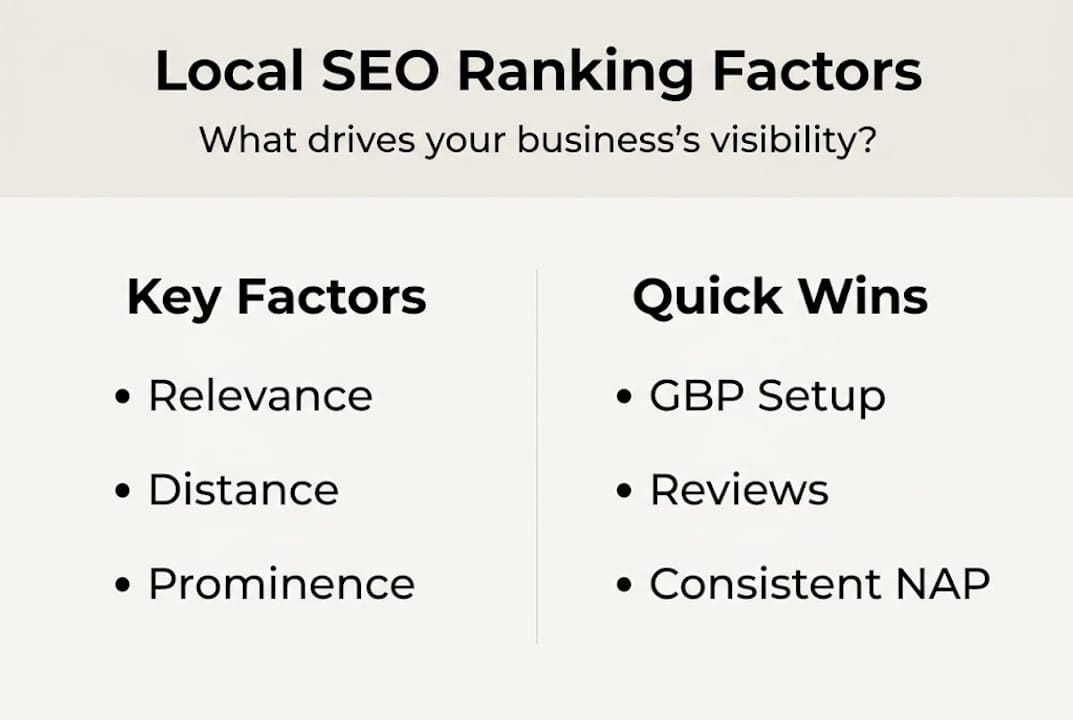
Relevance is how well your business profile matches what someone is searching for. If your Google Business Profile (GBP) clearly describes your services and categories, Google is more likely to show you for relevant queries.
Distance is how far your business is from the searcher or the location they’ve specified. You can’t move your shopfront, but you can make sure your address and service area are accurately listed.
Prominence refers to how well-known and trusted your business appears online. This includes reviews, backlinks, citations, and overall online reputation.
| Ranking factor | Relative weight | Key action |
|---|---|---|
| Google Business Profile | ~32% | Complete all fields, add photos, post regularly |
| Reviews and ratings | ~16% | Ask customers, respond to all reviews |
| On-page SEO signals | ~14% | Use local keywords, schema markup |
| Citations and NAP | ~11% | Ensure consistent Name, Address, Phone |
| Behavioural signals | ~10% | Drive clicks, calls, and direction requests |
GBP optimisation accounts for roughly 32% of local pack ranking weight, making it the single most impactful lever you can pull. Reviews are close behind, and their importance is only growing in 2026 as Google continues to weight trust signals more heavily.
Here are practical steps to improve each factor:
- Relevance: Choose precise primary and secondary categories in your GBP. Write a keyword-rich business description that matches how locals search.
- Distance: Verify your address is correct across all platforms. For service-area businesses, define your coverage zones clearly.
- Prominence: Build local backlinks from Australian directories, chambers of commerce, and industry associations. Encourage satisfied customers to leave Google reviews.
- On-page signals: Add your suburb and city to page titles, headings, and meta descriptions on your website.
- Behavioural signals: Use your GBP posts and offers to encourage clicks and calls directly from search results.
For tailored guidance, exploring local SEO tips specific to Australian businesses can help you prioritise the right actions. Working with an experienced Australian SEO agency can also accelerate your results significantly. Understanding the ranking factors, the next step is knowing how to optimise for them.
Essential local SEO strategies for Australian businesses
Knowing what matters is one thing. Knowing what to do about it is another. Here’s a practical playbook built around key methodologies that consistently deliver results for local businesses.
Optimise your Google Business Profile. This is your starting point. Fill in every field: business name, address, phone number, website, hours, categories, and services. Upload high-quality photos of your premises, team, and products. Post updates regularly to signal activity to Google.
Maintain NAP consistency. NAP stands for Name, Address, and Phone number. These details must be identical everywhere they appear online, including your website, social profiles, online directories, and local citations. Even small discrepancies (like “St” vs “Street”) can confuse Google and hurt your rankings.
Build and manage reviews. Ask every happy customer to leave a Google review. Make it easy by sending them a direct link. Respond to every review, positive or negative. This shows Google and potential customers that you’re engaged and trustworthy.

Research local keywords. Use Google’s autocomplete feature to discover how people in your area search for your services. Type your service plus your suburb and note what suggestions appear. These are real queries from real people nearby.
Implement schema markup. Schema is a type of code you add to your website that helps Google understand your business details. LocalBusiness schema tells Google your address, hours, and contact info in a structured format it can easily read.
| Local SEO activity | Impact on conversions | Estimated ROI |
|---|---|---|
| GBP optimisation | Up to 28% conversion rate | High, low cost |
| Review generation | Increases trust signals | Very high |
| Local citations | Improves ranking consistency | Moderate |
| Schema markup | Enhances search appearance | Moderate to high |
For SMB owners, starting with free GBP optimisation and tracking calls and direction requests gives you an immediate, measurable picture of ROI without any upfront spend.
Pro Tip: The most common mistakes we see are duplicate GBP listings and incomplete business profiles. Audit your existing listings before creating new ones, and make sure every field in your GBP is filled in completely.
Exploring SEO performance strategies can help you layer additional tactics on top of these essentials once your foundations are solid. With core strategies established, it’s time to tackle location-specific and emerging challenges.
Advanced and edge-case local SEO: Multi-location, service area, and voice search
As your business grows, local SEO gets more nuanced. Here’s how to handle the scenarios that trip up even experienced marketers.
Multi-location businesses need a unique approach. Multi-location businesses need separate GBP listings for each location, plus individual location pages on your website. Each page should have unique content tailored to that area. Don’t copy and paste the same text across pages. Google penalises duplicate content, and it also fails to serve local customers who want location-specific information.
For businesses with two to fifty locations, there’s no need to build separate websites. A single well-structured site with dedicated location pages is both more manageable and more effective.
Service-area businesses (SABs) operate differently. If you travel to customers rather than having them visit you, you can hide your physical address in GBP while still targeting specific suburbs and cities. Define your service area carefully and create content that speaks directly to each location you serve.
Voice and AI search are reshaping how people find local businesses. Queries typed into Google are short. Queries spoken aloud are conversational. “Hey Google, who fixes iPhones near me in Parramatta?” is a very different format from “iPhone repair Parramatta.” To capture voice traffic:
- Write FAQ-style content that mirrors how people speak
- Use natural language in your GBP description and posts
- Optimise for question-based queries like “who,” “where,” and “how near me”
- Ensure your website loads quickly on mobile devices
Pro Tip: Most businesses focus on typed queries and completely overlook voice search. Zero-click results, where Google answers the question directly without the user clicking through, are increasingly common. Structured FAQ pages and schema markup improve your chances of appearing in these featured answers.
For a broader view of SEO strategies for Australian businesses, including technical and content-based approaches, it’s worth reviewing what’s available beyond local tactics. You can also explore a local SEO complete guide for a thorough walkthrough of every scenario. We’ve covered both fundamental and advanced tactics; now let’s consider what most guides leave out.
What most guides get wrong about local SEO
Here’s something we’ve observed after working with Australian businesses across many industries: most local SEO advice overcomplicates things, and that complexity costs businesses time and money.
The biggest mistake we see is businesses building entirely separate websites for each location. It feels logical but it’s counterproductive. Separate sites split your authority, create management headaches, and rarely outperform a single well-structured site with unique location pages.
Another misconception is that traditional SEO tactics built around domain authority are sufficient for local intent. They’re not. Local SEO depends on NAP consistency, GBP optimisation, reviews, and proximity. A website with strong backlinks but a neglected GBP will consistently lose to a competitor with a complete, active profile.
Think of your GBP as your online homepage for local customers. Many people searching locally never even visit your website. They call directly from the search result, get directions, or read your reviews right there in Google. Your GBP is often the first and only impression you make.
For Australian businesses, the ROI from local SEO in Melbourne and other major cities is measurable and fast when you focus on the right things first.
Pro Tip: Before spending on ads or link building, get your GBP fully optimised and your reviews flowing. These two actions alone can move the needle faster than almost anything else in local SEO.
Partner with experts to boost your local SEO results
Local SEO is genuinely accessible for business owners willing to put in the groundwork. But getting it right across GBP optimisation, citations, schema, and content takes time and expertise. That’s where we come in.
At Design Box Digital, we specialise in helping Australian businesses build strong local search presence through our SEO services tailored to your market and goals. Whether you’re just getting started or looking to scale across multiple locations, our team brings over 20 years of experience to your strategy. Explore our proven SEO strategies or start with the SEO basics explained if you want to build your knowledge before booking a consultation. We’re here to help you turn local searches into real customers.
Frequently asked questions
How does local SEO differ from traditional SEO?
Local SEO focuses on ranking in searches for nearby customers, placing greater emphasis on Google Business Profile, NAP consistency, and reviews. Traditional SEO targets broader queries and prioritises domain authority over proximity signals.
What is the quickest way to improve local SEO for a small business?
Completing your Google Business Profile, ensuring NAP consistency across all listings, and actively collecting customer reviews are the fastest first steps. Start with GBP optimisation before investing in any paid strategies.
Can service-area businesses succeed with local SEO?
Absolutely. Service-area businesses hide their physical address in GBP while targeting specific suburbs and cities, and they can perform strongly by creating location-specific content optimised for conversational and voice queries.
Is it necessary to create separate websites for each business location?
No. Separate sites for locations split your authority and create duplication issues. Unique location pages on your main website are more effective and far easier to manage.
How can I track the impact of local SEO on my business?
Use Google Business Profile insights to monitor calls, direction requests, and profile views. Track calls and directions alongside your website analytics to build a clear picture of how local SEO is driving real business outcomes.