


PPC advertising is not just for big brands with bottomless budgets. Plenty of Australian small and medium businesses are using it right now to generate leads, fill their sales pipelines, and outrank competitors in search results. Australian PPC spend topped A$4.2B in 2026, which tells you this is no niche tactic. It is a mainstream strategy that businesses across Melbourne, Sydney, Brisbane, and beyond are leaning on hard. This guide will walk you through exactly what PPC is, how it works, what it costs in Australia, and how to avoid the mistakes that quietly drain budgets.
Table of Contents
- Understanding PPC advertising: What it is and how it works
- Core PPC campaign elements: Platforms, targeting & pricing
- PPC versus SEO: Short-term impact and long-term value
- Common PPC pitfalls (and how to avoid them)
- Why most Australian businesses misuse PPC (and what actually works)
- Partner with experts to unlock PPC growth
- Frequently asked questions
Key Takeaways
| Point | Details |
|---|---|
| PPC delivers fast results | You can drive leads and sales almost immediately with PPC advertising if set up correctly. |
| Costs and returns vary | Average cost per click in Australia ranges from $1.20 to $12.80; tracking conversions and optimising are vital. |
| Balance PPC and SEO | Short-term and long-term strategies work best together for digital growth. |
| Avoid common pitfalls | Clean data, structured campaigns, and regular testing help prevent wasted spend in PPC. |
| Expert help drives ROI | Professional management and continuous improvement amplify the impact of your PPC investment. |
Understanding PPC advertising: What it is and how it works
PPC stands for pay-per-click. It is a digital advertising model where you only pay when someone actually clicks your ad. You are not charged for every person who sees it. That distinction matters because it means your budget is tied directly to real engagement, not just eyeballs.
PPC ads appear across several channels. The most familiar is Google Search, where your ad shows up at the top of results when someone types in a relevant query. But PPC also covers display ads on websites, YouTube video ads, and ads across social platforms like Facebook and Instagram. Each channel has its own strengths depending on your goals.
Here is what makes PPC particularly attractive for Australian businesses:
- Immediate visibility: Your ads can appear within hours of launching a campaign, unlike SEO which takes months to gain traction.
- Measurable ROI: Every click, conversion, and dollar spent is tracked, so you know exactly what is working.
- Budget flexibility: You set your own daily and monthly limits, so there is no risk of runaway spending.
- Precise targeting: You can reach people based on location, search intent, device, time of day, and more.
- Scalability: Start small, prove the model, then scale up with confidence.
On average, 35% of digital ad spend goes to PPC for Australian businesses, which reflects just how central it has become to modern digital marketing strategies.
“PPC gives you a direct line to customers who are actively searching for what you sell. That intent-driven traffic is genuinely hard to replicate through any other channel.”
Pro Tip: If you are new to PPC, start with Google Search campaigns targeting your highest-value service or product. It is the fastest way to test whether paid search converts for your specific audience before expanding to other platforms.
For businesses ready to move beyond the basics, professional Google Ads management can make a significant difference in how efficiently your budget is used.
Core PPC campaign elements: Platforms, targeting & pricing
With the basics covered, it is time to dig into the building blocks of a successful PPC campaign. Understanding these components will help you make smarter decisions, whether you are managing campaigns yourself or working with an agency.
The major PPC platforms available to Australian businesses include:
- Google Ads: The dominant platform for search and display advertising, reaching users across Google Search, Gmail, and the Google Display Network.
- Meta Ads (Facebook and Instagram): Powerful for audience-based targeting, brand awareness, and retargeting warm leads.
- YouTube Ads: Ideal for video content and reaching users during the research phase of their buying journey.
- Retail media networks: Platforms like Amazon Ads or Woolworths Everyday Market for product-based businesses.
Every PPC campaign is built from a few core elements. Keywords trigger your ads when users search relevant terms. Ad groups organise related keywords and ads together. Targeting settings define who sees your ads based on location, demographics, or behaviour. Your budget caps daily spend. And your landing page is where users arrive after clicking, which is where conversions actually happen.
Australian pricing varies considerably by industry. Google Ads’ average CTR is 3.17%, with CPCs ranging from A$1.20 to A$12.80 depending on competition and sector.

| Platform | Average CPC (AUD) | Average CTR |
|---|---|---|
| Google Search | A$1.25 to A$12.80 | 3.17% |
| Meta (Facebook/Instagram) | A$0.50 to A$3.50 | 0.90% |
| YouTube | A$0.10 to A$0.30 per view | 0.51% |
Pro Tip: Do not judge a platform solely on CPC. A higher CPC on Google Search is often justified by the stronger purchase intent of search users compared to social media audiences who are browsing passively.
If you want to explore what well-structured AdWords PPC campaigns look like in practice, reviewing real campaign examples can help you benchmark your own setup.
PPC versus SEO: Short-term impact and long-term value
To decide where to invest your marketing dollars, it helps to weigh PPC against its most common counterpart, SEO. Both drive traffic to your website, but they work very differently.
PPC delivers results fast. You launch a campaign, your ads appear, and traffic starts flowing. You have full control over your messaging, targeting, and spend. The trade-off is that PPC traffic stops when spend stops, and costs are ongoing. The moment you pause a campaign, your visibility disappears.
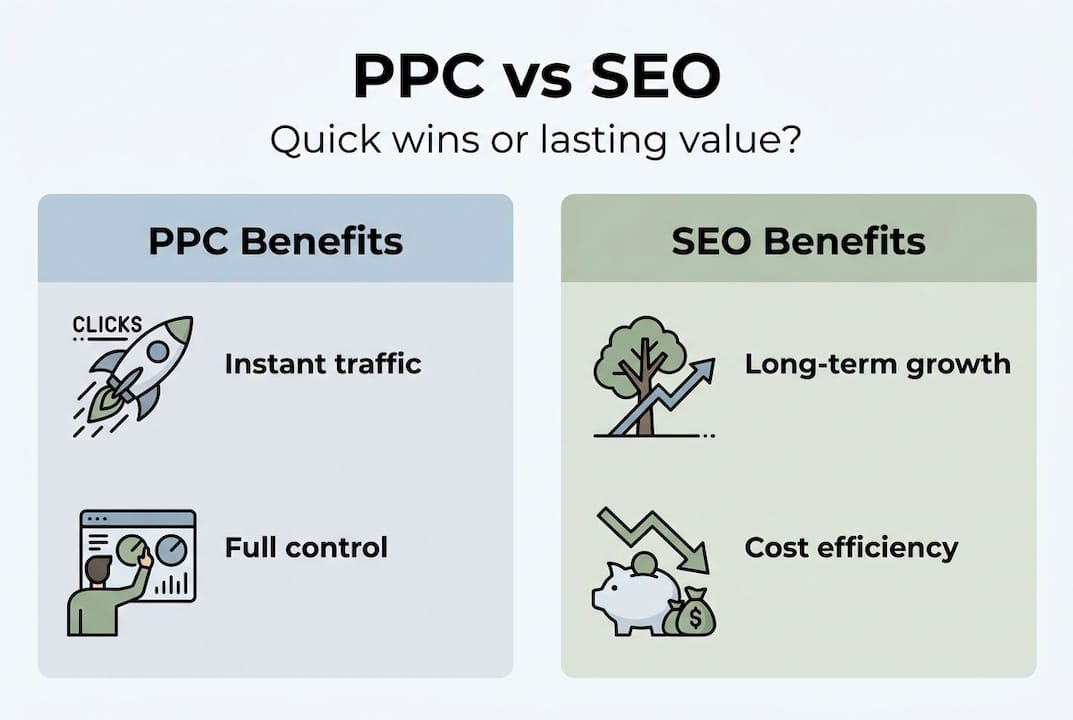
SEO, on the other hand, builds over time. It involves optimising your website so it ranks organically in search results without paying per click. The ramp-up is slower, often taking six to twelve months to see meaningful results. But once you rank, that traffic is effectively free and tends to carry higher trust with users.
Here is a quick comparison:
| Factor | PPC | SEO |
|---|---|---|
| Speed to results | Immediate | 6 to 12 months |
| Cost model | Pay per click | Upfront investment |
| Sustainability | Stops when budget stops | Builds over time |
| User trust | Moderate | Higher |
| Control | Full | Limited |
When PPC works best:
- Launching a new product or service with no existing organic presence
- Running time-sensitive promotions or seasonal campaigns
- Testing new markets or audience segments quickly
- Competing in a space where organic rankings are dominated by large players
When SEO works best:
- Building long-term brand authority in your industry
- Reducing reliance on paid channels over time
- Targeting informational queries that build trust before purchase
For most Australian businesses, the smartest approach combines both. Use PPC for SEO for visibility while your organic rankings grow, then gradually shift budget as SEO matures. You can also explore SEO performance tips to accelerate that timeline.
Common PPC pitfalls (and how to avoid them)
Of course, even the most promising strategy has its pitfalls. Let’s pinpoint and sidestep the most common PPC errors that Australian businesses make.
- Poor conversion tracking: If your tracking is set up incorrectly, your bidding algorithms are making decisions based on bad data. This leads to wasted spend and missed opportunities. Always audit your tracking before launching.
- Over-segmenting campaigns: Breaking campaigns into too many small ad groups or audiences starves AI bidding algorithms of the data they need to optimise. Consolidate where possible.
- Neglecting landing pages: Sending paid traffic to a generic homepage is one of the most common and costly mistakes. Each campaign needs a dedicated landing page aligned to the ad’s message.
- Ignoring negative keywords: Without a solid negative keyword list, your ads will show for irrelevant searches, burning budget on clicks that will never convert.
- Over-relying on automation: Google’s AI tools are powerful, but inconsistent tracking and over-reliance on AI without human oversight leads to poor outcomes. Review your campaigns weekly.
“Every click is a data point. The businesses that treat their PPC campaigns as ongoing experiments, rather than set-and-forget systems, are the ones that consistently outperform their competitors.”
Value-based bidding is another area worth attention. Rather than optimising purely for conversions, you can assign different values to different conversion types, so the algorithm prioritises the actions that actually drive revenue. This approach works especially well when integrated with your CRM data.
Pro Tip: Diversify beyond Google Search. YouTube and Meta Ads can reach potential customers earlier in their decision-making process, warming them up before they ever search for your product. This multi-channel approach often reduces your overall cost per acquisition.
Understanding AdWords campaign benefits in detail can help you set realistic expectations and structure your campaigns for better outcomes from the start.
Why most Australian businesses misuse PPC (and what actually works)
After years of working with Australian businesses across a wide range of industries, one pattern stands out clearly. Most PPC failures are not caused by the platform. They are caused by the approach.
The most common mistake is treating PPC as a set-and-forget channel. Business owners launch a campaign, check it once a month, and wonder why results are disappointing. PPC rewards active management. Bids, audiences, ad copy, and landing pages all need regular review and testing.
Another issue is chasing cheap clicks instead of valuable ones. A low CPC is meaningless if those clicks never convert. The businesses seeing real digital marketing results are the ones optimising for customer lifetime value, not just cost per click.
PPC also works best when it is not operating in isolation. Integrating your campaigns with SEO, CRM data, and email marketing creates a feedback loop that makes every channel stronger. Each click you pay for is a chance to learn something about your audience. That data, applied consistently, is where the real competitive advantage lives.
Partner with experts to unlock PPC growth
Ready to put PPC to work for your business? Here is how to take your strategy even further.
Managing PPC well takes time, expertise, and constant attention. That is exactly what we do at Design Box Digital.
With over 20 years of experience helping Australian businesses grow through paid and organic channels, our team builds campaigns that are structured to perform from day one. We handle everything from keyword research and ad copywriting to bid management and conversion tracking. Our PPC management services are tailored to your industry, your goals, and your budget. And because we take a comprehensive digital marketing approach, your PPC campaigns are always working in sync with your broader strategy. Get in touch with our team today to find out how we can help you generate more leads and grow your sales.
Frequently asked questions
What does PPC stand for and how is it billed?
PPC means pay-per-click, where advertisers pay only when someone clicks their ad, not for impressions or views.
How much does PPC advertising cost in Australia?
Australian CPC ranges from A$1.20 to A$12.80 depending on your industry, competition level, and the platform you are using.
Is PPC or SEO better for small businesses?
PPC offers instant results but requires ongoing investment, while SEO builds lasting visibility over time. Most small businesses benefit from running both together.
What are common mistakes to avoid with PPC?
Avoid dirty tracking and over-segmentation, and never rely solely on automation. Test your landing pages regularly and optimise campaigns for genuine business value.