



TL;DR:
- Technical SEO ensures search engines can crawl and index your website effectively.
- Fixing issues like site speed and crawl errors boosts search rankings significantly.
- Ongoing audits and strategic implementation of technical SEO create long-term visibility growth.
You’ve invested in great content, built backlinks, and optimised your keywords. Yet your website still isn’t ranking where it should. For many Australian businesses, this is a frustrating reality. The missing piece is often technical SEO, the behind-the-scenes infrastructure that determines whether search engines can even find and understand your site. Without it, even the strongest content strategy falls flat. This guide explains what technical SEO is, why it matters for your business, and the practical steps you can take to improve your website’s performance in search results.
Table of Contents
- What is technical SEO? The engine beneath your digital strategy
- Why technical SEO is critical for your search performance
- Essential elements of technical SEO: What Australian businesses must address
- How to audit and improve your website’s technical SEO
- What most SEO advice gets wrong about technical SEO
- Level up with expert SEO solutions for your Australian business
- Frequently asked questions
Key Takeaways
| Point | Details |
|---|---|
| Foundation for success | Technical SEO is the backbone that lets your content and backlinks work effectively for better rankings. |
| Ongoing maintenance | Quarterly audits help you spot and fix issues before they hurt your online visibility. |
| High business impact | Optimised technical SEO improves website speed, security, and exposure to more customers. |
| Actionable process | Simple tools and step-by-step checklists make technical SEO manageable and effective for any business. |
What is technical SEO? The engine beneath your digital strategy
Technical SEO refers to the work done on your website’s infrastructure to help search engines crawl, render, and index your pages correctly. According to Search Engine Land, technical SEO optimises a website’s infrastructure to enable search engines to efficiently crawl, render, index, and rank its content. It’s distinct from on-page SEO (your content and keywords) and off-page SEO (backlinks and authority). Think of it this way: on-page and off-page SEO are what you say and who vouches for you. Technical SEO is whether anyone can hear you at all.
There are four core pillars that define technical SEO:
| Pillar | What it means | Why it matters |
|---|---|---|
| Crawlability | Search engines can access your pages | Pages that can’t be crawled won’t rank |
| Indexability | Pages are stored in the search engine’s index | Indexed pages appear in search results |
| Site architecture | Logical structure and internal linking | Helps engines understand content hierarchy |
| Technical content signals | Structured data, canonical tags, meta signals | Sends precise ranking signals to search engines |
Our technical SEO expertise at Design Box Digital is built on understanding how these pillars interact. When one is weak, the others suffer. A site with brilliant content but poor crawlability is like a shop with no signage on a back street.
“Technical SEO is the foundation of your entire digital strategy. Without it, your content and backlinks simply cannot deliver the results you’re working toward.” — Design Box Digital
For business owners wanting to boost business growth through search, understanding this foundation is essential. If you’re new to the concept, brushing up on SEO basics will help you see how technical SEO fits into the bigger picture.
Why technical SEO is critical for your search performance
Ignoring technical SEO has real consequences. Your content investment can be completely wasted if search engines can’t properly access or interpret your site. Businesses across Australia are losing organic traffic every day because of fixable technical issues they don’t even know exist.
Common technical SEO pitfalls include:
- Slow page load times that cause users and search bots to abandon your site
- Duplicate content caused by URL variations confusing search engines
- Broken internal links that block crawlers from reaching key pages
- Missing or incorrect XML sitemaps leaving pages undiscovered
- Non-secure HTTP connections that reduce trust signals and rankings
- Poor mobile optimisation penalising your site in mobile-first indexing
Each of these issues can quietly erode your rankings over time. The technical SEO underpins all on-page and off-page efforts, and neglecting it causes content and backlinks to fail. That’s a sobering reality for businesses that have spent months producing quality articles or building link profiles.

Regular audits are the best way to catch these issues early. SEO auditing in Australia is something many businesses skip, but it’s one of the highest-value activities you can do for your website.
Pro Tip: Structured data and automation can dramatically lift your search visibility. Research shows automated SEO fixes can boost impressions by over 150%, making schema markup one of the most underutilised tools in Australian digital marketing.
When you increase online visibility through strong technical foundations, every other marketing effort becomes more effective. Paid ads, social media, and email campaigns all benefit when your website is technically sound. Following SEO best practices consistently is what separates businesses that grow organically from those that plateau.
Essential elements of technical SEO: What Australian businesses must address
So what does technical SEO optimising your website’s infrastructure actually involve in practice? Here are the key elements you need to address, and how they compare in terms of impact and complexity.
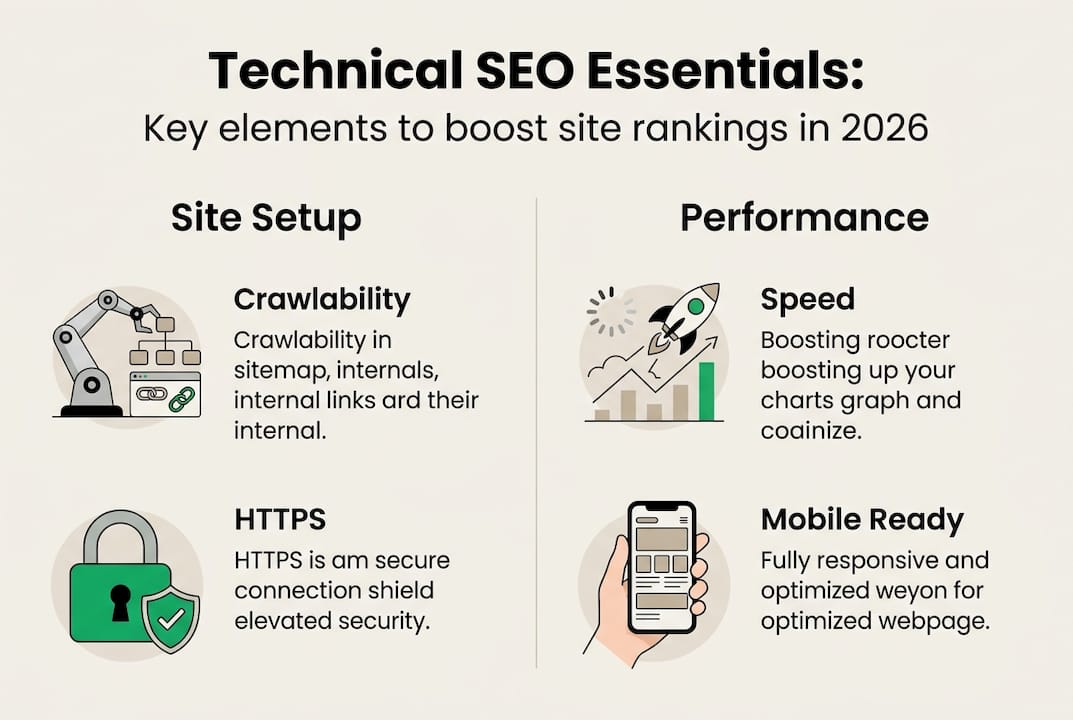
| Technical element | Impact on rankings | Complexity to fix | Priority |
|---|---|---|---|
| Site speed | Very high | Medium | Immediate |
| Mobile-friendliness | Very high | Medium | Immediate |
| HTTPS/secure protocol | High | Low | Immediate |
| XML sitemap | High | Low | High |
| Crawl errors | High | Medium | High |
| Structured data/schema | Medium-high | Medium | Ongoing |
| Canonical tags | Medium | Low | Ongoing |
Here’s a practical checklist to work through for your website:
- Check your site speed using Google PageSpeed Insights. Aim for a score above 80 on both mobile and desktop.
- Confirm HTTPS is active across your entire domain. Mixed content warnings hurt rankings and user trust.
- Submit an XML sitemap to Google Search Console so all important pages are discoverable.
- Review your robots.txt file to ensure you’re not accidentally blocking key pages from crawlers.
- Fix crawl errors identified in Google Search Console, especially 404 errors and redirect chains.
- Implement structured data (also called schema markup) to help Google understand your content type, whether it’s a product, article, or local business.
- Audit internal linking to ensure your most important pages receive the most link equity.
The relationship between web development and SEO is critical here. Many technical issues originate in how a website was built, not just how it’s maintained. Getting your development and SEO aligned from the start saves significant effort later. Pair this with well-crafted SEO meta tags and you’ll send clearer signals to search engines on every page.
How to audit and improve your website’s technical SEO
Knowing which elements matter is one thing. Actually auditing and fixing them is another. Here’s a clear process to follow.
- Start with Google Search Console. This free tool from Google shows crawl errors, indexing issues, mobile usability problems, and Core Web Vitals data. It’s the best starting point for any technical audit.
- Run a site crawl using Screaming Frog or Semrush. These tools simulate how a search engine crawls your site and surface broken links, duplicate content, missing meta tags, and redirect issues.
- Check your Core Web Vitals. These are Google’s page experience metrics: Largest Contentful Paint (LCP), Interaction to Next Paint (INP), and Cumulative Layout Shift (CLS). Poor scores directly affect rankings.
- Assess your mobile experience. Use Google’s Mobile-Friendly Test to confirm your site renders correctly on smartphones and tablets.
- Review your site’s structured data. Use Google’s Rich Results Test to check whether your schema markup is valid and eligible for rich snippets in search results.
- Prioritise fixes by impact. Address crawl errors and HTTPS issues first, then move to speed improvements and structured data.
Pro Tip: Research confirms you should prioritise audits quarterly to maintain strong performance. Set a recurring calendar reminder every three months to run through this checklist. Websites change constantly, and new issues can appear after any update.
If you’re ready to conduct an SEO audit but aren’t sure where to start, you can also take advantage of a free SEO audit to get a clear picture of where your site stands. Research into automated SEO improvements also shows that systematic fixes, applied consistently, compound over time to deliver significant ranking gains.
What most SEO advice gets wrong about technical SEO
Most guides treat technical SEO as a checklist you tick off once and forget. That’s a significant mistake. In our experience working with Australian businesses across many industries, the businesses that see the strongest long-term results are the ones that treat technical SEO as an ongoing discipline, not a one-time project.
The debate in the industry is real. Some practitioners see technical SEO purely as defence, essential groundwork that keeps your site from being penalised. Others, backed by data showing schema and automation can yield 150%+ impression gains, see it as a genuine competitive edge. We sit firmly in the second camp.
The businesses we see winning in search aren’t just fixing errors. They’re using structured data strategically, automating routine fixes, and integrating technical SEO into every website update and content decision. Following effective SEO strategies means making technical SEO a core part of your digital planning, not an afterthought.
Level up with expert SEO solutions for your Australian business
If reading this guide has made you realise there are gaps in your website’s technical foundations, you’re not alone. Most Australian business websites have fixable issues that are quietly limiting their rankings and traffic.

At Design Box Digital, we offer specialist SEO services designed to identify and resolve the technical issues holding your site back. As a leading provider of digital marketing in Melbourne, we combine technical expertise with strategic thinking to deliver measurable results. The best place to start is a free SEO audit, which gives you a clear, actionable picture of where your website stands right now.
Frequently asked questions
What is the main difference between technical SEO and regular SEO?
Technical SEO focuses on a website’s infrastructure and crawlability, while regular SEO typically refers to keyword optimisation and content strategy. As Search Engine Land explains, technical SEO optimises the underlying infrastructure that allows search engines to access and rank your content.
How often should I conduct technical SEO audits?
Quarterly audits are recommended for most businesses to catch issues before they impact rankings. Prioritising quarterly audits ensures your site stays healthy as it evolves and grows.
Does technical SEO matter for small business websites?
Yes, even small businesses benefit significantly from technical SEO through improved visibility, faster load times, and better search rankings. Technical SEO underpins all other SEO efforts, so neglecting it limits results regardless of your business size.
Can technical SEO improvements deliver quick results?
Some fixes, like resolving crawl errors or enabling HTTPS, can show improvements relatively quickly. However, schema and automation gains of 150%+ impressions come from consistent, ongoing effort rather than a single round of changes.