



TL;DR:
- SEO requires consistent effort over 6 to 12 months to see significant results.
- Focusing on buyer-intent keywords and optimizing site structure enhances e-commerce visibility.
- Regular technical audits, unique content, and ongoing updates are key to sustainable growth.
Running an Australian e-commerce store is competitive. You’re up against established brands, international retailers, and thousands of niche competitors all chasing the same organic traffic. Paid ads can drive short-term results, but relying on them alone is expensive and unsustainable. The real growth lever is SEO, yet most store owners struggle to see results because they lack a structured, repeatable approach. This guide walks you through a proven, step-by-step SEO framework built specifically for Australian e-commerce businesses. From auditing your current performance to creating content that converts, each section gives you clear, actionable steps you can start using today.
Table of Contents
- Assessing your e-commerce SEO baseline
- Targeting keywords that convert
- Optimising your site architecture for SEO
- Creating and optimising content that ranks
- What most e-commerce SEO guides miss: Real results come from consistency
- Take your e-commerce SEO further with expert help
- Frequently asked questions
Key Takeaways
| Point | Details |
|---|---|
| Start with an SEO audit | Measuring your current rankings and technical health is the first step to improvement. |
| Focus on buyer-focused keywords | Target search terms customers actually use at the point of purchase. |
| Structure your store logically | A clear category and menu structure boosts both SEO and user experience. |
| Create unique content for every page | Original, keyword-driven descriptions rank higher and convert more shoppers. |
| Consistency beats quick fixes | Long-term, regular action delivers the best SEO gains for Australian e-commerce. |
Assessing your e-commerce SEO baseline
Before you can optimise, it’s crucial to understand where your store’s SEO stands. Jumping straight into keyword research or content updates without knowing your starting point is like renovating a house without checking the foundations first.
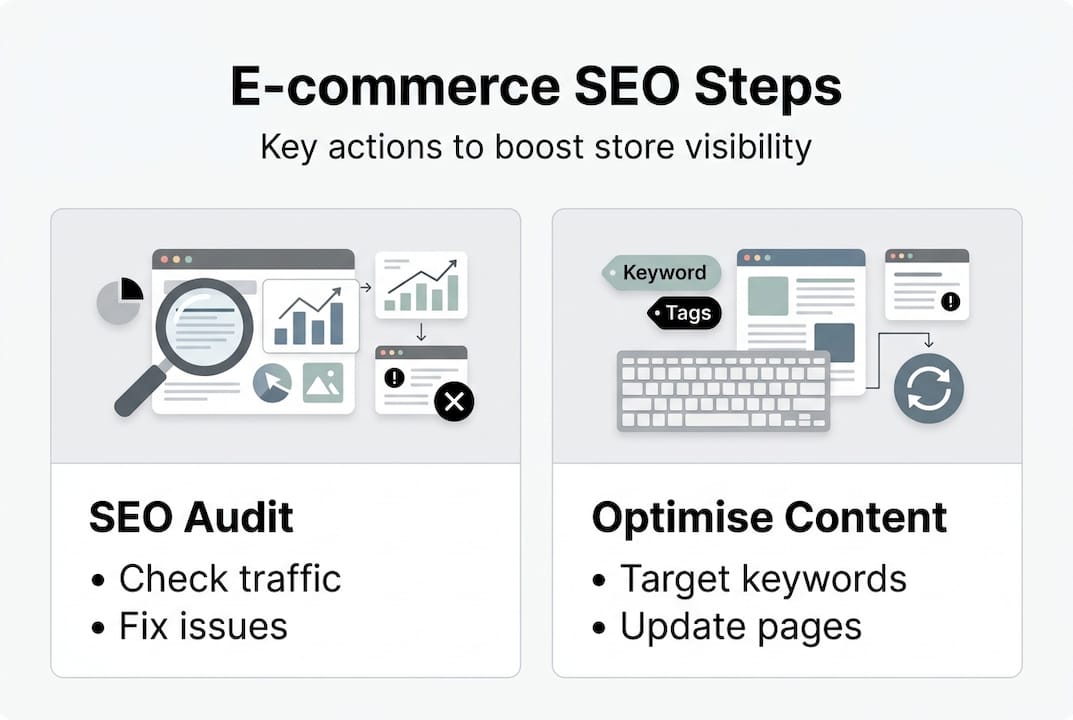
A technical site audit and baseline analytics are essential first steps in improving your store’s SEO. Start by reviewing the following key indicators:
| SEO indicator | What to check | Tool to use |
|---|---|---|
| Organic traffic | Monthly visits from search | Google Analytics |
| Indexed pages | How many pages Google sees | Google Search Console |
| Broken links | 404 errors across the site | Screaming Frog (free tier) |
| Mobile usability | Mobile errors and layout issues | Google Search Console |
| Page speed | Load time on desktop and mobile | PageSpeed Insights |
| Top keywords | Which terms drive organic visits | Google Search Console |
Once you have this data in front of you, patterns become clear. You might discover that your top product pages aren’t indexed, or that a batch of broken links is quietly draining your crawl budget.
A proper SEO audit process covers both technical health and on-page performance. On the technical side, check that your XML sitemap is submitted and up to date, your robots.txt file isn’t accidentally blocking important pages, and your site loads quickly on mobile. On the content side, look at which product and category pages attract the most organic visits and which are sitting with zero traffic.
Here’s what to document during your baseline review:
- Total number of pages indexed vs. total pages on your site
- Your top 10 organic keywords and their current ranking positions
- Any pages returning 404 or redirect errors
- Mobile usability issues flagged in Search Console
- Core Web Vitals scores for your key landing pages
For SEO growth in 2026, having this baseline documented means you can measure real progress over time rather than guessing.
Pro Tip: Google Search Console is free and gives you direct insight into how Google sees your store. Set it up, verify your domain, and check it weekly for crawl errors and performance trends.
Targeting keywords that convert
Once you know your baseline, it’s time to focus your store’s SEO effort where it delivers results: your keywords. Not all keywords are equal, and for e-commerce, the distinction between informational and transactional intent is critical.
Australian e-commerce sites see better results when they focus on buyer-intent keywords rather than generic terms. A shopper searching “buy noise-cancelling headphones online Australia” is far closer to purchasing than someone searching “how do headphones work.”
Here’s a comparison of keyword types and their value for e-commerce:
| Keyword type | Example | Intent | Best used on |
|---|---|---|---|
| Transactional | Buy running shoes Melbourne | High purchase intent | Product/category pages |
| Commercial | Best running shoes 2026 | Comparison/research | Category or blog pages |
| Informational | How to choose running shoes | Low purchase intent | Blog or FAQ content |
| Navigational | Nike shoes Australia | Brand-specific | Brand or landing pages |
For keyword research for e-commerce, start with tools like Google Keyword Planner for search volume data and Ahrefs’ free keyword explorer for difficulty scores and related terms. Both are accessible without a large budget.
Follow this process to build your keyword list:
- Brainstorm seed terms based on your product categories and what your customers would type into Google.
- Expand using tools by entering seed terms into Google Keyword Planner or Ahrefs to find related, high-volume variations.
- Filter for buyer intent by prioritising terms that include words like “buy,” “price,” “online,” “Australia,” or specific product attributes.
- Shortlist 3 to 5 keywords per page rather than targeting dozens. Focus wins over volume.
- Map keywords to pages by assigning each shortlisted keyword to a specific product or category page on your site.
Review SEO best practices for e-commerce and Shopify SEO tips to see how this keyword mapping process applies to popular Australian store platforms.
Optimising your site architecture for SEO
With your keyword plan in hand, you need a site structure that supports SEO and helps buyers convert. Site architecture refers to how your pages are organised and linked together, from your homepage down to individual product pages.

A well-organised site structure makes it easier for both users and search engines to navigate your e-commerce store. A logical structure looks like this: Homepage > Category page > Subcategory page > Product page. Each level should be reachable within three clicks from the homepage. This is known as reducing click-depth, and it matters because pages buried deep in your site are harder for Google to crawl and rank.
Follow these three steps to improve your site architecture:
- Audit your current menu structure. Map out every category and subcategory. Identify any pages that are more than three clicks from the homepage and consider whether they can be elevated or consolidated.
- Create clean, keyword-rich URLs. A URL like yourstore.com.au/running-shoes/womens is far better than yourstore.com.au/product?id=4872. Use your mapped keywords in the URL slug for every category and product page.
- Build a logical internal linking structure. Link from category pages down to products, and from blog content back to relevant category or product pages. This distributes SEO authority across your site and guides users toward purchase.
For practical guidance on structuring e-commerce sites, Shopify’s Australian blog covers platform-specific recommendations worth reading.
Pro Tip: Add breadcrumb navigation to every product and category page. Breadcrumbs improve user experience by showing shoppers exactly where they are in your store, and they also help Google understand your site’s hierarchy, which can result in breadcrumb trails appearing directly in search results.
If you’re running WooCommerce, check out our guide on WooCommerce SEO structure for platform-specific architecture tips.
Creating and optimising content that ranks
With your site’s structure set, it’s time to fill key pages with compelling content that drives both rankings and sales. Content is where many e-commerce stores fall short, either using manufacturer descriptions copied across multiple pages or writing thin copy that tells Google nothing useful.
Content that’s unique, detailed, and targets the right keywords outperforms duplicate or thin descriptions every time. Google’s systems are designed to reward pages that genuinely help users, and product pages are no exception.
“Google prioritises helpful, expert e-commerce content that demonstrates product knowledge, addresses buyer questions, and provides clear value over generic or copied descriptions.”
Here’s what strong product and category content looks like in practice:
- Unique descriptions for every product. Even if two products are similar, write distinct copy that highlights what makes each one different.
- Natural keyword placement. Include your primary keyword in the page title, first paragraph, at least one subheading, and the meta description. Don’t force it.
- Buyer-focused language. Address common questions, highlight key benefits, and mention specific use cases relevant to Australian shoppers.
- Scannable formatting. Use short paragraphs, bullet points, and subheadings so shoppers can find what they need quickly.
- Trust signals. Include reviews, ratings, return policies, and delivery information on product pages. These elements improve conversion rates alongside rankings.
For content strategies for e-commerce SEO, the focus should always be on your core pages first. Category pages in particular are underutilised. A well-written category introduction of 150 to 250 words that naturally incorporates your target keyword can significantly lift that page’s ranking potential.
You can also optimise e-commerce content by refreshing existing pages regularly. Update product descriptions when stock changes, add new FAQs based on customer questions, and revise category copy to reflect seasonal trends or new arrivals.
What most e-commerce SEO guides miss: Real results come from consistency
Here’s something worth saying plainly: most store owners read guides like this one, make a few changes, and then wonder why their rankings haven’t shifted six weeks later. The uncomfortable truth is that SEO doesn’t reward one-off effort. It rewards consistency.
We’ve worked with Australian e-commerce businesses across many industries, and the pattern is always the same. The stores that achieve consistent SEO application over 6 to 12 months outperform competitors who spend more on ads but neglect their organic foundations. The biggest ranking wins often arrive months after the work was done, not immediately.
This means treating SEO as an ongoing operational task, not a one-time project. Schedule monthly technical checks, quarterly content refreshes, and regular reviews of your keyword rankings. Build internal links as you add new pages. Fix errors as they appear. The stores that grow organically aren’t doing anything magical. They’re simply doing the basics, repeatedly and well. That discipline is rarer than it sounds, and it’s exactly where the competitive advantage lies.
Take your e-commerce SEO further with expert help
If you’re ready to transform your store’s SEO into a true growth engine, we can help. Implementing the steps above takes time, technical knowledge, and ongoing attention. That’s where working with an experienced team makes a real difference.
At Design Box Digital, we specialise in professional SEO support for Australian e-commerce businesses, from full technical audits to content strategy and ongoing optimisation. Our e-commerce solutions are tailored to your platform, your industry, and your growth goals. Whether you need a structured SEO plan or hands-on implementation, we’re here to guide you. Explore our approach to enhancing your SEO performance or get in touch to discuss a customised strategy for your store.
Frequently asked questions
What SEO tools are best for Australian e-commerce stores?
Google Search Console, Ahrefs (free version), and Moz are ideal for tracking rankings, auditing your site, and researching keywords. Tools like Search Console and Ahrefs provide actionable SEO data that’s directly relevant to online stores.
How long does it take to see SEO results?
Most stores see noticeable ranking and traffic improvements within 3 to 6 months of consistent, best-practice SEO work. SEO is a long-term investment with most meaningful results emerging over several months of sustained effort.
Is blogging necessary for e-commerce SEO?
Helpful blog content can support rankings, but your product and category pages should be the first priority for optimisation. Optimised core pages typically have a greater impact on e-commerce SEO than blogging alone.
Do I need to optimise for mobile shoppers?
Absolutely. Most organic search traffic comes from mobile devices, so mobile-friendliness is essential for both rankings and conversions. Mobile usage is a dominant factor in e-commerce SEO results across Australian markets.
What’s the biggest SEO mistake e-commerce owners make?
The most common mistake is duplicating content across product or category pages instead of writing unique copy for each. Unique content is essential for better rankings and avoiding penalties from Google’s quality systems.
Recommended
- Master Shopify SEO to boost your e-commerce traffic
- Boost your business growth with effective SEO strategies
- Master WooCommerce SEO to boost your online store sales
- How SEO Boosts Online Visibility for Business Owners • Design Box Digital
- Site orienté conversion : boostez vos ventes en 2026 – Vamyr Studio