


TL;DR:
- Google Ads reaches active buyers across multiple platforms, offering measurable, scalable marketing options.
- Correct campaign selection and ongoing management are essential for maximizing return on ad spend.
- Blending automation with human oversight leads to better results than relying solely on AI tools.
Many Australian business owners assume Google Ads is either too expensive or too complicated to be worth the effort. That assumption costs them real customers every day. Google Ads is one of the most measurable, flexible, and scalable advertising platforms available, and it works for businesses of every size and budget. Whether you run an e-commerce store in Brisbane or a professional services firm in Melbourne, Google Ads puts your brand in front of people who are actively searching for what you offer. This guide walks you through what Google Ads is, how the auction system works, which campaign types suit your goals, and how to avoid the mistakes that drain budgets.
Table of Contents
- What is Google Ads and how does it work?
- Core features and campaign types in Google Ads
- How Google Ads auction, bidding, and costs work
- Common mistakes and expert tips for Google Ads success
- Our take: why blending tech and human insight beats Google Ads guesswork
- Power up your results with expert Google Ads management
- Frequently asked questions
Key Takeaways
| Point | Details |
|---|---|
| Intent-based targeting | Google Ads lets you reach high-intent customers actively searching for your products or services. |
| Multiple campaign types | Choose from Search, Display, Video, Shopping, or Performance Max depending on your business goals. |
| Australian cost benchmarks | Expect average CPC near $3.60, with higher costs in competitive verticals like legal or finance. |
| Blended strategy works best | Combining precision Search campaigns with Performance Max’s automation delivers robust results for most. |
| Ongoing optimisation essential | Regular reviews and tuning are necessary to prevent wasted spend and ensure consistent growth. |
What is Google Ads and how does it work?
Google Ads is not just a search engine tool. According to official Google Ads documentation, it is Google’s online advertising program that allows businesses to create ads appearing on Google Search, YouTube, Display, Maps, and more, to reach customers searching for products or services. That reach is enormous. Google processes over 8.5 billion searches per day, and your ad can appear at the exact moment someone is ready to buy.
The system runs on an auction model. Every time a user types a query into Google, an automated auction takes place in milliseconds. Your ad competes against others based on your bid, your Quality Score (a measure of ad relevance and landing page experience), and several contextual signals like the user’s location and device. You do not simply win by paying the most. A highly relevant ad with a strong landing page can outrank a competitor paying double your bid.
This intent-based model is what makes Google Ads so powerful for Australian businesses. Unlike social media advertising, where you push your message to people who may or may not care, Google Ads connects you with people who are already looking for a solution. That is a fundamentally different, and often more efficient, way to spend your marketing budget.
Google Ads appears across a wide range of surfaces, including:
- Google Search results (top and bottom of the page)
- Google Display Network (over two million websites and apps)
- YouTube pre-roll and in-feed video ads
- Google Maps listings and local search results
- Gmail sponsored promotions
- Google Shopping results
You can learn more about setting up your first Adwords campaign basics or explore professional Google Ads management if you want expert guidance from the start.
“Quality Score is not just a vanity metric. It directly affects how much you pay per click and where your ad appears. Improving relevance is often more valuable than raising your bid.”
Core features and campaign types in Google Ads
Knowing the basics of how Google Ads works, let’s look at the main types of campaigns you can run and how each can be leveraged for your specific goals.
Google offers several distinct campaign types, and choosing the right one matters enormously. Campaign types include Search, Performance Max, Display, Video, Shopping, and App, each designed for a different objective and audience stage.
Here is a quick comparison to help you decide:
| Campaign type | Purpose | Best for | Key consideration |
|---|---|---|---|
| Search | Keyword-triggered text ads | High-intent leads and sales | Precise control, strong ROI |
| Performance Max | AI-driven, multi-channel | E-commerce volume and scale | Less transparency, needs data |
| Display | Visual banner ads | Brand awareness and remarketing | Lower intent, wider reach |
| Video | YouTube ads | Engagement and brand building | Best with creative assets |
| Shopping | Product listing ads | E-commerce retailers | Requires product feed setup |
| App | Drive app installs | Mobile app promotion | Specialised use case |
Search campaigns are the foundation for most businesses. They target users with high purchase intent and give you precise control over keywords, bids, and ad copy. If someone searches “accountant in Sydney,” your Search ad can appear immediately.

Performance Max (often called PMax) is Google’s AI-powered campaign type that runs across all Google channels simultaneously. It is powerful for businesses with sufficient conversion data, particularly e-commerce stores. However, Performance Max uses AI for multi-channel reach but offers less control compared to Search’s precision, which means you need to monitor it closely to avoid wasted spend.
Understanding the Google AdWords campaign benefits available to your business is a smart first step before committing budget to any campaign type.
Pro Tip: Start with a Search campaign to build conversion data and establish your baseline cost per lead. Once you have consistent results over 30 to 60 days, layer in Performance Max to expand your reach without sacrificing lead quality.
How Google Ads auction, bidding, and costs work
To make the most of each campaign, it is vital to understand how your money is really spent in Google’s auction.
The ad auction process runs every time a user searches, and several factors determine where your ad appears and what you pay:
- You set a maximum bid for a keyword or audience
- Google calculates your Quality Score based on ad relevance, expected click-through rate, and landing page experience
- Your Ad Rank is determined by combining bid, Quality Score, ad assets, and contextual signals
- Ads are ranked and displayed based on Ad Rank, not bid alone
- You pay only when someone clicks, and often less than your maximum bid
Bidding strategies vary in complexity. Bidding strategies include manual CPC (cost per click), automated options like Maximise Clicks, and Smart Bidding strategies such as Target CPA (cost per acquisition), Target ROAS (return on ad spend), and Maximise Conversions, all using machine learning for auction-time optimisation based on contextual signals.
Here is what typical costs and returns look like for Australian advertisers in 2026:
| Industry | Average CPC | Average CPA | Typical ROAS |
|---|---|---|---|
| E-commerce | $1.20 | $28 | 4x to 5x |
| Professional services | $6.50 | $95 | 3x to 4x |
| Legal | $12.80 | $145 | 2x to 3x |
| Finance | $9.40 | $120 | 2.5x to 3.5x |
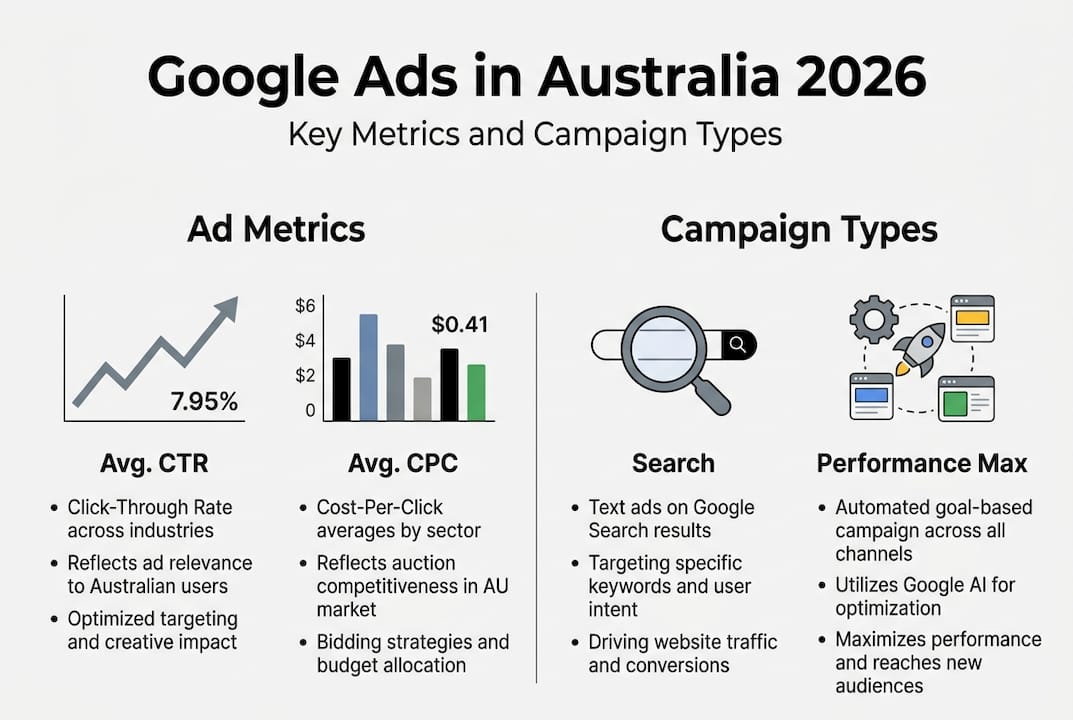
Australia’s average Search CTR sits at 3.17%, with an average CPC of $3.60 and ROAS ranging from 3x to 5x depending on the sector. Legal and finance advertisers pay significantly more per click due to high competition, while e-commerce businesses often achieve strong returns at lower cost.
Understanding PPC performance in Australia helps you set realistic budget expectations before you launch. Pairing your ads with strong SEO and ad performance strategies can also lower your overall customer acquisition costs over time.
Common mistakes and expert tips for Google Ads success
Even with all this power, there are traps that can undermine your spend. Here is how to steer clear and drive the best results.
Australian advertisers consistently repeat the same errors. Recognising them early saves you significant budget. The most common Google Ads mistakes include:
- Inconsistent or broken conversion tracking, which blinds your optimisation efforts
- Over-relying on broad match keywords without adding negative keywords
- Ignoring Quality Score and exact match keyword opportunities
- Auto-applying Google’s recommendations without reviewing their impact
- Setting campaigns live and never reviewing them again
- Allowing Performance Max to cannibalise high-intent Search traffic
The hybrid approach of running Search alongside Performance Max works well for most businesses, but only when managed carefully. PMax can sometimes compete with your own Search campaigns for the same queries, driving up your costs without adding new reach. Segmenting your campaigns and using brand exclusions helps prevent this.
Pro Tip: Review your search terms report every week. Add irrelevant queries as negative keywords immediately. This single habit can reduce wasted spend by 20% or more within the first month.
Expert optimisation strategies consistently reinforce one principle: ad relevance and landing page quality matter more than bid size. Prioritise improving your ad copy and destination pages before increasing your budget.
“The best spend goes to ads and landing pages, not just the highest bid. Businesses that invest in relevance consistently outperform those that simply outspend their competitors.”
Stay across digital marketing best practices to keep your campaigns aligned with platform changes and evolving consumer behaviour in the Australian market.
Our take: why blending tech and human insight beats Google Ads guesswork
Now, bringing all these insights together, here is the truth most guides will not tell you about Google Ads in the real world.
Performance Max and Google’s AI tools are genuinely impressive. They process signals and make bid adjustments that no human could replicate at scale. But they are not infallible, and in fast-moving Australian markets, blind trust in automation is a real risk.
We have seen businesses hand full control to PMax and watch their cost per lead quietly double over three months because nobody reviewed the data. The algorithm optimises for what it is told to optimise for, and if your conversion tracking is flawed or your goals are poorly defined, the machine will confidently spend your budget in the wrong direction.
What consistently works is a blended approach:
- Run Search campaigns for high-intent, high-value keywords with tight control
- Introduce PMax only after you have 30 to 60 days of clean conversion data
- Schedule weekly reviews of search terms, audience signals, and asset performance
- Apply local market knowledge, seasonal trends, and competitor activity that no algorithm can fully account for
Our team at Design Box Digital applies this methodology through structured optimisation strategies that combine data rigour with hands-on management. Technology is the engine, but human judgement is the steering wheel.
Power up your results with expert Google Ads management
If you are ready to capture more of the right customers through Google Ads, here is how to get dedicated help.
At Design Box Digital, we build and manage professional Adwords campaign management strategies tailored specifically for Australian businesses. Our Google Ads management services cover everything from campaign structure and keyword research to ongoing optimisation and reporting. We also know that your ads are only as effective as the page they land on, which is why our website design upgrades are built to convert visitors into customers. If you want campaigns that are set up correctly from day one and managed with genuine expertise, get in touch with our Melbourne team today.
Frequently asked questions
What is the main advantage of Google Ads for Australian businesses?
Google Ads gives you targeted access to local customers who are actively searching for your products or services, making it one of the most cost-effective ways to generate qualified leads.
How much does Google Ads typically cost in Australia?
The average CPC in Australia is around $3.60, with e-commerce clicks starting from $1.20 and legal sector clicks reaching as high as $12.80 depending on competition.
Is Performance Max better than Search Ads?
Neither is universally better. Performance Max suits broad reach and e-commerce scale, while Search Ads deliver stronger control for high-intent leads. A hybrid approach typically produces the best outcomes.
What is the most common Google Ads mistake?
The most costly mistake is setting campaigns and forgetting them. Without regular search term reviews and conversion tracking checks, budget drains quickly with little to show for it.