



TL;DR:
- Google now considers real user behavior signals like dwell time and bounce rate for rankings.
- Prioritize UX factors such as page speed, mobile responsiveness, and clear navigation to boost SEO.
- Combining SEO with user experience, called SXO, offers long-term, sustainable search performance.
Most business owners assume SEO is purely about keywords, backlinks, and technical tweaks. That assumption is costing them rankings. Google’s algorithms have grown sophisticated enough to measure how real visitors behave on your site, and those behaviour signals now play a measurable role in where you appear in search results. Low bounce rates and high dwell time indicate content relevance and satisfaction, indirectly boosting rankings through Google’s RankBrain system. If your site frustrates visitors, Google notices. This article walks you through the evidence, clears up common myths, and gives you practical steps to improve your website’s user experience (UX) for stronger SEO results.
Table of Contents
- Why user experience matters for SEO today
- The key UX factors that influence search rankings
- SXO: The fusion of UX and SEO for the whole user journey
- How to improve user experience for better SEO: Practical actions
- Our take: Why user experience is the unsung hero of modern SEO
- Get expert help elevating your SEO and user experience
- Frequently asked questions
Key Takeaways
| Point | Details |
|---|---|
| User signals drive SEO | Metrics like dwell time and reduced bounce rates tell Google your site satisfies visitors and can boost your search ranking. |
| Core Web Vitals are critical | Fast, stable, and responsive sites consistently outperform slow or clunky ones in organic search. |
| Integrate UX and SEO | A holistic approach combining user experience with SEO delivers better results than focusing on either alone. |
| Practical improvements matter | Simple changes to speed, navigation, and content can deliver measurable SEO benefits quickly. |
Why user experience matters for SEO today
With the search landscape evolving rapidly, user experience is now considered central to SEO, not just a nice-to-have addition. Google evaluates web pages using real user signals collected from millions of searches every day. These signals help the algorithm determine whether your page actually satisfies what someone was looking for.
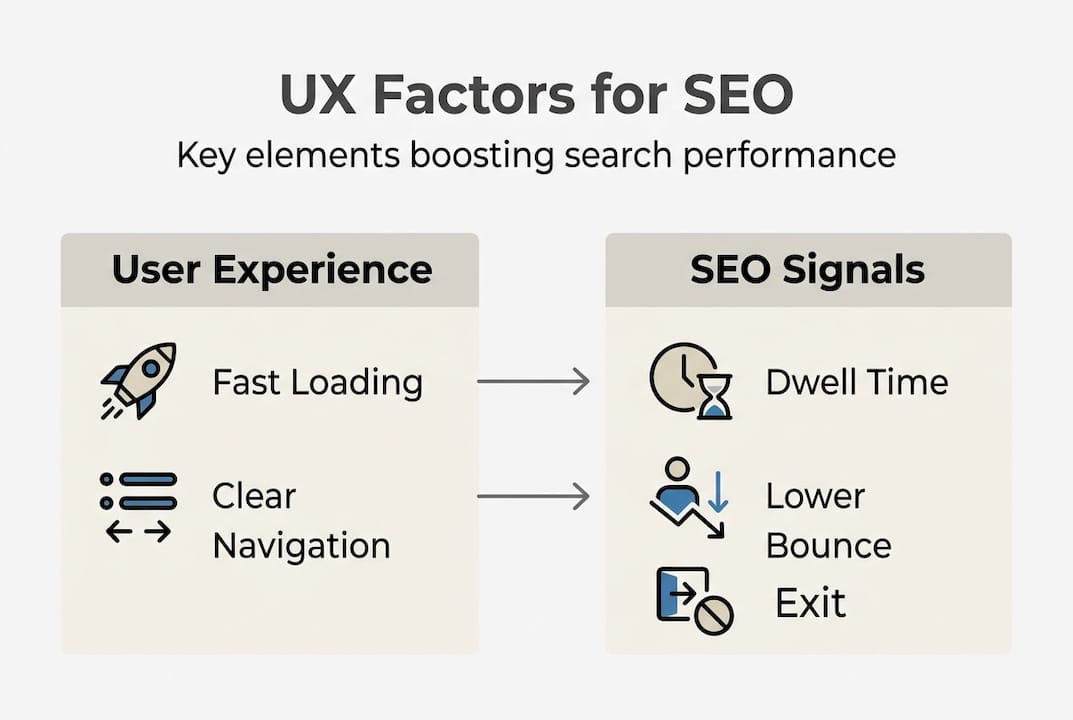
The three user behaviour signals that matter most are:
- Bounce rate: The percentage of visitors who leave after viewing only one page. A high bounce rate can suggest your content didn’t meet expectations.
- Dwell time: How long a visitor stays on your page before returning to the search results. Longer dwell time signals genuine engagement.
- Pogo-sticking: When a user clicks your result, leaves quickly, and clicks a competitor’s result instead. This is a strong negative signal.
Google’s RankBrain system processes these signals to assess content relevance and satisfaction. Understanding how UX boosts visibility in search results helps you see why investing in your site’s experience pays off directly in rankings.
“User behaviour signals like low bounce rate, high dwell time, and reduced pogo-sticking indicate content relevance and satisfaction, indirectly boosting rankings via RankBrain and engagement metrics.”
One persistent myth is that bounce rate doesn’t matter for SEO. The data tells a different story. While bounce rate alone isn’t a confirmed direct ranking factor, it correlates strongly with poor user experience, which absolutely affects rankings. A visitor who bounces immediately is telling Google your page wasn’t the right answer. Over thousands of visits, that pattern shapes your position in the results.
Satisfied visitors signal value to Google in ways that no amount of keyword stuffing can replicate. When someone reads your content thoroughly, explores multiple pages, and completes an action, your site earns credibility with the algorithm. This is why a technically perfect page with poor content or confusing navigation will still underperform in search.
The key UX factors that influence search rankings
Now that you know why UX influences SEO, let’s break down which aspects of user experience matter most for rankings. Not all UX improvements carry equal weight. Some are essential, others are enhancements. Here’s how to prioritise your efforts.
| UX factor | SEO impact | Priority level |
|---|---|---|
| Page speed | High | Must-have |
| Mobile responsiveness | High | Must-have |
| Content readability | Medium-high | Must-have |
| Clear navigation | Medium | High priority |
| Accessible design | Medium | High priority |
| Visual stability | High | Must-have |
The top UX factors to address, in order of importance:
- Page speed: Slow pages drive visitors away before they even read a word. Optimising Core Web Vitals has been shown to triple average search positions and drop bounce rates by 40% in documented cases.
- Mobile responsiveness: More than half of Australian web traffic comes from mobile devices. If your site doesn’t adapt to smaller screens, you’re losing rankings and visitors simultaneously.
- Content formatting: Break up text with headings, short paragraphs, and bullet points. Walls of text increase bounce rates significantly.
- Navigation clarity: Visitors should find what they need within two or three clicks. Confusing menus create frustration and early exits.
- Accessibility: Alt text for images, sufficient colour contrast, and keyboard navigation support both users and search crawlers.
Real-world results back this up. Improving Core Web Vitals boosted organic traffic by 40% in one documented case study. These aren’t marginal gains. They’re the kind of results that shift a business’s revenue. Pairing technical improvements with well-crafted SEO meta tags further strengthens your click-through rates from search results.

Pro Tip: Run your site through Google’s PageSpeed Insights tool monthly. It scores your Core Web Vitals and gives specific, prioritised recommendations you can act on immediately.
SXO: The fusion of UX and SEO for the whole user journey
Moving beyond individual UX signals, the leading edge of SEO blends user experience into a holistic strategy. This approach has a name: Search Experience Optimisation, or SXO.
SXO combines traditional SEO tactics like keyword research, link building, and technical optimisation with deliberate UX design across the entire user journey. The goal is to make every touchpoint, from the moment someone sees your result in Google to the moment they complete a purchase or enquiry, as smooth and satisfying as possible.
| Old SEO approach | SXO outcome |
|---|---|
| Keyword stuffing pages | Relevant content matched to intent |
| Chasing backlinks only | Authority built through trust and engagement |
| Surface-level technical fixes | Holistic site experience improvements |
| Ignoring post-click behaviour | Optimising for dwell time and conversions |
The key benefits of adopting an SXO mindset include:
- Stronger alignment between what users search for and what they find on your site
- Improved engagement metrics that reinforce your rankings over time
- Reduced reliance on short-term tactics that Google’s updates often penalise
- Better conversion rates alongside better rankings
User signals in Google’s Navboost and PageRank systems now influence how pages are evaluated, making the fusion of UX and SEO not just smart but necessary. Piecemeal improvements, fixing only your page speed or only your content, rarely produce lasting results. Integrated site redesigns that consider the full user journey consistently outperform surface tweaks.
Exploring advanced SEO strategies shows how this integrated thinking plays out in practice. It’s also why web development and SEO need to be planned together from the start, not bolted on separately after launch.
Pro Tip: Before your next site update, map out your user journey from search result to conversion. Identify every point where a visitor might feel confused or frustrated. Those friction points are your highest-priority fixes.
How to improve user experience for better SEO: Practical actions
Understanding is only half the battle. Here’s how you can immediately make your website’s user experience work for your SEO goals.
- Audit your current UX. Use Google Analytics to review engagement rates, average session duration, and pages with high exit rates. These numbers tell you where visitors are losing interest.
- Optimise page speed. Compress images, enable browser caching, and reduce unnecessary scripts. Core Web Vitals improvements have tripled average search positions for some businesses, making this one of the highest-return actions you can take.
- Make your site fully mobile-responsive. Test every page on multiple screen sizes. Buttons should be easy to tap, text should be readable without zooming, and forms should work smoothly on touchscreens.
- Refine your navigation. Simplify your menu structure. Use clear, descriptive labels. Add a search function if your site has more than 20 pages.
- Enhance on-page content. Use subheadings, short paragraphs, and visuals to break up text. Answer the user’s question clearly and early in the page.
- Monitor engagement metrics regularly. Set up monthly reviews of your Core Web Vitals, bounce rate, and average engagement time in Google Analytics 4.
Quick wins checklist for immediate improvements:
- Compress all images above 200KB
- Add descriptive alt text to every image
- Ensure your site loads in under 3 seconds on mobile
- Check that all links and buttons work correctly
- Review your most-visited pages for readability
Common mistakes to avoid include ignoring mobile users, publishing content that doesn’t match search intent, and failing to track results after making changes. Sustainable business growth with SEO requires ongoing measurement, not a set-and-forget approach. Staying current through a reliable SEO tips resource keeps your strategy sharp as algorithms evolve.
Our take: Why user experience is the unsung hero of modern SEO
Here’s our candid take, informed by hands-on experience and client results across more than two decades of digital marketing work.
Technical SEO wins are real, but they’re fragile. We’ve seen businesses achieve strong rankings through technical fixes alone, only to lose them within months because their site experience was poor. Visitors arrived, felt underwhelmed, and left. Google adjusted accordingly.
The clients who see lasting results are the ones who invest in UX alongside SEO. Not as separate projects, but as a unified strategy. The return on investment from that approach is consistently higher than from technical optimisation alone.
The uncomfortable truth is that many agencies focus on rankings without addressing the actual user experience driving those rankings. It’s easier to report keyword positions than to fix confusing navigation or slow load times. But the businesses that win long-term are the ones that treat their visitors well.
We’d encourage every business owner to read about SEO and branding synergy because the connection between how your site feels and how your brand is perceived is far stronger than most people realise.
Get expert help elevating your SEO and user experience
Ready to see the benefits of user-centred SEO on your own site? Design Box Digital works with Australian businesses to build websites and SEO strategies that perform on both fronts.

Our team offers professional website design that prioritises speed, usability, and conversion alongside search performance. As experienced SEO experts based in Melbourne, we combine technical optimisation with UX improvements that produce measurable, lasting results. Whether you need a full site audit, a targeted UX review, or a complete SEO overhaul, we can help. Explore our proven SEO strategies or get in touch to discuss what your website needs to rank and convert more effectively.
Frequently asked questions
Does improving user experience guarantee higher search rankings?
No improvement can guarantee first place, but strong user experience significantly increases your chances by sending positive signals to Google. Low bounce rate and high dwell time indicate content relevance and satisfaction, which influence rankings indirectly.
What are Core Web Vitals and why do they matter for SEO?
Core Web Vitals are Google’s metrics for measuring real user experience, covering page load speed, interactivity, and visual stability. Improving these metrics has been shown to significantly improve search rankings and organic traffic.
Is bounce rate still important for SEO in 2026?
Bounce rate isn’t a confirmed direct ranking factor, but it correlates strongly with poor user experience. Bounce rate correlates with UX issues that do affect rankings, making it a useful indicator to monitor.
How can I check if my website’s UX is helping or hurting my SEO?
Use Google Analytics 4 and Google Search Console to review engagement rates, page speed scores, and Core Web Vitals. These tools highlight exactly where your site’s experience is working and where it needs attention.
Do small content tweaks matter or do I need a full site redesign?
Small tweaks can produce quick wins, but sustainable ranking improvements come from holistic UX and SEO changes that address the full user journey rather than isolated elements.