



Picture this: a customer in your suburb searches for exactly what you sell, but your business doesn’t appear anywhere on the first page. Your competitor, just two streets away, takes the call instead. This is the reality for thousands of Australian small and medium-sized businesses (SMBs) that haven’t yet invested in local SEO. In 2026, local search is more competitive than ever, and showing up in Google Maps and local results can directly drive foot traffic, phone calls, and online sales. This guide walks you through every step you need to take to improve your local search visibility and win more customers in your area.
Table of Contents
- Understanding local SEO and why it matters for Australian businesses
- What you need before starting: Tools, platforms, and prerequisites
- Step-by-step local SEO process for 2026
- Troubleshooting, common pitfalls, and verifying results
- Next steps: Boosting your local SEO with expert support
- Frequently asked questions
Key Takeaways
| Point | Details |
|---|---|
| Australian SEO essentials | Local SEO requires consistent business information across directories and a strong Google Business Profile. |
| Optimisation process | Follow a step-by-step approach: preparation, execution, audits, and review of local SEO efforts. |
| Avoid common mistakes | Check for duplicate or inconsistent listings, focus on local intent, and update your citations regularly. |
| Expert support matters | You can boost results with help from professional Australian SEO specialists. |
Understanding local SEO and why it matters for Australian businesses
Local SEO (search engine optimisation) is the process of improving your online presence so your business appears in search results when people nearby look for your products or services. It’s different from general SEO because it focuses on geographic relevance. When someone types “plumber near me” or “Melbourne accountant,” Google uses local signals to decide which businesses to show.
In 2026, those signals include your Google Business Profile, your website’s on-page content, online reviews, and your presence across local directories. Google also weighs proximity, relevance, and prominence when ranking local results. Prominence, in particular, is influenced by how consistently your business information appears across the web.
For Australian businesses, this means paying close attention to local platforms and directories that Google recognises as authoritative in this market. Australian local SEO best practices confirm that local citations build consistency and prominence in search results. A citation is simply any online mention of your business name, address, and phone number.
Here’s why local SEO matters for your business right now:
- More qualified traffic: People searching locally are ready to buy, not just browse.
- Higher conversion rates: Local searches convert at a significantly higher rate than broad searches.
- Competitive edge: Many Australian SMBs still haven’t optimised for local search, so the opportunity is real.
- Trust signals: Appearing in local results builds credibility with nearby customers.
- Mobile visibility: Most local searches happen on mobile devices, and Google prioritises businesses with strong local signals.
Understanding local trust factors is also essential, as Google’s E-E-A-T (Experience, Expertise, Authoritativeness, Trustworthiness) framework now plays a bigger role in SEO in 2026 than ever before.
“Consistency in your business name, address, and phone number across all online platforms is one of the most powerful things you can do for local search visibility.”
Now that we’ve established why local SEO is critical, let’s organise everything you need before diving into the process.
What you need before starting: Tools, platforms, and prerequisites
Before you start optimising, you need the right tools and accurate business information ready to go. Jumping in without preparation leads to inconsistent data, which can actually hurt your rankings.
Here’s a checklist of business information you’ll need:
- Business name (exactly as it appears on your signage and ABN registration)
- Physical address (including suburb and postcode)
- Phone number (local area code preferred)
- Business hours (including public holidays)
- Website URL
- Business category (primary and secondary)
- A short business description (keyword-rich but natural)
- High-quality photos of your premises, team, and products
Pro Tip: Use the exact same business name, address, and phone number everywhere. Even small differences like “St” versus “Street” can create inconsistencies that confuse search engines and reduce your citation consistency.
Here’s a comparison of the key tools you’ll use:
| Tool | Purpose | Australian relevance |
|---|---|---|
| Google Business Profile | Primary local listing and maps presence | Essential for all Australian businesses |
| SEMrush | Keyword research and rank tracking | Strong local keyword data for Australia |
| Moz Local | Citation management and audit | Supports Australian directory submissions |
| BrightLocal | Local rank tracking and reporting | Excellent for Australian market reporting |
| Ahrefs | Backlink and competitor analysis | Useful for identifying local link opportunities |
You’ll also want to claim your listings on major Australian directories. Our Melbourne local SEO experts recommend starting with Yellow Pages, TrueLocal, Yelp Australia, and Hotfrog. For technical setup, our technical SEO services page outlines what’s involved in getting your site ready for local search. You can also explore our SEO agency resources for a broader view of what a complete SEO strategy looks like.

With everything ready, it’s time to execute the local SEO process step by step.
Step-by-step local SEO process for 2026
Follow these steps in order. Each one builds on the last, so skipping ahead can leave gaps in your strategy.
-
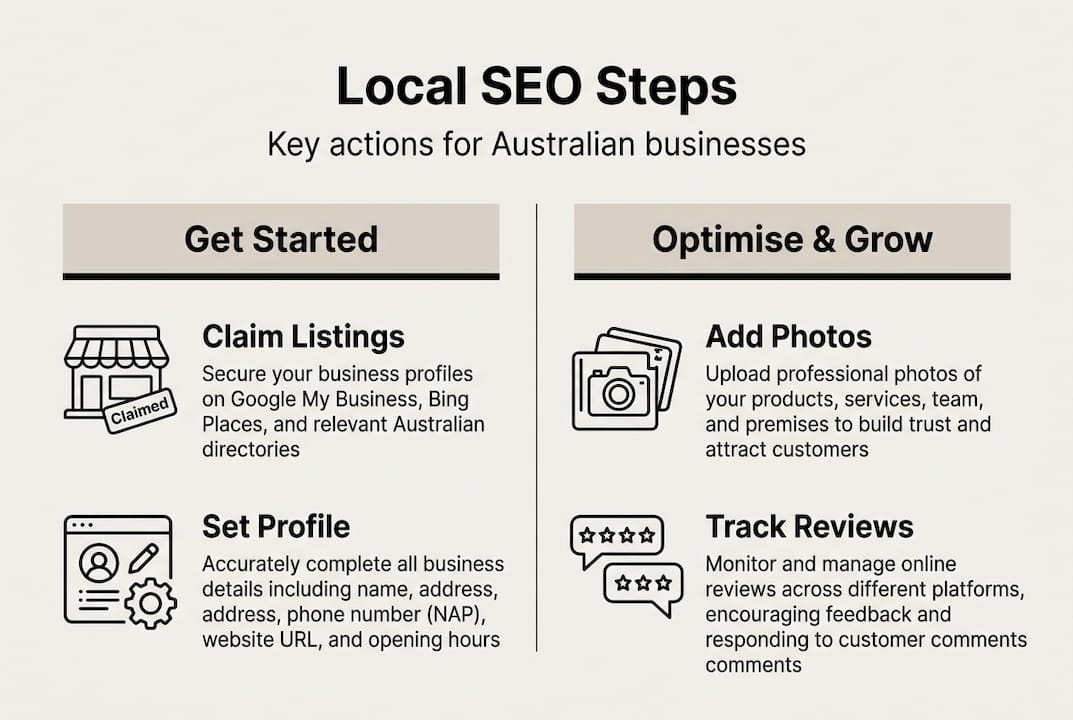
Set up and optimise your Google Business Profile. Claim your profile at business.google.com, fill in every field, choose accurate categories, and upload at least ten photos. Add your products or services, set your service area, and enable messaging.
-
Claim and update Australian directory listings. Submit your business to Yellow Pages, TrueLocal, Yelp Australia, Hotfrog, and StartLocal. Use your exact business details every time. Directory citation strategies show that consistent citations across multiple platforms significantly boost local prominence.
-
Optimise your website for local keywords. Add your suburb and city to your page titles, meta descriptions, headings, and body content. Include your address in the footer and create a dedicated contact page with an embedded Google Map.
-
Add structured data (schema markup). Use LocalBusiness schema on your website to help Google understand your location, hours, and services. This is a technical step, but it makes a measurable difference to how your site appears in search results.
-
Create locally focused content. Write blog posts, service pages, and FAQs that target local search terms. Our SEO content writing tips can help you build content that ranks. If your site runs on WordPress, our WordPress SEO advice covers the technical side of content optimisation.
-
Gather and manage online reviews. Ask satisfied customers to leave Google reviews. Respond to every review, positive or negative. Reviews are a direct ranking factor for local search.
-
Ensure mobile optimisation. Your site must load quickly and display correctly on smartphones. Most local searches happen on mobile, so a slow or broken mobile experience will cost you rankings and customers.
Pro Tip: Schedule a quarterly audit of all your directory listings. Business details change, and outdated information across platforms can drag down your local rankings over time. Use a tool like Moz Local or BrightLocal to automate this process.
Here’s a summary of each step, the tools involved, and what you can expect:
| Step | Tool/platform | Expected outcome |
|---|---|---|
| Google Business Profile setup | Google Business Profile | Appear in Maps and local pack results |
| Directory listings | Yellow Pages, TrueLocal, Moz Local | Improved citation consistency and prominence |
| On-page local optimisation | Your CMS, Google Search Console | Higher rankings for suburb-specific searches |
| Schema markup | Google’s Structured Data tool | Rich results and better search appearance |
| Local content creation | Your blog, SEMrush | Increased organic traffic from local queries |
| Review management | Google Business Profile, email | Stronger trust signals and higher rankings |
| Mobile optimisation | Google PageSpeed Insights | Lower bounce rates and better mobile rankings |
For businesses focused on lead generation through SEO, these steps form the foundation of a strategy that delivers measurable results.
Once you’ve worked through the process, it’s crucial to know how to check your progress and avoid costly mistakes.
Troubleshooting, common pitfalls, and verifying results
Even with the best intentions, local SEO efforts can go sideways. Here are the most common issues Australian businesses face and how to fix them.
Common problems to watch for:
- Inconsistent business details: Different phone numbers or address formats across directories confuse Google and reduce your rankings.
- Duplicate listings: Multiple Google Business Profile listings for the same location can split your authority and cause ranking drops.
- Negative reviews left unaddressed: Ignoring negative feedback signals poor customer service to both Google and potential customers.
- Neglecting Australian-specific directories: Focusing only on global platforms and skipping local ones like TrueLocal or Yelp Australia means missing out on locally relevant citations.
- Poor mobile experience: A site that loads slowly or breaks on mobile will lose rankings fast in 2026.
To verify your results, track these metrics monthly:
- Local pack rankings: Are you appearing in the top three map results for your key search terms?
- Google Business Profile insights: Monitor views, clicks, calls, and direction requests.
- Organic traffic from local queries: Use Google Search Console to see which local keywords are driving visits.
- Conversion actions: Are more people calling, emailing, or visiting your store?
“Regular audits of your local SEO are not optional in 2026. The businesses that check and update their listings consistently are the ones that hold their rankings.”
The 2026 SEO visibility guide outlines how search behaviour is shifting and why staying on top of your local presence is a continuous effort, not a one-time task. As troubleshooting tips for local SEO confirm, citation accuracy is one of the most overlooked but impactful factors in maintaining strong local rankings.
Now you understand how to manage, monitor, and improve your local SEO. Let’s explore how professional help or tailored strategies can take your visibility to the next level.
Next steps: Boosting your local SEO with expert support
If you’ve worked through this guide and want to accelerate your results, working with a specialist team makes a real difference. DIY local SEO gets you started, but a data-driven strategy built by experts can take your visibility and sales to a new level.
At Design Box Digital, we’ve spent over 20 years helping Australian businesses grow through targeted SEO services Melbourne businesses trust. Whether you need a full local SEO audit, citation management, content strategy, or technical fixes, our team handles it all. Explore our proven strategies to enhance SEO performance or start with the basics by reading what SEO is and how it applies to your business. Get in touch with our Melbourne team today to find out how we can help you rank higher and win more local customers.
Frequently asked questions
How do Australian local directories impact SEO?
Australian directories such as Yellow Pages and TrueLocal boost your local search visibility by ensuring business citations are consistent and prominent across the web, which Google uses as a trust signal.
How often should I update my business information on directories?
Update your business information at least quarterly or whenever your details change. Outdated or inconsistent information can reduce your local search rankings over time.
Which platforms are most important for Australian local SEO?
Google Business Profile is the single most important platform, followed by key Australian directories like Yellow Pages, TrueLocal, and Yelp Australia for building local citation authority.
What are common mistakes in local SEO?
The most frequent errors include inconsistent business details across platforms, duplicate listings, neglecting Australian-specific directories, and failing to optimise for mobile users.