


TL;DR:
- Google Shopping ads drive 85.3% of clicks and deliver high return on ad spend for Australian e-commerce.
- Well-structured campaigns, optimized landing pages, and conversion tracking are essential for maximizing ROI.
- Continuous refinement and alignment between ads, landing pages, and SEO unlock long-term sales growth.
Many Australian e-commerce businesses pour energy into organic search, assuming it will carry the bulk of their sales. The reality is different. Google Shopping ads attract 85.3% of clicks and generate exceptional return on ad spend for online retailers across Australia. Paid advertising, particularly through Google Ads, has become the primary driver of high-intent traffic and predictable revenue. This guide breaks down exactly how Google Ads works for Australian e-commerce, what the numbers mean, and how to build campaigns that deliver real, scalable results.
Table of Contents
- How Google Ads drives online sales in Australia
- Key metrics: Understanding costs and returns
- Campaign structure and targeting best practices
- Maximising impact: Landing pages, measurement, and SEO synergy
- Why most Australian e-commerce brands underuse Google Ads’ full potential
- Get more from your Google Ads investment
- Frequently asked questions
Key Takeaways
| Point | Details |
|---|---|
| Shopping ads dominate sales | Google Shopping captures the majority of product search clicks and offers high returns for Australian businesses. |
| Know your metrics | Monitoring CPC, CPA, and ROAS helps you spot opportunities and assess true campaign profitability. |
| Structure and tracking matter | A clear campaign structure and proper conversion tracking set the foundation for sustained results. |
| Landing pages boost ROI | Optimised landing pages and using Google Ads data for SEO multiply long-term sales impact. |
How Google Ads drives online sales in Australia
Now that we’ve set the stage for Google Ads’ importance, let’s break down exactly how it fuels online sales for Australian retailers.
Google Ads works because it targets people who are already looking to buy. Unlike social media advertising, which interrupts users mid-scroll, Google Ads appears when someone types in a search query with clear purchase intent. That distinction matters enormously for conversion rates.
The three campaign types most relevant to Australian e-commerce are Search, Shopping, and Performance Max. Each serves a different purpose, but Shopping campaigns consistently dominate click share and revenue generation for product-based businesses.
| Campaign type | Avg. click share | Avg. CPC | Avg. ROAS |
|---|---|---|---|
| Shopping | 85.3% | $0.66 | 8x |
| Search | 10.2% | $1.82 | 4x |
| Performance Max | Varies | $1.20 | 5x+ |
Google Ads sales data shows that Shopping ads capture 85.3% of clicks with an average ROAS of 8x in the Australian market. That figure alone explains why most e-commerce managers prioritise Shopping campaigns above all else.
Here’s what makes each campaign type valuable:
- Shopping campaigns display your product image, price, and store name directly in search results, placing your brand at the exact moment a customer is ready to purchase.
- Search campaigns use text ads triggered by keyword queries, ideal for capturing branded and category-level intent.
- Performance Max campaigns run across all Google networks including Search, Display, YouTube, and Gmail, using machine learning to find conversions wherever they occur.
Performance Max campaigns are particularly powerful for reaching audiences across multiple touchpoints in a single campaign. The trade-off is that they require strong creative assets and sufficient conversion data to optimise effectively. For most Australian retailers, Shopping campaigns remain the foundation, with Performance Max layered on top for broader reach.

The core benefits of running Google Ads for e-commerce are straightforward. You get immediate visibility in front of buyers who are actively searching. You attract qualified traffic rather than passive browsers. And you gain conversion predictability, meaning you can forecast revenue based on spend and historical ROAS.
Key metrics: Understanding costs and returns
With the campaign types mapped out, it’s vital to understand what success looks like. Let’s decode the numbers that matter most.
Three metrics define Google Ads performance for e-commerce: CPC, CPA, and ROAS.
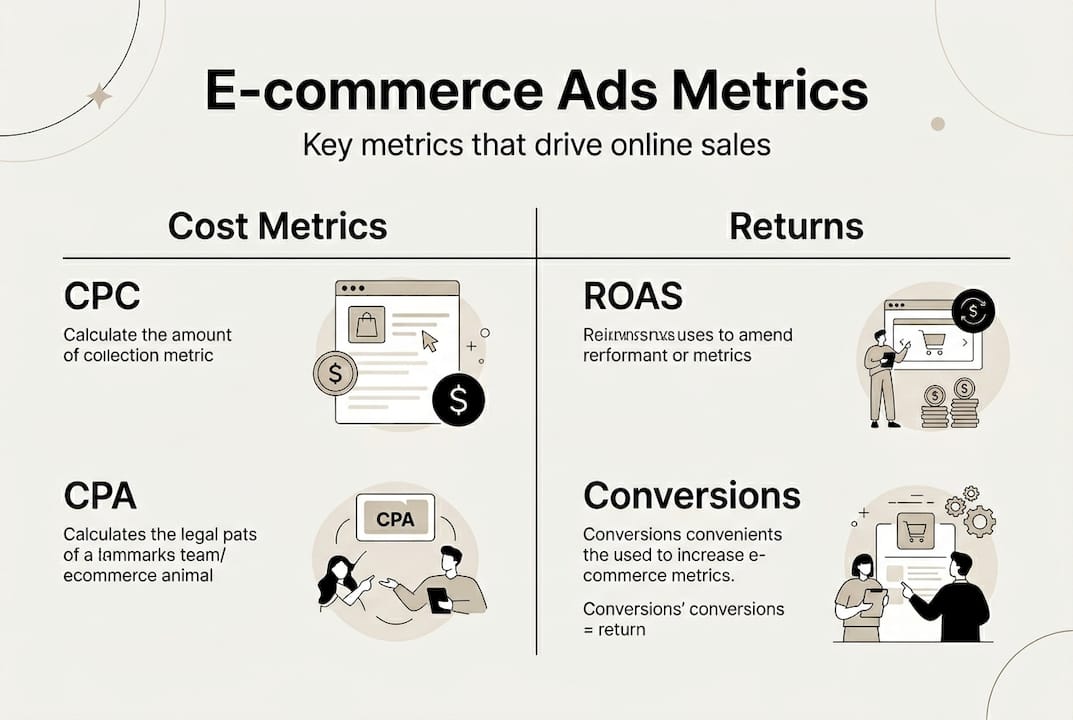
CPC (cost per click) is simply what you pay each time someone clicks your ad. CPA (cost per acquisition) is the total cost to generate one sale or conversion. ROAS (return on ad spend) measures revenue earned for every dollar spent on ads. If you spend $1,000 and generate $5,000 in sales, your ROAS is 5x.
| Metric | Shopping benchmark | Search benchmark |
|---|---|---|
| Average CPC | $0.66 | $1.82 |
| Average CPA | $28 | $38 |
| Average ROAS | 8x | 4x |
Australian e-commerce benchmarks show average CPC ranging from $1.20 to $1.82, CPA between $28 and $38, and ROAS of 4x to 5x across campaigns. Shopping campaigns consistently outperform Search on both CPC and ROAS.
Here’s how to estimate and monitor these metrics for your own campaigns:
- Set a starting budget based on your target CPA and expected monthly sales volume. If your CPA is $35 and you want 50 sales per month, budget at least $1,750.
- Track conversions from day one using Google Ads conversion tracking linked to your e-commerce platform.
- Review ROAS weekly during the first month, then adjust bids and budgets based on what the data tells you.
- Benchmark against your niche rather than industry averages. A fashion retailer and a hardware store will see very different CPCs.
- Calculate your break-even ROAS by dividing your revenue by your cost of goods sold. Any ROAS above that figure is profitable.
Understanding PPC advertising tips alongside your SEO best practices gives you a complete picture of where your marketing dollars are working hardest.
Pro Tip: Don’t chase the lowest CPC. A higher CPC on a tightly targeted keyword often delivers a far better CPA than cheap clicks from broad, unqualified traffic.
Campaign structure and targeting best practices
Once you understand the numbers, the next step is using best-practice structure and targeting to unlock those results.
A well-structured campaign is the difference between an account that scales and one that bleeds budget. Here’s how to build it:
- Organise campaigns by product category. Separate your campaigns by product type so you can control budgets and bids at a granular level. Don’t lump all products into one campaign.
- Create separate ad groups for each subcategory. This keeps your targeting tight and your quality scores high.
- Apply audience signals. Use your existing customer data, website visitors, and similar audiences to tell Google who your best buyers are.
- Enable Smart Bidding with Target ROAS. This tells Google’s algorithm to optimise bids automatically toward your revenue goal.
- Use broad match keywords with strong signals. When paired with Smart Bidding and audience data, broad match can expand reach without wasting spend.
Smart Bidding with Target ROAS can deliver 14% more conversion value than target CPA bidding, making it the preferred strategy for e-commerce accounts with sufficient conversion data.
“Smart Bidding with Target ROAS can deliver 14% more conversion value than tCPA, making it the strongest bidding strategy for revenue-focused e-commerce campaigns.”
Pro Tip: Avoid running Performance Max on budgets under $3,000 per month. The campaign type needs volume to learn and optimise. On low budgets, it often underperforms compared to a well-structured Shopping campaign.
Working with professional Ads management ensures your campaign structure is built correctly from the start, avoiding the costly trial-and-error phase that burns budget without results. If you want to explore specific Adwords campaign tactics, there are proven frameworks tailored to Australian market conditions.
Maximising impact: Landing pages, measurement, and SEO synergy
But Google Ads success doesn’t operate in isolation. Critical support comes from what happens after the click and in parallel channels.
Your ad can be perfectly targeted with an excellent ROAS goal, but if the landing page is slow, confusing, or irrelevant, conversions will suffer. The landing page is where the sale is won or lost.
Quality landing pages and conversion tracking are essential for long-term Google Ads success. Here’s what a high-converting landing page needs:
- Message match: The headline on your landing page should mirror the language in your ad. Consistency builds trust instantly.
- Single, clear call to action: Remove distractions. One goal per page, whether that’s adding to cart or completing a purchase.
- Fast load speed: Every additional second of load time reduces conversions. Aim for under two seconds on mobile.
- Social proof: Customer reviews, star ratings, and trust badges reduce purchase hesitation significantly.
- Mobile optimisation: Over 60% of Australian e-commerce traffic comes from mobile devices. Your page must perform flawlessly on smaller screens.
Conversion tracking is non-negotiable. Without it, you’re flying blind. Set up Google Ads conversion tracking to record every purchase, including the transaction value. This data feeds your Smart Bidding strategy and tells you which campaigns, ad groups, and keywords are generating real revenue.
Pro Tip: Align your ad copy directly with your landing page headline. If your ad says “Shop women’s running shoes from $89,” your landing page should open with exactly that offer. Any disconnect causes drop-off.
Google Ads data also strengthens your broader SEO performance strategies. The keywords that convert well in paid search are often the same ones worth targeting organically. Use your Ads search terms report to identify high-intent queries, then build content and product pages around them for compounding long-term visibility.
Why most Australian e-commerce brands underuse Google Ads’ full potential
After seeing the practical tactics, it’s worth considering why some brands soar with Google Ads while others tread water.
In our experience working with Australian e-commerce clients, the most common problem isn’t budget. It’s focus. Brands launch campaigns, see an initial sales lift, and then leave the account largely untouched. They treat Google Ads as a tap you turn on, rather than a system you continually refine.
The second biggest missed opportunity is the landing page. Businesses invest heavily in ad spend but send traffic to generic category pages or slow-loading product pages. The ad does its job, but the page fails the customer.
Then there’s the SEO synergy gap. Your advanced Google Ads strategies generate a goldmine of keyword and audience data that most brands never feed back into their organic strategy. That’s leaving compounding value on the table.
The uncomfortable truth is this: consistent, methodical optimisation of campaign structure, landing pages, and audience targeting will outperform a larger budget running on a neglected account. Spend smarter before you spend more.
Get more from your Google Ads investment
If you’re ready to scale your online sales efficiently, here’s how Design Box Digital can help.
Design Box Digital brings over 20 years of experience managing Google Ads management for Australian e-commerce businesses. We understand the local market, the competitive landscape, and the campaign structures that actually deliver results here.
From Shopping and Performance Max campaigns to full e-commerce expertise and conversion-focused website design, we handle every element that influences your return on ad spend. Explore our Adwords solutions and find out how a tailored strategy can turn your Google Ads spend into consistent, measurable sales growth.
Frequently asked questions
How much should an Australian online store budget for Google Ads?
Most Australian e-commerce shops start with $1,000 to $3,000 per month, targeting $1.20 to $1.82 per click and aiming for a 4x to 8x ROAS depending on their product niche and competition level.
What are the most effective Google Ads campaign types for e-commerce?
Shopping and Performance Max campaigns deliver the strongest results for product-based businesses, with Shopping capturing 85.3% of clicks across the Australian market.
How does Google Ads data help with SEO?
Ads data uncovers top-performing keywords and high-intent search queries that you can use to strengthen your organic content strategy and improve search rankings over time.
Why is conversion tracking essential for Google Ads?
Conversion tracking shows you exactly which ads, keywords, and campaigns are generating sales, allowing you to optimise your budget toward the highest-returning activity and improve ROAS continuously.