



TL;DR:
- Effective SEO audits go beyond technical checks to include strategic alignment and prioritization.
- Prioritizing Tier 1 blockers like indexation issues is crucial for meaningful website growth.
- Combining automated tools with manual review ensures accurate, context-driven SEO improvements for Australian businesses.
Many Australian business owners assume an SEO audit is simply a technical checklist you hand to a developer. Run the tool, fix the flagged errors, done. But this approach misses the point entirely. A well-executed SEO audit is a strategic exercise that reveals why your website isn’t performing and what to do about it. The difference between a surface-level audit and a genuinely useful one can mean the difference between stagnant traffic and consistent growth. This guide walks you through what effective SEO auditing actually involves, how to prioritise what matters, and how to turn findings into real results for your Australian business.
Table of Contents
- Understanding SEO auditing: Beyond the technical checklist
- Tiered priorities: What matters most in an SEO audit
- Manual vs automated audits: Context matters
- Applying SEO audit insights to Australian business growth
- Why most SEO audits miss what drives real growth
- Ready to drive growth with expert SEO auditing?
- Frequently asked questions
Key Takeaways
| Point | Details |
|---|---|
| Prioritise high-impact issues | Fix indexation and crawl errors before tackling minor SEO items. |
| Combine manual and automated audits | Use tools for initial reports, but manual audits provide essential context. |
| Translate audits into growth | Actionable changes based on audit findings improve visibility and conversions. |
| Choose business-relevant improvements | Always link audit recommendations to your business objectives for lasting results. |
Understanding SEO auditing: Beyond the technical checklist
An SEO audit is a structured review of your website’s ability to be found, crawled, and ranked by search engines. But that definition only scratches the surface. There are two dimensions to every effective audit: the technical side (how your site is built and functions) and the strategic side (whether your content and structure align with your business goals and audience intent).
Most business owners only encounter the technical side. They run a tool like Screaming Frog or Semrush, receive a report with hundreds of flagged issues, and feel overwhelmed. The problem is that tool audits flag low-impact issues, and without prioritisation, you end up spending time fixing things that barely move the needle. Missing image alt text on a decorative banner is not the same as a noindex tag blocking your entire product catalogue from Google.
Understanding SEO basics is the foundation before any audit can be meaningful. Without that context, a list of errors is just noise.
A genuinely useful audit covers five core categories:
- Indexation: Are your key pages actually visible to Google?
- Crawlability: Can search engine bots access and navigate your site without errors?
- Core Web Vitals: Does your site load fast enough and provide a stable user experience?
- Link structure: Are internal and external links supporting your authority and navigation?
- Content relevance: Does your content match what your target audience is searching for?
Each of these categories can contain both critical blockers and minor cosmetic issues. The skill is in knowing which is which. A free SEO audit can give you a starting point, but interpretation and prioritisation are what turn findings into growth.
The strategic layer of auditing asks harder questions. Is your site architecture helping users find what they need? Are you targeting keywords your actual customers use? Are your conversion pathways clear? These questions require human judgement, not just automated scanning.
Tiered priorities: What matters most in an SEO audit
Once you understand what an audit covers, the next challenge is knowing where to start. Not all issues are equal. A tiered framework helps you focus your resources where they will have the greatest impact.
Tier 1: Indexation and crawl errors. These are the blockers. If Google cannot find or access your pages, nothing else matters. Noindex tags applied to the wrong pages, broken sitemaps, and crawl errors sit here. Fix these first, always.
Tier 2: Core Web Vitals and site speed. Google uses Core Web Vitals as a ranking signal. Slow load times, layout shifts, and poor interactivity scores hurt both rankings and conversions. These are high-impact and worth addressing early.

Tier 3: Link structure, backlinks, and site architecture. Internal linking guides both users and bots through your site. Weak or broken link structures dilute authority and confuse navigation. Backlink quality also sits here.
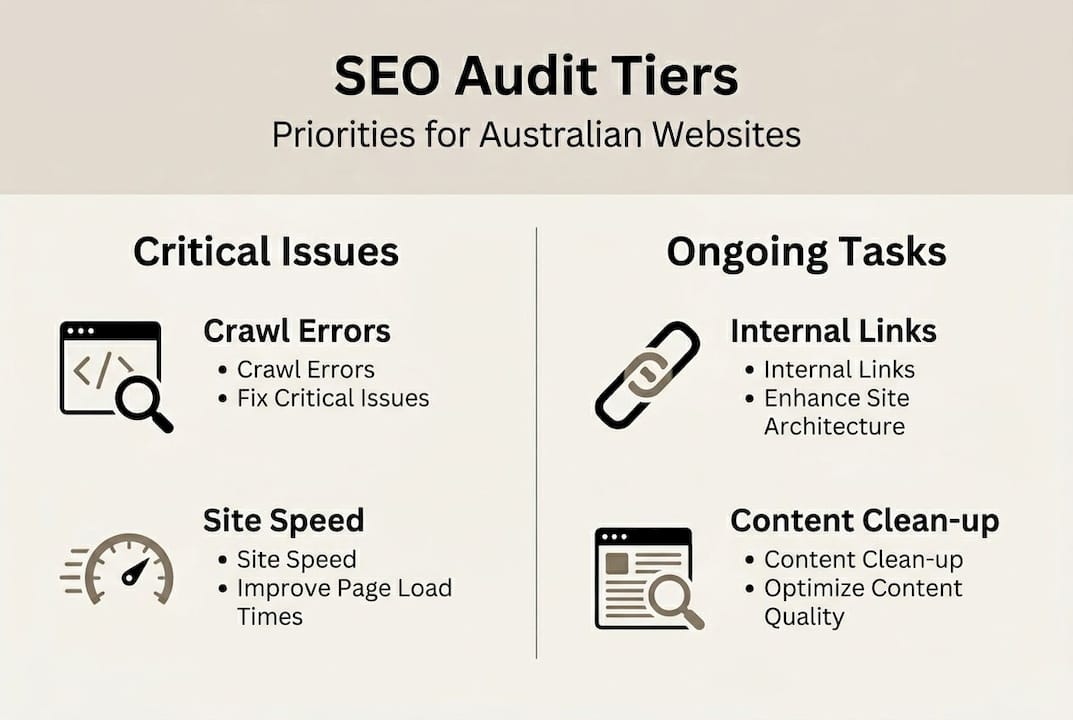
Tier 4: Minor clean-up. Decorative image alt text, low-word-count pages with minimal traffic, and other cosmetic issues. Important to address eventually, but not at the expense of Tier 1 work.
| Tier | Issue type | Impact | Urgency |
|---|---|---|---|
| 1 | Noindex errors, crawl blocks | Critical | Immediate |
| 2 | Core Web Vitals, site speed | High | Soon |
| 3 | Link structure, backlinks | Medium | Planned |
| 4 | Alt text, thin content | Low | Ongoing |
Research confirms you should prioritise Tier 1 blockers before spending any time on Tier 4 clean-up. This sounds obvious, but many businesses do the opposite because Tier 4 issues are easier to fix and make the issue count drop quickly.
Pro Tip: Before touching anything else in your audit report, search Google for site:yourdomain.com.au and check how many pages are indexed. If the number looks wrong, you likely have a Tier 1 blocker that needs immediate attention.
Applying this framework to your SEO performance strategies means every hour you invest goes toward changes that actually move rankings and traffic.
Manual vs automated audits: Context matters
Automated SEO tools are genuinely useful. They scan thousands of pages quickly, surface technical errors, and give you a starting point. But they have a significant limitation: they have no idea what your business does, who your customers are, or what actually matters for your goals.
Full manual audits provide context and prioritisation that tools simply cannot match. A tool might flag 200 pages with thin content. A manual reviewer would recognise that 180 of those pages are archived blog posts with no traffic value, while 20 are core service pages that urgently need improvement.
| Audit type | Speed | Context | Prioritisation | Cost |
|---|---|---|---|---|
| Automated | Fast | None | Poor | Low |
| Manual | Slow | High | Excellent | Higher |
| Combined | Moderate | High | Strong | Moderate |
The most effective approach combines both. Here is how to do it:
- Run your automated tool (Semrush, Ahrefs, or Screaming Frog) and export the full report.
- Filter by impact category. Group issues into the four tiers outlined above.
- Apply business context. Ask which flagged pages actually matter to your customers and revenue.
- Manually review Tier 1 and Tier 2 issues by visiting the pages, checking Google Search Console, and verifying what the tool found.
- Build a prioritised action list with clear owners, timelines, and expected outcomes.
Understanding why website audits matter helps you make the case internally for investing time in this process. And if your site was recently redesigned, the connection between web development and SEO means a post-launch audit is essential, not optional.
The combined approach gives you speed from automation and intelligence from human review. Neither alone is enough.
Applying SEO audit insights to Australian business growth
An audit is only valuable if it leads to action. Once you have a prioritised list of issues, the next step is translating those findings into changes that improve your visibility, user experience, and conversions.
SEO audits unlock performance, visibility, and conversion growth when findings are acted on systematically. For Australian businesses, this often means addressing local search factors alongside technical issues. A Melbourne-based accounting firm, for example, might discover their Google Business Profile is inconsistent with their website NAP (name, address, phone) data. That is a local SEO blocker that no generic audit template will flag unless someone applies business context.
Industry-specific challenges also shape audit priorities. An e-commerce retailer will focus heavily on product page indexation and site speed. A professional services firm like those covered in our SEO for accounting firms guide will prioritise content relevance and local authority. A national brand working with an Australian SEO agency will look at site architecture across multiple locations.
Here are the most impactful post-audit actions for Australian businesses:
- Fix Tier 1 blockers immediately. Resolve noindex errors, broken redirects, and sitemap issues before anything else.
- Improve page speed. Compress images, reduce unused JavaScript, and consider a content delivery network (CDN) for faster load times.
- Update underperforming content. Refresh pages that rank on page two or three with improved targeting and depth.
- Strengthen internal linking. Connect related pages to distribute authority and improve navigation.
- Align metadata with search intent. Rewrite title tags and meta descriptions to match what your customers actually search for.
- Monitor progress in Google Search Console. Track impressions, clicks, and crawl coverage after each round of fixes.
Pro Tip: Schedule a full SEO audit at least twice a year. Markets shift, competitors change tactics, and Google updates its algorithm regularly. A six-monthly audit keeps your strategy current and catches new issues before they compound.
Why most SEO audits miss what drives real growth
After working with Australian businesses across many industries, we have seen the same pattern repeat. A business invests in an automated audit, receives a report with 400 issues, and spends three months fixing alt text and meta description lengths. Traffic stays flat. They conclude SEO does not work.
The real problem was never the alt text. It was a noindex tag on the services section or a Core Web Vitals score tanking mobile rankings. Automated tools create false urgency around low-impact issues because they cannot weigh business context.
Australian businesses thrive when SEO focuses on context and outcomes, not just error counts.
Real growth comes from audits that ask the right questions first. What is blocking indexation? What is slowing the site? What content is failing to convert? These are Tier 1 and Tier 2 questions. Once those are resolved, the smaller issues become worth addressing. Applying enhancing SEO strategies with this mindset is what separates businesses that grow from those that stay stuck.
Ready to drive growth with expert SEO auditing?
If your audit findings are sitting in a spreadsheet without a clear action plan, you are not alone. Turning technical data into growth requires both expertise and business context.
At Design Box Digital, we combine over 20 years of experience with a practical, tiered approach to SEO auditing. Our professional SEO services are built around what actually moves rankings for Australian businesses, not just what fills an error report. Whether you want to explore proven SEO strategies or get a clear picture of where your site stands right now, we are here to help. Start with a free SEO assessment and find out exactly what is holding your website back.
Frequently asked questions
What is the main goal of an SEO audit?
The primary aim is to identify and fix site issues that block search visibility and harm user experience, so your website can grow consistently. SEO audits unlock performance, visibility, and conversion growth when findings are acted on.
How often should Australian businesses run SEO audits?
Twice a year is the recommended minimum, though highly competitive or large websites benefit from quarterly reviews. Full manual audits provide the context needed to make each round of fixes count.
Are automated SEO audits reliable?
Automated tools are useful for spotting issues quickly, but they often over-emphasise minor problems and miss business-critical context. Tool audits flag low-impact issues, so manual review is essential for accurate prioritisation.
What are Tier 1 SEO audit blockers?
Tier 1 blockers are issues that prevent your site from being indexed or crawled, such as noindex tags on key pages and crawl errors. Prioritise Tier 1 blockers before addressing any lower-tier clean-up tasks.
What is the difference between technical and strategic SEO auditing?
Technical auditing examines how your site is built and whether it functions correctly for search engines. Strategic auditing goes further by aligning your SEO activity with business goals, audience intent, and conversion outcomes. Full manual audits are best placed to cover both dimensions effectively.