


TL;DR:
- Technical SEO standards like HTTPS and title tags are now essential and widely adopted in 2026.
- Google’s core update emphasizes E-E-A-T and information gain, making content authority vital.
- Local SEO generates significant revenue for Australian SMEs, with mobile queries dominating.
Technical SEO compliance has never been more demanding. With HTTPS adoption surpassing 91% and title tag accuracy sitting at 99%, the baseline for competitive search visibility in Australia has shifted significantly. For digital marketing decision-makers at Australian SMEs, 2026 is not the year to coast on last year’s settings. Google’s evolving algorithms, a major core update, and the rise of AI-influenced search are reshaping how businesses appear online. This article walks you through the key technical standards, content priorities, local SEO opportunities, and future-focused tactics you need to act on now.
Table of Contents
- Emerging technical SEO standards for 2026
- Core update impacts: E-E-A-T and information gain
- Local SEO benchmarks and ROI for Australian SMEs
- Future-focused strategies: AI, velocity trends, and schema
- What most businesses miss: SEO is not ‘set and forget’
- Next steps for Australian SEO success
- Frequently asked questions
Key Takeaways
| Point | Details |
|---|---|
| Technical compliance now vital | Australian SMEs must meet rising standards like HTTPS and accurate title tags for visibility. |
| Auditing for Google core updates | Routine E-E-A-T and information gain audits are essential following recent Google algorithm shifts. |
| Local SEO delivers strong ROI | Investing in local SEO drives significant revenue and mobile-driven growth for businesses of all sizes. |
| AI and schema are essential | Smart use of AI and advanced schema help maintain relevance and authority in 2026 search results. |
Emerging technical SEO standards for 2026
With the foundation set, let’s get into the precise technical standards Australian SMEs must address to stay competitive. The gap between compliant and non-compliant sites is widening fast, and the consequences for visibility are real.
According to recent industry analysis, technical SEO adoption rates in 2026 show HTTPS usage above 91%, title tag compliance at 99%, robots.txt implementation widespread, and viewport meta tags near universal. These are no longer differentiators. They are table stakes. If your site falls short on any of these, you are not competing on a level playing field.
Here is a snapshot of where the industry currently sits:
| Technical standard | Adoption rate (2026) | Priority level |
|---|---|---|
| HTTPS | 91%+ | Critical |
| Title tags | 99% | Critical |
| Robots.txt | High adoption | High |
| Viewport meta tag | Near universal | High |
| FAQ schema | Growing rapidly | Medium-High |
| llms.txt | Emerging | Forward-looking |
The emerging llms.txt standard is worth noting. Similar to how robots.txt instructs search engine crawlers, llms.txt is designed to guide large language models (AI systems like ChatGPT) on how to interact with your site content. This is a forward-looking standard, but early adoption signals technical authority.
For Australian SMEs, here is a practical compliance checklist to work through:
- Audit your HTTPS status across all pages, including subdomains and redirects
- Review every title tag for accuracy, uniqueness, and keyword relevance
- Check your robots.txt file to ensure it is not accidentally blocking important pages from being crawled
- Implement FAQ schema on relevant pages to capture rich result placements in search
- Test your viewport meta tag to confirm mobile rendering is correct
- Consider adding llms.txt to your root directory as AI-driven search grows
Pro Tip: Use Google Search Console’s Coverage and Enhancements reports to quickly identify pages with technical issues. Fixing these before they compound saves significant time and protects your rankings.
For a broader view of where SEO in 2026 is heading, it helps to understand not just what standards exist, but why they matter to search engines. Google rewards sites that are structured, secure, and easy to crawl. Applying best SEO practices consistently is what separates sites that hold rankings from those that fluctuate unpredictably.
Core update impacts: E-E-A-T and information gain
Understanding the technical standards lays the groundwork, but content strategy is now equally vital after Google’s major 2026 update. The March 2026 Google Core Update was one of the most significant algorithm shifts in recent years, and its effects are still being felt across industries.
The update placed heavy emphasis on E-E-A-T, which stands for Experience, Expertise, Authoritativeness, and Trustworthiness. Google added the first “E” for Experience in a previous update, and 2026 has seen this signal weighted even more heavily. Sites that demonstrate real-world experience through case studies, author credentials, and original insights are performing noticeably better.
Information gain is the other major factor. This refers to how much unique, original value your content adds beyond what already exists on the web. If your article simply restates what ten other sites have already published, Google’s systems are increasingly able to identify that and deprioritise it. The March 2026 core update was highly volatile, with 55% of tracked sites experiencing notable ranking shifts, making content audits essential.
Key insight: The March 2026 Google Core Update affected 55% of tracked sites, signalling that topical authority and information gain are now non-negotiable ranking factors.
Here is a step-by-step approach to updating your content after this core shift:
- Identify your most important pages using Google Analytics and Search Console traffic data
- Audit each page for E-E-A-T signals, including author bios, credentials, and original research
- Check for information gain by comparing your content against the top five ranking pages for your target keywords
- Add unique insights, original data, or first-hand experience to pages that feel generic
- Update internal linking to connect related content and signal topical authority across your site
- Monitor ranking changes weekly for the first month after updates go live
The comparison below shows the difference between content that meets 2026 standards and content that does not:
| Content type | E-E-A-T signal | Information gain | Likely outcome |
|---|---|---|---|
| Generic how-to with no author | Low | Low | Ranking decline |
| Expert-authored with case study | High | Medium | Stable or growth |
| Original research with data | High | High | Strong ranking gains |
For Australian SMEs weighing whether this investment is worthwhile, the case for investing in SEO has never been stronger. Organic traffic compounds over time, and sites that adapt to core updates quickly tend to recover and grow faster than those that wait. Pairing this with a strong local SEO guide approach ensures you are capturing both broad and location-specific traffic.

Local SEO benchmarks and ROI for Australian SMEs
With core updates affecting site-wide strategy, SMEs must also understand the local ROI drivers for SEO in an Australian context. The numbers here are compelling and often underestimated.
Australian local SEO benchmarks show the sector generates AUD 4.2 billion in annual revenue nationwide, with 78% of local search queries originating from mobile devices. These figures reflect how deeply embedded local search has become in everyday purchasing behaviour. When someone in Melbourne searches for a plumber, a café, or a marketing agency, they are almost certainly doing it on their phone.
For SMEs, the practical implication is clear. Your Google Business Profile (GBP) is often the first thing a potential customer sees. It is free to set up, relatively quick to optimise, and delivers measurable results. Yet many Australian businesses still have incomplete or outdated GBP listings.
Here is a practical checklist for maximising your local visibility:
- Claim and verify your Google Business Profile if you have not already done so
- Complete every section including business hours, service areas, categories, and photos
- Collect and respond to reviews consistently, as review volume and recency affect local rankings
- Add posts to your GBP regularly to signal that your business is active
- Ensure NAP consistency (Name, Address, Phone) across your website, GBP, and all directory listings
- Build local citations by listing your business on relevant Australian directories
- Optimise your website for local keywords that include suburb or city-level terms
Pro Tip: Google’s local algorithm weighs three main factors: relevance, distance, and prominence. You can influence all three through consistent GBP management, local content creation, and earning quality backlinks from local sources.
Working with a Melbourne local SEO agency can accelerate results significantly, particularly for businesses competing in high-density markets. If you are ready to act on your own, these local SEO tips provide a strong starting point for boosting visibility without a large budget.
Future-focused strategies: AI, velocity trends, and schema
Having covered benchmarks and local ROI, let’s look ahead to future-proof strategies that will keep Australian SMEs ahead in SEO through 2026. The tools and tactics available today are more powerful than ever, but only if you know how to use them.
AI tools are transforming how SEO professionals identify opportunities. From keyword clustering to content gap analysis, AI can process data at a scale that would take weeks manually. For SMEs without large in-house teams, this levels the playing field significantly. Tools like AI-assisted content briefs help ensure every new page you publish is targeting the right intent and covering the right subtopics.
Content velocity is another concept gaining traction. It refers to how frequently and consistently you publish high-quality, relevant content. Velocity trends via Google Trends show that sites which align their publishing schedule with rising search interest outperform those that publish sporadically. Staying timely means monitoring what your audience is searching for and responding with well-structured content quickly.
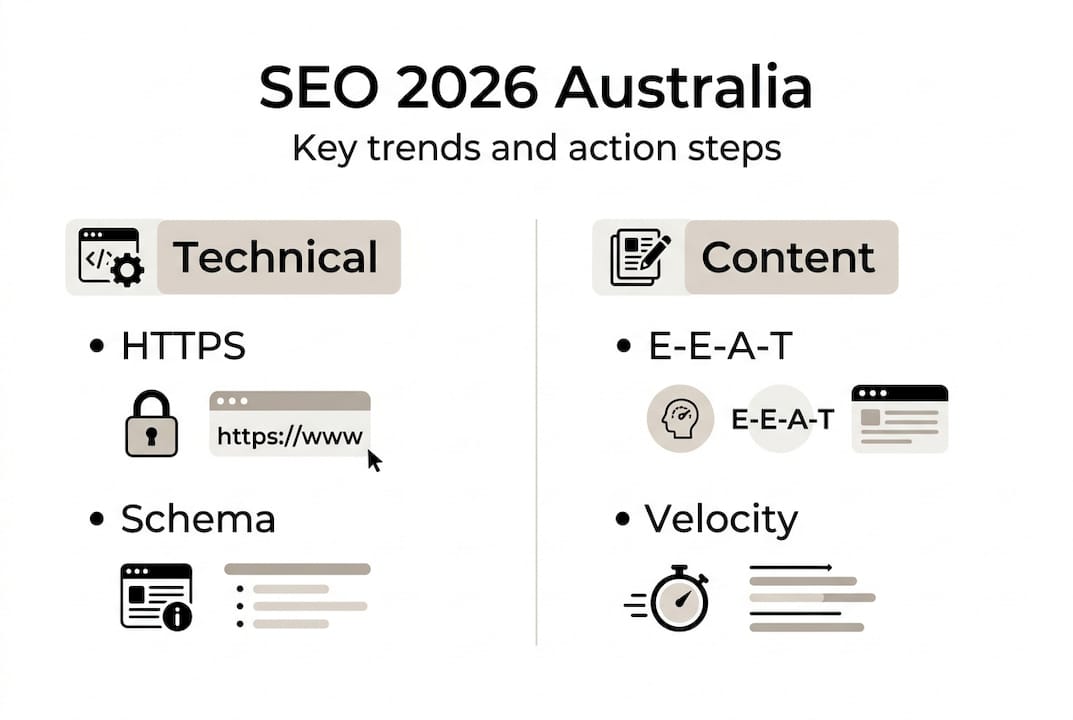
Schema markup (structured data added to your website’s code to help search engines understand your content) is now a significant factor in achieving rich results. FAQ schema, product schema, and review schema all contribute to stronger E-E-A-T signals and improved information gain scoring. Rich results, such as star ratings, FAQs, and product details appearing directly in search, increase click-through rates and build user trust before they even visit your site.
Here are the future-focused tactics worth prioritising now:
- Use AI tools for keyword research, content gap analysis, and on-page optimisation
- Monitor Google Trends weekly to identify rising topics in your industry before competitors do
- Implement relevant schema types including FAQ, LocalBusiness, Product, and Review
- Run post-core-update audits immediately after any major Google update to catch ranking shifts early
- Invest in content velocity by building a realistic publishing calendar tied to search demand
- Track E-E-A-T signals across your site and update author information, credentials, and source links regularly
For businesses focused on growth, understanding how SEO drives lead generation is essential context for prioritising these investments. Every tactic listed above feeds into a broader system designed to attract, engage, and convert the right visitors.
What most businesses miss: SEO is not ‘set and forget’
Here is the honest truth that most SEO articles skip over. Many Australian SMEs invest in an SEO setup once, see initial results, and then assume the work is done. It is not. SEO is a living system that requires ongoing attention, not a one-time project.
The businesses that consistently outperform their competitors are the ones running regular audits, tracking algorithm changes, and adjusting their strategies based on real data. They are not guessing. They are responding. When a core update rolls out and 55% of sites are affected, the businesses that recover fastest are those already watching their metrics closely.
Static, checklist-only approaches are a liability in 2026. The web is changing too quickly for a set-and-forget mindset to hold up. What worked 12 months ago may actively hurt your rankings today if it conflicts with current E-E-A-T or information gain expectations.
Working with an experienced Australian SEO agency means having a team that monitors these shifts for you, adapts your strategy in real time, and keeps your visibility growing even as the rules change.
Next steps for Australian SEO success
The SEO trends covered in this article are not theoretical. They are active, measurable, and affecting Australian businesses right now. Understanding them is the first step. Acting on them is what creates results.
At Design Box Digital, we help Australian SMEs translate these insights into real outcomes through our SEO services built specifically for the Australian market. Whether you want to rank #1 with SEO in your local area or build long-term organic growth, our team brings over 20 years of hands-on experience. Explore our proven SEO strategies and find out how we can help your business stay visible, competitive, and growing through 2026 and beyond.
Frequently asked questions
What are the top SEO technical standards for Australian businesses in 2026?
HTTPS, accurate title tags, robust robots.txt, and advanced schema markup like FAQ are critical for industry compliance. Technical SEO standards show HTTPS above 91%, title tags at 99%, and FAQ schema growing rapidly as a visibility driver.
How can SMEs adapt to the Google core update in 2026?
Audit for E-E-A-T and information gain, update content for authority and uniqueness, and monitor site volatility closely. The March 2026 core update affected 55% of tracked sites, making proactive audits essential for recovery and growth.
Is investing in local SEO worth it for Australian SMEs?
Yes, and the data backs it up strongly. National benchmarks show AUD 4.2 billion in annual revenue from local SEO, with 78% of queries coming from mobile devices, making local optimisation one of the highest-ROI activities available.
How does schema markup enhance visibility in 2026?
Schema adoption improves information gain scoring and enables rich results in search, helping sites achieve stronger E-E-A-T signals and higher click-through rates from search engine results pages.