


TL;DR:
- Australian SMEs can improve Google rankings through practical, foundational SEO efforts.
- Effective SEO combines technical health, user-focused content, and quality backlinks for sustained growth.
- Regular measurement and adaptation are vital to maintaining visibility in evolving AI search environments.
If your website is sitting on page two of Google while competitors scoop up the customers you should be winning, you’re not alone. Many Australian small and medium-sized businesses find search engine optimisation (SEO) frustrating, technical, and hard to know where to start. The good news is that improving your website’s visibility doesn’t require a computer science degree. With the right foundations, clear strategy, and consistent effort, you can attract more local customers, generate quality leads, and grow your sales online. This guide breaks SEO into practical, achievable steps tailored specifically for Australian SMEs ready to see real results.
Table of Contents
- Essential tools and prerequisites for website SEO
- On-page SEO: Creating user-first, AI-ready content
- Off-page SEO: Building authority with quality links and brand mentions
- Measuring SEO success and fine-tuning your strategy
- Why the fundamentals of SEO still matter in an AI-driven world
- Amplify your SEO results with expert support
- Frequently asked questions
Key Takeaways
| Point | Details |
|---|---|
| Set strong foundations | Technical basics like site speed, security, and mobile usability must be in place for good SEO. |
| Focus on quality content | User-first pages formatted for AI and clear brand mentions drive rankings and visibility. |
| Build authority off-page | Pursue quality backlinks, mentions, and PR to signal trust and expertise to search engines. |
| Track and adapt | Monitor SEO performance and update your approach for ongoing gains. |
Essential tools and prerequisites for website SEO
Now that you understand why SEO matters for visibility and sales, let’s start with the essentials you need in place before anything else.
Think of SEO tools as your diagnostic kit. Without them, you’re making decisions based on guesswork rather than data. The good news is that many of the most powerful tools are free or low cost, making them accessible for businesses of all sizes.
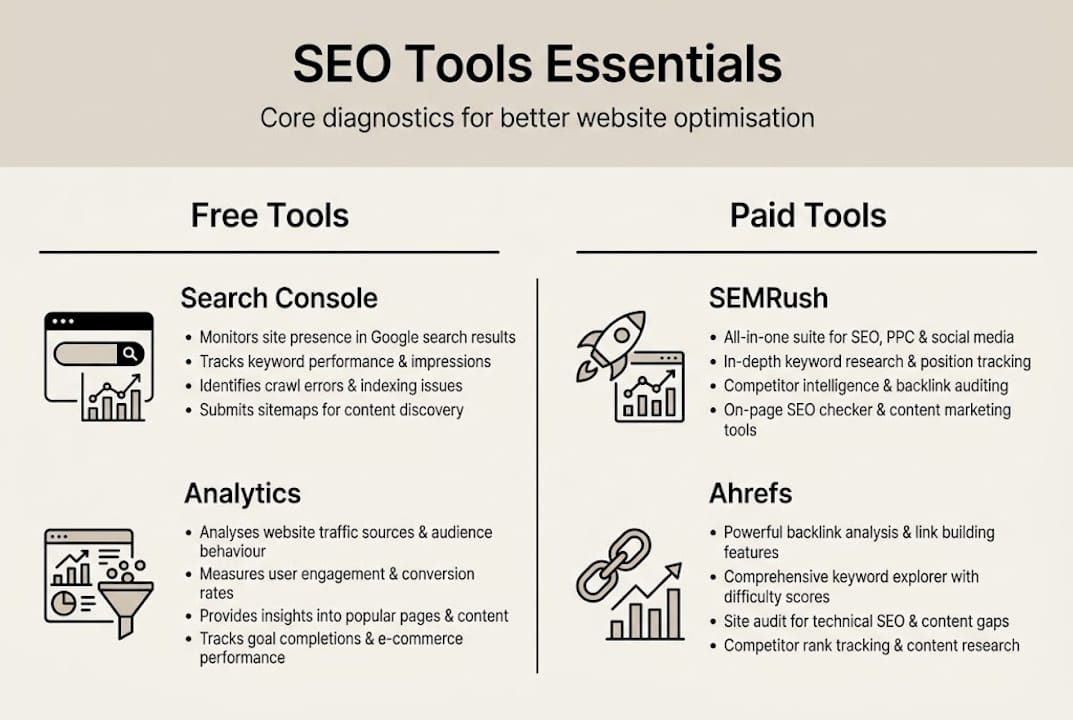
| Tool | Purpose | Cost |
|---|---|---|
| Google Search Console | Monitor search performance and fix errors | Free |
| Google Analytics 4 | Track website traffic and user behaviour | Free |
| Google PageSpeed Insights | Measure and improve load speed | Free |
| Ahrefs or Semrush | Keyword research and competitor analysis | Paid |
| Screaming Frog | Full site audit and technical health check | Free/Paid |
Before you start building content or chasing links, run a quick on-site audit. Check for these common issues first:
- Slow page load times: Pages that take more than three seconds to load lose visitors fast.
- Missing SSL certificate: An insecure site (HTTP instead of HTTPS) damages trust and rankings.
- Broken links and 404 errors: These frustrate users and waste your crawl budget.
- Non-mobile-friendly design: Google indexes mobile versions first, so a poor mobile experience hurts rankings directly.
- Missing or duplicate meta titles and descriptions: Every page needs a unique, descriptive title and summary.
Understanding technical SEO fundamentals is non-negotiable at this stage. As SEO fundamentals 2026 confirms, technical soundness is a core SEO principle that remains crucial despite emerging trends. A shaky technical foundation will undermine every other effort you make, no matter how good your content is.
Exploring proven SEO strategies alongside your audit will help you prioritise what to fix first and avoid wasting time on low-impact tasks.
Pro Tip: Start with Google Search Console and Google Analytics 4 before investing in paid tools. These two platforms alone will reveal your biggest opportunities and most urgent technical problems without spending a cent.
On-page SEO: Creating user-first, AI-ready content
With your tools and foundations ready, the next step is making your website content work hard for you and new AI-driven search experiences.

On-page SEO refers to everything you control directly on your website pages, from headings and copy to images and internal links. The goal is simple: create content that genuinely answers what your audience is searching for, structured in a way that both people and search engines can easily understand.
Here’s a step-by-step approach to get it right:
- Research your keywords: Use Google Search Console or a tool like Ahrefs to find terms your target customers actually type. Focus on specific, intent-driven phrases rather than broad single words.
- Optimise your headings: Use one H1 per page that includes your primary keyword. Break content into logical sections using H2 and H3 headings.
- Write for people first: Answer questions clearly and directly. Avoid keyword stuffing. Google’s algorithms are sophisticated enough to reward genuinely helpful content.
- Add internal links: Connect related pages on your site to help both users and search engines navigate your content.
- Optimise images: Compress file sizes and add descriptive alt text to every image.
Formatting also matters more than ever in 2026. AI Overviews and featured snippets pull content directly from well-structured pages. Short, direct answers placed near the top of a section, supported by clear headings, significantly increase your chances of appearing in these prime positions. As research into AI Overviews shows, brand mentions fuel new visibility beyond traditional search results.
Building topical authority is equally important. Consistently publishing content around your core subject area signals to Google that your site is a trusted source. Understanding the different SEO types for Australian businesses and keeping across SEO trends for 2026 will help you stay ahead as search continues to evolve.
| Content element | Best practice |
|---|---|
| Page title | Include primary keyword, under 60 characters |
| Meta description | Summarise page value, under 160 characters |
| H1 heading | One per page, keyword-rich |
| Body content | Minimum 600 words, user-focused |
| Images | Compressed, with descriptive alt text |
Pro Tip: Include your business name and core service terms naturally throughout your content. This strengthens brand entity signals, which Google increasingly uses to determine topical relevance and trustworthiness.
Off-page SEO: Building authority with quality links and brand mentions
Strong on-site efforts must be supported by building a trustworthy reputation across the web. That’s where off-page SEO comes in.
Off-page SEO covers everything that happens outside your website that influences how search engines perceive your authority. The most well-known element is backlinks, which are links from other websites pointing to yours. Think of each quality backlink as a vote of confidence in your content and credibility.
For Australian SMEs, practical off-page tactics include:
- Guest posting: Write articles for reputable industry websites or local business blogs that link back to your site.
- Partner mentions: Ask suppliers, industry associations, and complementary businesses to reference your website.
- Customer reviews: Encourage satisfied clients to leave Google Business Profile reviews. These build local authority and trust.
- Local directory listings: Ensure your business is listed accurately on directories like True Local, Yellow Pages, and industry-specific platforms.
- Digital PR: Pitch stories or data to Australian media outlets and bloggers to earn editorial mentions.
Not all links are equal. Here’s a quick comparison of safe versus risky link-building tactics:
| Safe tactics | Risky tactics |
|---|---|
| Earning links through quality content | Buying links from link farms |
| Guest posts on relevant, reputable sites | Mass directory submissions |
| Genuine PR and media mentions | Private blog network (PBN) links |
| Partner and supplier mentions | Comment spam with keyword-rich anchors |
As off-page SEO research confirms, backlinks and digital PR remain crucial even as AI changes search visibility. Spammy or low-quality links can actively harm your rankings, so quality always beats quantity. Understanding how brand citations and SEO work together will help you build a sustainable authority profile. Exploring digital PR strategies is a smart way to amplify your reach beyond traditional link building.
Pro Tip: Reach out to your local chamber of commerce, industry association, or council business directory. These local mentions carry strong geographic relevance signals that are particularly valuable for Australian businesses targeting local customers.
Measuring SEO success and fine-tuning your strategy
Once you’ve put your SEO strategy into action, staying on track depends on how you measure and adjust.
Without tracking, you can’t know what’s working or where to focus your energy next. The good news is that the tools you set up earlier, particularly Google Search Console and Google Analytics 4, give you most of what you need.
Here are the key metrics Australian SMEs should review every month:
- Organic traffic: How many visitors are arriving from search engines? Look for consistent growth over time.
- Keyword rankings: Are your target keywords moving up in search results? Track a core set of 10 to 20 priority terms.
- Click-through rate (CTR): The percentage of people who see your page in search results and actually click. A low CTR suggests your title or meta description needs improvement.
- Bounce rate: If visitors leave immediately without engaging, your content may not match their intent.
- Conversions and leads: Traffic means nothing without action. Track form submissions, calls, and purchases.
- Backlink growth: Monitor new links pointing to your site using a tool like Ahrefs or Google Search Console.
As SEO success factors research highlights, success is ultimately measured by core business outcomes including traffic, leads, and authority, not just rankings alone.
Regular review of your SEO data is what separates businesses that plateau from those that keep growing. Monthly check-ins let you catch problems early and double down on what’s already delivering results.
When you spot a page with high impressions but low clicks, update the title and meta description. When a page ranks well but converts poorly, review the content and calls to action. Learning how to drive growth with effective SEO is an ongoing process, and our SEO tips blog is a useful resource to keep your knowledge current as search evolves.
Why the fundamentals of SEO still matter in an AI-driven world
With the technical details covered, it’s worth stepping back to consider what really drives reliable SEO gains over the long term.
There’s a lot of noise right now about AI search, generative results, and new ranking signals. Many businesses chase every new feature or algorithm update, reshuffling their entire strategy every few months. In our experience, this is often counterproductive.
The businesses that consistently perform well in search are the ones that invest in the basics: a technically sound website, content that genuinely helps their audience, and a real reputation built through quality links and brand mentions. These elements don’t become irrelevant when AI enters the picture. They become more important, because AI systems are trained to surface trustworthy, well-structured, authoritative sources.
Short-term tactics like keyword stuffing, thin content, or buying cheap links might produce a brief spike, but they rarely hold. The risk of a Google penalty is real and the recovery process is painful. Investing in modern SEO strategies that blend proven fundamentals with smart adaptation to new formats is the approach we recommend for every Australian SME we work with. Build the foundation right, then layer on the new.
Amplify your SEO results with expert support
If you’re ready to put these strategies into practice but want expert support to fast-track your progress, here’s how we can help.
At Design Box Digital, we’ve spent over 20 years helping Australian businesses improve their search rankings, attract more customers, and grow their revenue online. We know that SEO can feel overwhelming, especially when you’re running a business at the same time.
Our team of specialists can audit your current website, identify your biggest opportunities, and build a tailored strategy that delivers measurable results. Whether you need end-to-end SEO services or a high-performing site from our website design experts, we’re here to make it straightforward. Get in touch today for a consultation and take the next step towards better visibility and more sales.
Frequently asked questions
What is the most important factor in optimising website SEO?
The most important factor is combining high-quality, user-focused content with a technically sound website. Core principles like these remain fundamental regardless of how search engines evolve.
How long does it take to see SEO results for an Australian SME website?
Most SMEs notice measurable improvements within three to six months with consistent effort. SEO outcomes require persistence and ongoing attention to technical health to sustain growth.
Is off-page SEO still important in 2026?
Yes, quality backlinks, PR, and brand mentions remain crucial even as search engines evolve with AI. Off-page SEO is essential for both traditional rankings and AI-driven search visibility.
How do I prepare my content for AI Overviews or Google’s new search features?
Structure your pages with clear headings, concise direct answers, and consistent brand mentions. Structuring content for AEO significantly improves your chances of appearing in AI-generated search results.