


AI in SEO in 2026 is not a new keyword list. The posts ranking for this topic keep saying the same thing, in different jackets: search still sends people, but a growing share of the answer now happens above the blue links. Google AI Overviews, ChatGPT, Gemini and Perplexity synthesise an answer and sometimes cite a source. If you are not the source, you are the also-ran under the box.
Traditional SEO is not dead. It is the entry ticket. Thin pages, blocked crawlers and a site that fails Core Web Vitals still lose. What changed is the job on top: make claims a machine can lift, prove them, mark them up, and measure citations as well as rank. We do that from Queens Road, Melbourne. We do not sell a #1 ranking in ChatGPT, because that product does not exist.
TL;DR
- Ranking AI-in-SEO articles in 2026 cluster on citations, AI Overviews, GEO/AEO, extractable content, schema, and measurement beyond position.
- Public reports (including Ahrefs) have linked AI Overviews to a sharp drop in click-through on the top organic result — often cited around 34.5% for position one when an Overview is present. Informational queries get hit hardest. Treat that as a published industry figure, not a Design Box study.
- SEO still feeds Google’s AI surfaces. A page Google cannot rank or render is a weak candidate to cite. ChatGPT and Perplexity pull from a wider mix, so Google rank is necessary, not sufficient.
- Do the unglamorous work: answer-first H2s, FAQ and Article schema, author and organisation markup, original proof, reviews, and crawler access.
- Measure: Search Console impressions up / clicks flat (Overview fingerprint), referrals from chatgpt.com and perplexity.ai, and a frozen prompt set you re-ask monthly.
- Our SEO retainers typically sit at $1,500–$5,000+ per month. No #1 guarantee. If the site is not ready, that is a rebuild conversation first.
What the ranking AI-in-SEO posts are actually about
We looked at what is competing for “AI in SEO”, “how AI is changing SEO 2026”, “AI Overviews SEO”, and the Australian GEO/AEO variants. The themes repeat. That is useful. It is also why another 800-word “AI will change everything” post is wasted.
Theme 1 — Citations, not just positions. Adobe, Trakkr, Cite, CrawlRaven and others frame 2026 visibility as “are we named inside the generated answer?” Rank still matters on Google’s AI surfaces. Ahrefs-style analyses widely quoted in 2026 say only a minority of AI Overview citations now come from the classic top 10 (figures in the high-30s percent have been circulating, down from a much higher share a year earlier). Do not treat a blog round-up as a lab. Do treat the direction: corroborated, extractable sources get cited even when they are not sitting on pixel one.
Theme 2 — Zero-click and CTR. Evergreen, Stackmatix, Similarweb and Australian agencies all lead with traffic risk. The Ahrefs ~34.5% CTR drop on position one when an AI Overview shows is the number everyone copies. Similarweb’s zero-click work on news queries (mid-50s percent climbing toward ~70% in their published windows) is used to argue the pool of clicks is shrinking. Cited brands, in some of those same write-ups, are said to earn more clicks than the uncited ranker underneath. The honest Melbourne read: informational pages that only existed to rank for a question will leak traffic. Service pages with a reason to click (quote, suburb, price, booking) still have a job.
Theme 3 — GEO, AEO, LLM SEO — three labels, one extra job. Ranking pages spend a lot of ink on acronyms.
| Label | What they mean in practice | Surface |
|---|---|---|
| SEO | Crawl, render, rank, earn the link | Google organic, Maps |
| AEO | Win the extractable answer | Featured snippets, People Also Ask, many AI Overviews |
| GEO / LLM SEO | Be a source the model will name | ChatGPT, Perplexity, Gemini, Copilot, Overviews |
We will use the words because buyers search them. We will not invent a silver/gold/platinum GEO menu. The work is still technical SEO, content with proof, and entity trust. E-E-A-T for Melbourne businesses is the same discipline with a louder microphone.
Theme 4 — Extractability. Silktide, Uygen, Stackmatix: keyword-aligned H2, a short claim in the first 40–100 words of the section, no promotional sludge in the sentence you hope gets lifted. CrawlRaven’s version is “answer capsules” under each H2. That is just good editing. It also happens to be what a synthesiser can quote.
Theme 5 — Schema and entities. FAQPage, Article, Organisation, Person, LocalBusiness, speakable-style Q&A. Schema does not buy an Overview. It tells the machine what the page is. Combined with consistent NAP, a real author, and the same business name on the site, GBP and LinkedIn, you look like one entity instead of five aliases.
Theme 6 — Measurement has split. Rank trackers still matter. They do not describe an Overview. Ranking posts push citation share, mention sentiment, a frozen prompt set, and a GA4 channel for AI referrals. Google Search Console’s generative-AI controls and the impressions-without-clicks pattern are the free starting point.
Theme 7 — SEO is the foundation, not the obituary. Similarweb’s GEO guide is blunt: Google’s AI Mode and Overviews draw from Google’s index. No index, no citation there. ChatGPT/Perplexity are sloppier about “must be top 10”, which is why off-site corroboration (reviews, Reddit, industry pages) keeps appearing in the same SERPs. We already argued SEO is not dead. This post is the operating manual.
What actually changed in the SERP
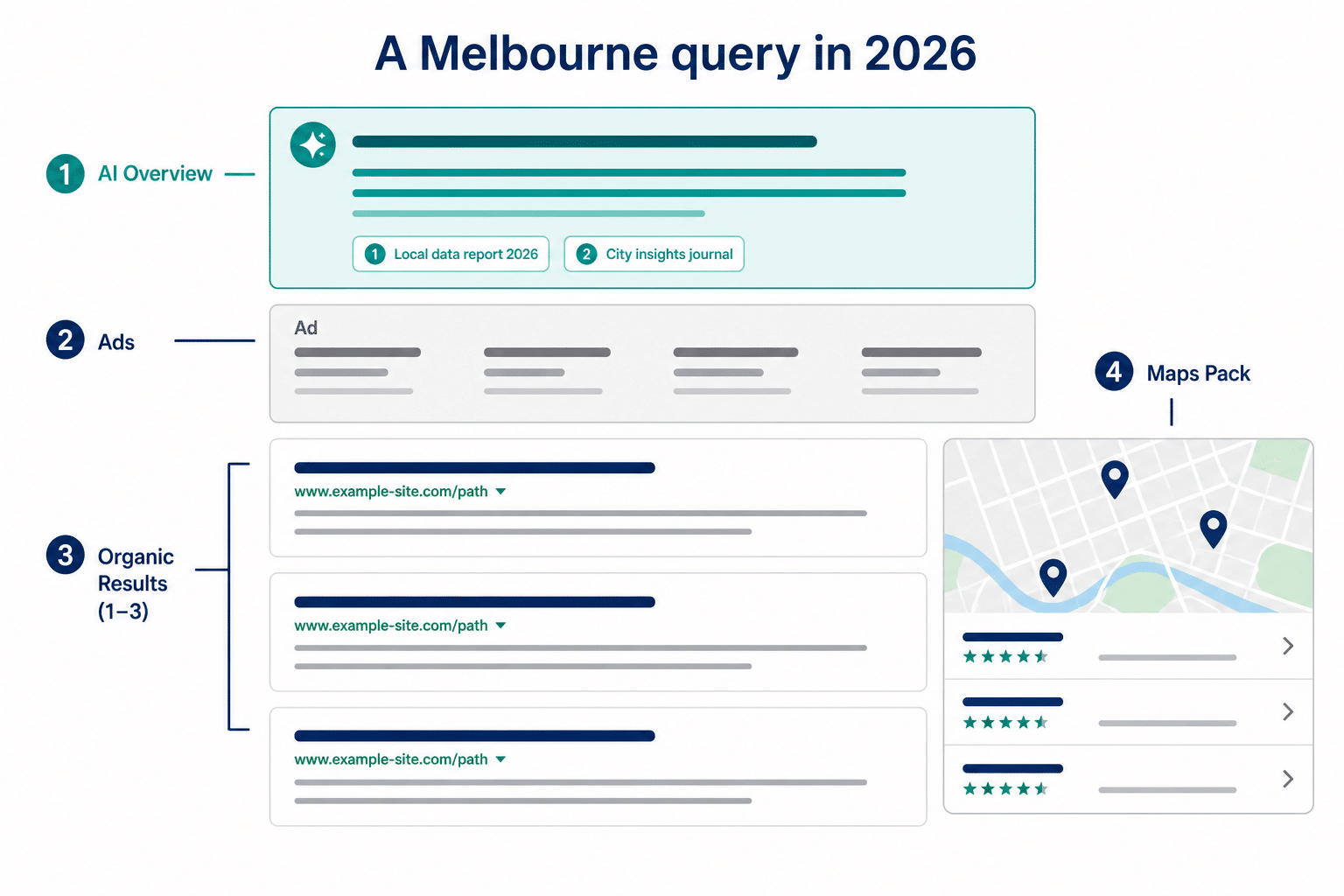
For a Melbourne query like “best accountant in Richmond” or “how much does a website cost”, you now often get:
- An AI Overview (or AI Mode follow-up) that answers the question and may cite two to four sources.
- Ads.
- The classic results, Maps, and People Also Ask.
The Overview does not care about your H1 poetry. It cares whether a passage is a clean claim, whether other trusted pages say something similar, and whether Google already trusts the domain. Local queries still have a Maps layer; AI has not deleted the pack. If your Google Business Profile is a mess, fix that before you buy a “GEO retainer”.
Standalone assistants are a second funnel. A buyer asks ChatGPT for “a Melbourne SEO agency that does technical work in-house”. The model names who it has seen corroborated. That is not a paid placement. It is a reputation problem with a content shape.
SEO vs AEO vs GEO — without the brochure
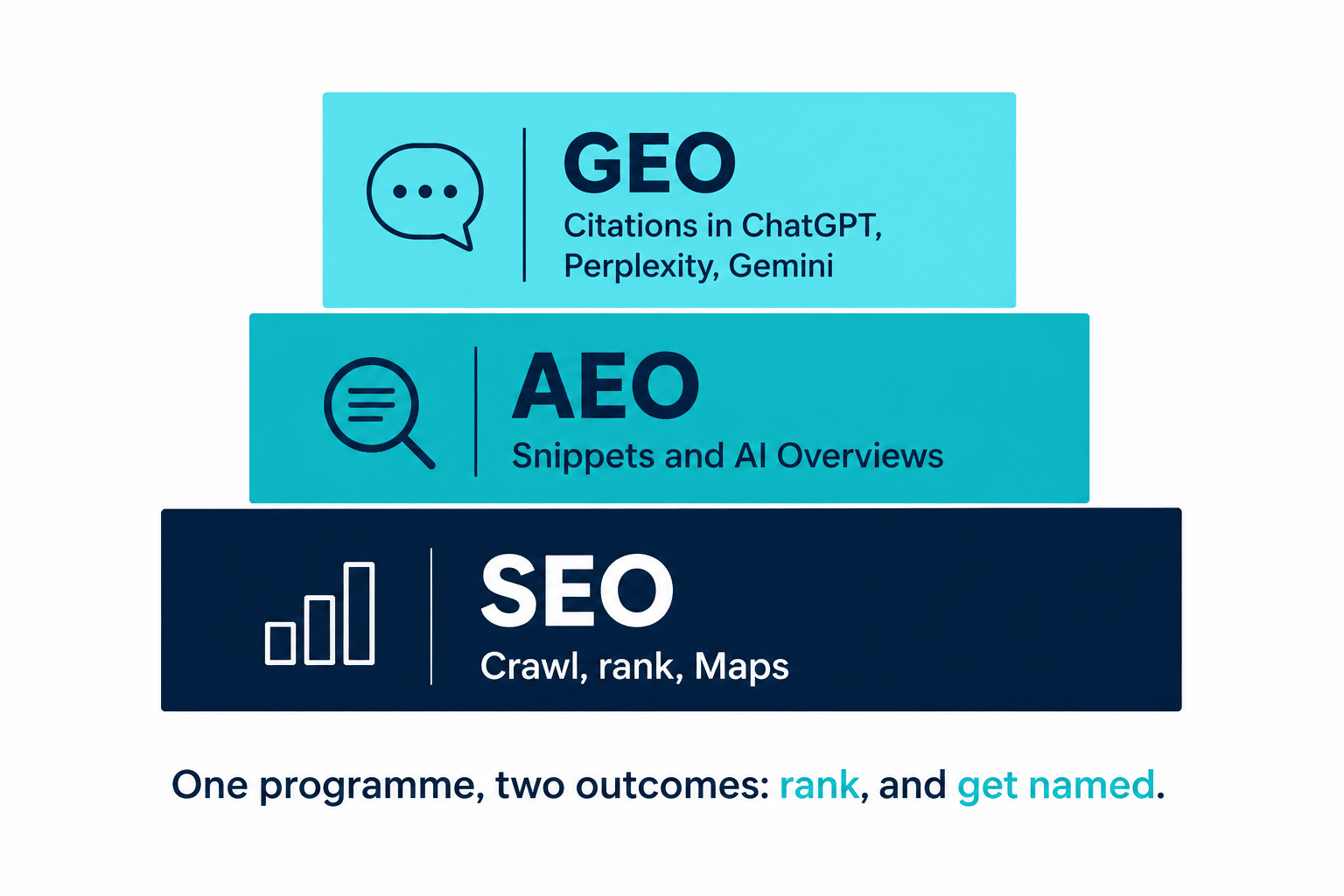
Do not run three agencies for three acronyms. One programme. Two outcomes: rank, and get named.
SEO you already know. Indexation, canonicals, INP and LCP, internal links, how long it actually takes (initial movement 3–6 months; substantial results in competitive Melbourne markets 6–12 months). AI did not shorten that clock.
AEO is formatting for the answer box. Question-shaped H2s. The answer in the first sentence. FAQ blocks that match real questions. Tables. FAQPage schema only where the Q&A is on the page.
GEO is making the brand citable. Original numbers, methods, named authors, third-party mentions, reviews, and pages other people already repeat. Princeton-style GEO papers (widely cited in these ranking posts) found original statistics and citations on the page help visibility in generative answers; keyword stuffing hurts. That matches what we already refuse to do.
If a pitch separates GEO into a product with a magic prompt pack and no technical work, it is a slide deck.
What to change on the page
This is the part ranking posts under-specify. Here is the page-level bar we use.
Lead with the answer. The first 80–120 words should state the claim a buyer (or a model) came for. Not a history of search.
One claim per H2. Heading matches the query. First paragraph under it is a 40–90 word capsule a model can lift without the rest of the essay. Then you can write like a human.
Proof in the same block. Named client result, dated method, or a labelled public figure with the publisher. “Studies show” with no source is how you get ignored. NC Fitness Gear is our published example: bounce from over 50% to under 3% after technical SEO and Ads work — that is a site-speed and quality story, not an Overview hack.
Schema that matches the HTML.
Article(orTechArticle) with author, datePublished, dateModified, publisher.FAQPageonly for visible FAQs.Organisation/LocalBusinesson the site, not stuffed into every blog.Personon the author. Tristan Brunsdon writes this; the byline is not a ghost.
Make it crawlable. Server-render the important copy. Do not hide the answer behind a tab a bot never opens. Check robots.txt is not blocking GPTBot, PerplexityBot, ClaudeBot, Google-Extended if you want those systems to use the page — that is a policy choice, not a default religion. Google Search still needs Googlebot. If you noindex the page, you will not be in Overviews that draw from Search.
Local entity hygiene. Same business name, Docklands address, 1300 322 971, across site, GBP and schema. Suburb pages that are unique, not spun. AI local answers lean on the Knowledge Graph and reviews as much as on your blog.
Kill thin informational filler. If the page exists only because a keyword tool said so, and a model can answer it from Wikipedia, you will donate the click. Write the page you would still publish if Overviews vanished: the quote, the process, the constraint, the Melbourne specificity.
How to measure it (without buying a vanity dashboard)
- Search Console. Queries where impressions rise and clicks stall are Overview suspects. Check the page, then the live SERP. Google has been adding generative-AI site controls in Search Console for eligible sites — use them; do not assume a plugin is doing it.
- Live SERP log. Once a month, the same 15 buyer questions. Screenshot: Overview yes/no, are you cited, who is. Spreadsheet beats a SaaS logo in month one.
- Frozen prompts in ChatGPT, Gemini, Perplexity. Same wording, logged in. You are looking for presence, accuracy, and whether they send people to a competitor.
- GA4. Referrals from chatgpt.com, perplexity.ai, gemini.google.com. Small numbers. Sometimes better intent. Do not forecast them like organic.
- Rank still. If you fall out of the top 10 on Google, many Overview programs get harder. SEO cost in Melbourne did not go to zero because a model learned to summarise.
Anyone selling “we will get you in ChatGPT this month” is selling a screenshot.
What Melbourne businesses should do this quarter
A sequence. Not a rebrand.
- Pick 10–15 real questions customers ask before they call. Use their words. “Do you do Shopify in Melbourne”, “how long until we rank”, “do you host WordPress”.
- Ask each engine those questions. Record who gets named. That is the gap analysis. No tool required on day one.
- Fix the money pages first — services, pricing, location — not a new blog silo. Answer-first, schema, author, internal links to proof.
- Technical pass. Indexation, canonicals, INP, FAQ/Article JSON-LD that matches the DOM. If the theme is soup, stop. Rebuild floors: landing from $1,100, business WordPress from $3,300, ecommerce from $7,000.
- Authority you can verify. Reviews you actually earned. Pages other people already cite. Staff bios that are not lorem. We refuse Wix and Squarespace; if you are still there, GEO will not save you.
- Keep the useful URLs fresh. Visible dates. Update the claim when the number changes. Models like current sources; so does Google.
That is the same programme as serious technical SEO. The acronyms are new. The excuses are not.
What not to buy
- A GEO-only retainer with no crawl, no GSC, no content ownership.
- Guaranteed inclusion in AI Overviews or ChatGPT.
- Mass AI-written blogs. Ranking posts agree this is how you teach the model you are interchangeable. We would rather publish fewer pages with a method.
- “We added FAQ schema” as the entire deliverable. Schema without the FAQ on the page is a lie in JSON.
Our published SEO retainers typically $1,500–$5,000+ per month. The audit, when you are buying the work, is normally $3,300 inc GST. GST is 10%; the quote says exclusive or inclusive. How to choose an agency still applies: in-house, no #1 theatre, they will tell you if the site is not ready.
FAQ
Does AI replace SEO in 2026?
No. It adds a citation job on top of ranking. Google’s AI surfaces still lean on the index. Assistants add another retrieval path. Dropping technical SEO to “do GEO” is how you fall out of both.
What is GEO in SEO?
Generative engine optimisation: making your brand and pages easy for AI systems to retrieve, trust and name. It is not a ranking factor Google publishes. It is a way of talking about extractable, corroborated content.
What is AEO?
Answer engine optimisation: structuring pages so a direct answer can be lifted — snippets, Overviews, voice. Question headings, first-sentence answers, FAQ schema that matches the page.
Do I need different content for ChatGPT vs Google?
Build one authoritative page. Then make it legible: crawlable HTML, schema, proof, consistent entity. Tune examples and FAQs for the questions each surface actually asks. Do not clone the site per model.
Will AI Overviews kill my traffic?
They can cut clicks on informational queries. Public CTR studies on position one are ugly when an Overview is present. Pages that deserve a click (quote, tool, local proof) still earn one. Cited sources in some reports do better than silent rankers. Measure your own GSC before you panic.
What schema should we add?
Article + author, FAQPage for real FAQs, Organisation/LocalBusiness at site level. Valid JSON-LD that matches visible content. Schema is a label, not a ranking cheat.
How long until we see AI citations?
Same honesty as rankings: months, not a sprint. Entity and authority compound. Structure and freshness move faster. Timelines we already publish still hold for the SEO layer.
Talk to Docklands, not a prompt pack
If you want a Melbourne team to treat AI search as an extra retrieval layer — not a rebrand of last year’s blog — call 03 9067 5679 or 1300 322 971. Ask for a technical SEO look plus an AI-visibility pass on the ten questions you actually lose sleep over. We will tell you whether the site can be cited, whether the theme is the blocker, and whether you should stop publishing filler.
Design Box Digital, Level 10, 611 Flinders Street, Docklands. In-house. No #1 guarantee. We will still answer the phone when the Overview changes next quarter.