


Featured image: Photo on Unsplash.
How Long Does SEO Take in Melbourne? Real Timelines for 2026
How long does SEO take in Melbourne in 2026? Initial movement in rankings and organic traffic typically shows in 3–6 months. Substantial results in competitive Melbourne markets take 6–12 months of consistent work. That is the timeline we publish on our SEO services page. It is not a slogan, and it is not “page one in 90 days.”
The same clock holds for most of Australia. Suburb and long-tail work can move inside that first window. National commercial terms, new domains, and ecommerce catalogues sit toward the long end. Nobody honest guarantees #1.
Generic “SEO takes three months” posts flatten every Melbourne business into one number. Three months is a useful start of movement for some sites. It is not when a CBD law firm displaces incumbents, and it is not when a thousand-SKU store owns category terms. Rankings are a leading indicator. The product is enquiries, bookings and sales.
I am Tristan Brunsdon. We have been doing this from Melbourne for over twenty years. We would rather lose a pitch than sell a 30-day clock.
TL;DR
- Our published timeline only: 3–6 months for initial movement; 6–12 months for substantial results in competitive Melbourne markets (real estate, law, trades at metro scale, crowded inner-city categories).
- Month-by-month is a work plan — audit, technical, pages, local, then compounding — not a fake rank graph.
- A Thornbury air-conditioning company and a CBD lawyer are not on the same clock. New domains take longer. Ecommerce catalogues sit toward the long end.
- Google Ads can carry leads while organic is built. SEO is slower and keeps working when the ads pause.
- “Page one in 30 days” is a red flag. We do not guarantee #1. Work is in-house from Docklands, never offshore. Retainers typically $1,500–$5,000+ a month.
- Proof without invented month-counts: NC Fitness Gear and Kollab. Free SEO audit (normally $3,300 inc GST).
Month by month: what should happen (not a rank graph)
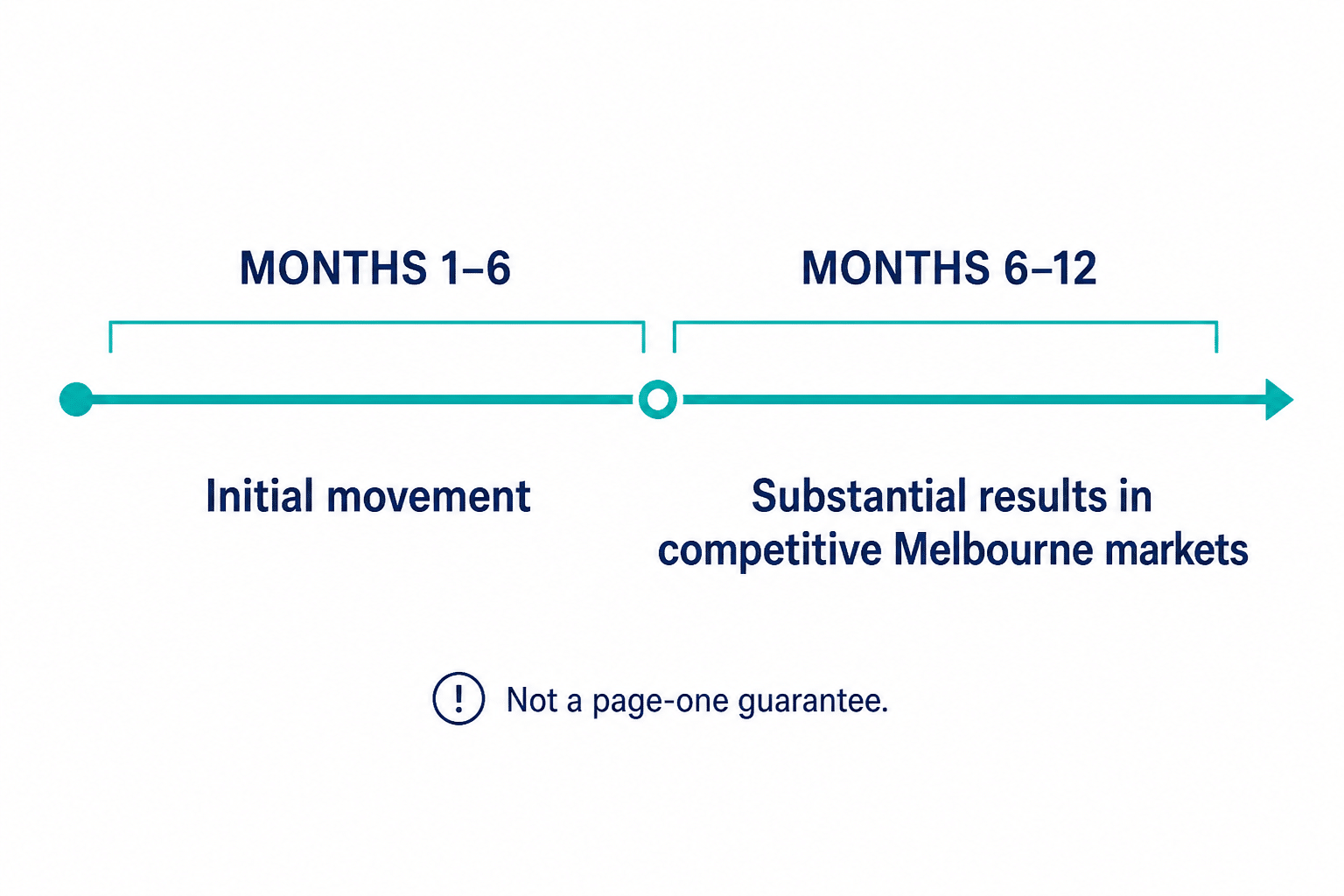
If an agency walks in with a chart that already knows your position in week six, they are selling. Dates below assume the site can be crawled, you approve work at a normal pace, and the retainer is a real campaign — typically $1,500–$5,000+ per month. Pricing is in How much does SEO cost in Melbourne in 2026?.
| Window | What should happen | What should not |
|---|---|---|
| Month 1 | Access, baseline, technical diagnosis, keyword and page map | Ranking screenshots, “we’re already moving” |
| Month 2 | Fixes live; on-page on pages you already have; GBP and NAP in shape | A lead flood |
| Month 3 | Real service, suburb or category pages shipped and indexed | Declaring the campaign a success |
| Months 3–6 | Initial movement: impressions up, long-tail and suburb terms shifting, some Map Pack progress if local | #1 for “lawyer Melbourne” |
| Months 6–12 | Substantial results in competitive markets: commercial terms in contention, organic becoming a real lead source | Stopping because “SEO is done” |
Month 1 — Diagnose, don’t decorate. Access sorted: Analytics, Search Console, the CMS, Google Business Profile. A technical pass that names crawl, indexation, duplicates, speed and Interaction to Next Paint (INP) — not a 40-page PDF of green ticks. A keyword and page map against your competitors, and a baseline on commercial terms, not your brand name. A graph in week three is almost always brand or a phrase nobody searches.
Month 2 — Make the site fit to rank. Technical fixes go live. On-page work lands on the service or category URLs that can convert. For local businesses, Google Business Profile is a channel — categories, services, photos, NAP consistent with the site and Australian directories — not a listing claimed in 2019 and left. If the site is slow, unindexable, or has nowhere for new pages to live, this month is repair. Sometimes that is a rebuild. We will say so — we also build the WordPress and Shopify sites.
Month 3 — Pages Google can cite. Service pages with real expertise, suburb pages that are not the same three paragraphs with the place name swapped, category pages that describe what you sell. They get indexed. Search Console may show impressions on long-tail queries — a signal, not a victory lap. Thin AI copy and spun suburb templates do not count, and they do not get cited in AI Overviews.
Months 3–6 — Initial movement. This is the window we publish. Impressions climb. Some suburb and long-tail terms move into the top 20 or onto page two. A local business with a healthy profile can see Map Pack movement for the suburbs they actually cover. You might pick up a handful of extra enquiries on easier queries. You should not own “lawyer Melbourne” because the calendar hit month four. Reporting should show work done, technical health, the agreed keyword set, and enquiries — not a vanity screenshot of branded traffic.
Months 6–12 — Substantial results in competitive markets. This is the other number we publish, and the one generic posts skip. In crowded Melbourne categories — law, real estate, metro-scale trades, inner-city retail, healthcare — commercial terms start sitting in contention and organic becomes a lead source you can plan around. Pages from the first quarter compound. Ecommerce catalogues, national product terms, and new domains still sit toward the long end. Twelve months is not a finish line. It is when a serious campaign should have traffic that is not brand, leads you can cost, and a pipeline that does not vanish if ads pause. After that you defend and expand.
What slows you down
Most delayed campaigns are not “Google being slow.” They are the site, the SERP, the copy, or the link history — wearing a timeline as a disguise.
The site. Crawl traps, parameter chaos, four versions of every URL, blocked resources, a JavaScript render that never finishes, menus and add-to-cart that stutter on mobile. That is technical SEO, including INP. A clean WordPress or Shopify build moves. A plugin-heavy theme that fails INP spends the first quarter in hospital. Until the foundation is fixed, new blogs are decoration.
The competition. Ranking air conditioning in Thornbury is a fight you can win on a modest retainer. Ranking a lawyer in the CBD is a different sport — more incumbents, more content, more authority already in the SERP. “Air conditioning Melbourne” is a brawl; “air conditioning Thornbury” is local intent you can capture. We would rather win the suburbs you actually cover than spray “Melbourne” on every title tag and lose. That is local SEO, not a consolation prize. If the proposal does not name who occupies page one today, it does not have a clock. It has a hope.
The content. Spun suburb pages, keyword-stuffed homepages, and AI sludge that could belong to any business in Australia. Google already has “good enough” results. Two proper pages a month beat a content mill. In 2026 a chunk of informational queries get an AI summary before the blue links. Being the source that gets cited takes first-hand copy — slower than a blog calendar, more durable.
Junk links. A prior agency’s “20 links a month” quota is often cleanup: directories, guest-post mills, PBNs. Relevant Australian mentions take longer to earn. Fixed link numbers are a red flag when you choose an SEO agency. A new domain takes longer because Google has less history to trust — there is no official “sandbox” you can pay to skip. An old domain with junk links can be slower still.
Two more clocks people underestimate. Ecommerce catalogues sit toward the long end: hundreds of SKUs need architecture, product SEO, Merchant Centre and crawl budget. Budget and stop-start: under about $800 a month in a competitive vertical is usually a listing tidy-up. Pausing every quarter resets compounding. If title tags sit in a client inbox for six weeks, the calendar is not the agency’s.
Proof without invented clocks
We will stand behind named outcomes. We will not retrofit a month-count onto them to win a comparison table.
NC Fitness Gear. We fixed technical SEO issues and tightened Google Ads. Bounce rate went from over 50% to under 3%. They now rank in top positions in Australia for gym equipment phrases.
Kollab. From one ranking page to 450+ first-page results, with organic traffic growing over 100% yearly. They rank alongside the biggest competitors in Australia on major product lines.
Those are ecommerce results on competitive terms — not a promise your site will match them, and not “page one in 90 days.” Results depend on the site, the market, and the time you give the work.
SEO vs Ads while you wait
Different jobs. Treat them that way.
Google Ads can put you on page one tomorrow. You pay for every click. It stops when the budget does. Useful while organic is being built — especially if the site is in repair, the domain is new, or the category is a CBD brawl.
SEO is slower. Initial movement in 3–6 months; substantial results in competitive Melbourne markets in 6–12 months. Organic clicks do not have a CPC, and the pages keep working overnight. Most Melbourne businesses that care about pipeline run both. We run both in-house from Docklands, so they should not bid against each other. Leads this week is ads alongside SEO — not a reason to skip organic, and not a reason to believe a 30-day pitch.
Red flags: page one in 30 days and friends
Page one in 30 days. Crawl, index, compete, displace incumbents, and convert — in a month. On a commercial Melbourne term that is not how the system works. Ranking for your own brand, a quiet suburb long-tail, or an unclaimed Map Pack listing is a fine fast win. It is not a campaign.
Guaranteed #1. Google does not sell positions to agencies. We do not guarantee a #1 spot, and neither should anyone else. A #1 for a phrase with no search volume is a screenshot.
Rank graphs with no work log. If month two is a traffic chart and no list of URLs shipped, technical fixes, or GBP changes, you are watching a tool, not a team.
Offshore hours with a Melbourne logo. Cheap delivery gets resold as a local retainer. Australian English, NAP and suburb intent do not survive that model. Ask who will edit the templates.
A 12-month lock-in with silence. SEO takes time. That is not a reason to sign a year of no visibility. You should see what was done, what moved, and what is next — every month. If two of those show up in the pitch, walk. More on that in How to choose an SEO agency in Melbourne.
How we approach the clock at Design Box
We are Design Box Digital Pty Ltd, Level 10, 611 Flinders Street, Docklands. I am Tristan Brunsdon, CEO and technical lead. The SEO, the sites and the ads are done here — in-house, never offshore. You can meet the people who log into WordPress. Custom, not packages: a clinic in Brighton is not a national gym-equipment catalogue. We quote the work the SERP needs, usually inside $1,500–$5,000+ per month.
No #1 guarantee. We will tell you if the site is not ready, if the budget will not touch the market, or if paid search should carry the next quarter. The only timeline we will put in a proposal is the one we publish: initial movement in 3–6 months; substantial results in competitive Melbourne markets in 6–12 months. New domains take longer. Ecommerce catalogues sit toward the long end.
If you want a diagnosis before a retainer, use the free SEO audit (normally $3,300 inc GST). The automated pass is a start; a proper conversation still needs Analytics and Search Console.
FAQ
How long does SEO take in Melbourne?
3–6 months for initial movement in rankings and traffic; 6–12 months for substantial results in competitive Melbourne markets. That is our published timeline. Faster claims usually mean brand search, a quiet suburb query, or a screenshot.
How long does SEO take in Australia?
The same range. Local and long-tail work can move in the first window. National commercial terms, new domains and ecommerce catalogues take longer.
Will I be on page one in 90 days?
Not as a promise, and not on a competitive head term. Some low-competition suburb queries can move earlier if the site is healthy and the listing work is done. That is not the same as “SEO worked.” We do not sell a 90-day page-one clock.
Why do new domains and ecommerce catalogues take longer?
A new domain has less history to trust. There is no paid skip. An old domain with junk links is slow for a different reason: cleanup first. Ecommerce adds URLs, faceted navigation, crawl budget, product copy and Merchant Centre. Plan toward the long end of 6–12 months for category terms.
How do I know the campaign is on track before month six?
Work shipped (pages, technical fixes, GBP). Indexation and INP moving the right way. Search Console impressions on the terms in scope — not only brand. A few long-tail or suburb rankings shifting. Enquiries tracked. Silence is not “SEO takes time.”
Can you guarantee we’ll be #1?
No. Anyone who does is a red flag. We guarantee the way we work: in-house, ethical, reported, aimed at traffic, leads and sales rather than a rank-tracker screenshot.
What does a Melbourne SEO retainer cost?
Reputable campaigns typically sit at $1,500–$5,000+ per month. Under ~$800 in a competitive vertical is usually wasted. Details are in the 2026 pricing guide.
Get a timeline that belongs to your site
If you want a clock for your domain, competitors and suburbs — not a generic “three months” — talk to us.
Design Box Digital Pty Ltd
Level 10, 611 Flinders Street, Docklands
Tristan Brunsdon, CEO
03 9067 5679 / 1300 322 971
Free SEO audit (normally $3,300 inc GST) · SEO services · About the team
In-house. No #1 theatre. If the site is not ready, we will say so.