


Featured image: Photo on Unsplash.
How to Choose an SEO Agency in Melbourne (Without Getting Burned)
Choosing an SEO agency in Melbourne is less about who talks loudest on the sales call and more about who is still in the room in month six. Ask whether the work is done in-house in Australia, whether they refuse a #1 ranking guarantee, whether they can tell you if the website is not ready, and whether the proposal names work — not packages.
Reputable Melbourne retainers typically sit at $1,500–$5,000+ a month. Honest timelines are 3–6 months for initial movement and 6–12 months for substantial results in competitive markets. Page one in 30 days is theatre.
This is a buyer checklist, not a pep talk. If you already know you need help and want to know who to hire — and who to walk away from — start here.
TL;DR
- Ignore guaranteed #1 rankings, offshore $10–$50/hour farms with a Melbourne logo, backlink quotas, 12-month lock-ins with silence, and cookie-cutter “silver/gold/platinum” packages.
- On the sales call, ask who does the work, what months 1–3 contain, how they report, and whether they will tell you to fix the site first.
- A usable proposal names pages, technical work, content, local SEO, and how success is measured. A PDF of logos is not a plan.
- In-house Australian teams own the templates, schema and copy. Offshore resellers own a margin.
- If the site is slow, unindexable or cannot convert, SEO spend is wasted. We build sites and run Google Ads, so we can say so.
- Design Box Digital: 20+ years, in-house from Docklands, no #1 guarantee, technical SEO including INP. Free SEO audit (normally $3,300 inc GST).
Red flags that should end the meeting
Melbourne is full of agencies and directories who will take a retainer. Most of the damage is done in the first conversation.
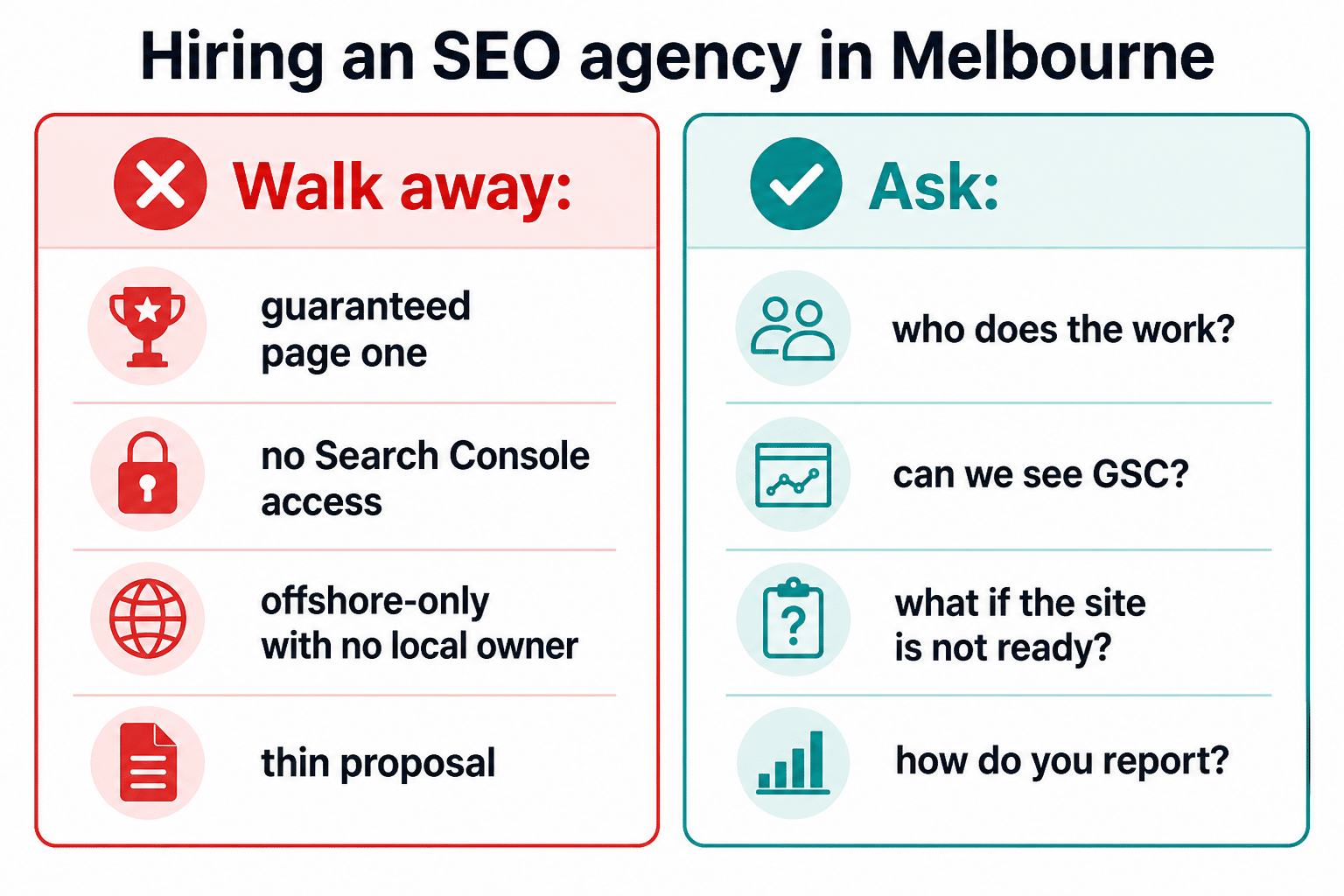
Guaranteed #1 rankings. Nobody controls Google. We do not guarantee a #1 spot, and neither should anyone else. Algorithms change, competitors spend, and a #1 for a phrase nobody searches is worthless. A guarantee is naïve or a sales script. Walk.
Offshore work sold at $10–$50 an hour with a Melbourne phone number. Cheap hours get marked up as a local package. You get spun suburb pages, broken NAP (name, address, phone), and copy that does not sound like a business in Richmond or Footscray. Australian English, local citations and suburb-level intent do not survive that model. Ask where the people who will edit your site sit. If the answer is vague, you already have it.
Backlink quotas. “20 links a month” is a production target, not a strategy. A handful of relevant Australian mentions beats a spreadsheet of junk. Fixed monthly link numbers usually mean guest-post mills, PBNs or directories Google has already discounted. Ask which sites and why those sites, not how many.
A 12-month contract with silence. SEO takes time. That is not a reason to sign a year of no visibility. You should see what was done, what moved, and what is next — every month. A long lock-in with no reporting calendar is the agency protecting itself from poor performance.
Cookie-cutter packages. Five keywords, two blogs, three backlinks. A plumbing firm covering the inner west and a national ecommerce catalogue do not need the same scope. Templated packages fit the agency’s product sheet. They rarely fit your competitors. We quote custom work inside our published band, not silver/gold/platinum.
If two or more of those show up in the pitch, walk.
Questions to ask on the sales call
Write the answers down. Compare agencies on the same list.
1. Who actually does the work, and where?
Not the account manager — the people who will change templates, write copy and fix crawl issues. Employees in Australia, contractors, or an offshore desk? Can you speak to them before you sign?
2. Will you guarantee rankings?
The only acceptable answer is no. What they can commit to is method: ethical work, reporting, and a plan aimed at traffic, enquiries and sales.
3. What happens in months 1, 2 and 3?
A real agency can describe the first quarter without a brochure: technical diagnosis and fixes, keyword and page strategy, Google Business Profile and on-page work on pages that can actually rank; then content; then authority work. If they cannot name the sequence, they do not have one yet.
4. What will you refuse to do?
Good shops will not stuff keywords, buy junk links, or run SEO on a site that cannot convert. If they will take any brief at any budget, they are selling hours.
5. If the website is the bottleneck, will you say so?
SEO-only shops dodge this, because the honest answer kills the retainer. We sell web design and SEO, so we can tell you to rebuild or repair first. Landing pages from $1,100, business sites from $3,300, ecommerce from $7,000 — those floors exist because a $3,000/month campaign on a theme that fails Interaction to Next Paint (INP) is how you pay for content nobody sees.
6. How do you report, and what does “success” mean?
Ask for a sample. You want work completed, rankings on the terms you care about, organic traffic, and enquiries or revenue — not a vanity screenshot of “traffic up 40%.”
7. Do I own Analytics, Search Console, Google Business Profile and the content?
You should, from day one. If they want to “look after” logins they will not share, you are renting your own marketing.
8. What does this cost, and what does that number buy?
Press past “it depends.” Our published market/own band for a reputable Melbourne retainer is $1,500–$5,000+ per month. We have written out what those numbers buy in How much does SEO cost in Melbourne in 2026?. Under about $800 a month in a competitive vertical is usually a listing tidy-up, not a campaign.
How to read a proposal
Treat the proposal as a scope of work, not a brochure.
Named work. Which URLs? Which technical issues (crawl, indexation, speed, INP, schema)? Which content, for which queries? What happens on Google Business Profile? If you cannot point to a page or a task, it is not scoped.
A diagnosis, not a package name. The proposal should show they opened the site. A pitch that could be sent to any Melbourne business was written for the agency, not for you.
Measurement. Baseline, leading indicators (indexation, rankings on a defined set, technical health), and business indicators (organic sessions that matter, form fills, calls, revenue). Rank-tracker screenshots without conversions are how retainers get renewed on hope.
Exclusions and commercial terms. A grown-up proposal says what is not included: paid media, a rebuild, digital PR at scale, a national catalogue on a local budget. Note the notice period, reporting cadence, who owns accounts, and what happens if the site needs development. SEO that depends on template changes you cannot approve will stall.
Case studies with numbers, not wallpaper. Named clients, named outcomes. We will stand behind two without inflating them: NC Fitness Gear — bounce rate from over 50% to under 3%, now in top Australian positions for gym equipment phrases; Kollab — from one ranking page to 450+ first-page results, organic traffic growing over 100% yearly. Your site will not clone those results. Anyone who implies it will is selling.
Twenty pages of process diagrams and one page of tasks is a sales deck.
In-house vs offshore
This is not patriotism. It is operational.
An in-house Australian team can change the theme, the schema and the copy in the same week, in Australian English, with NAP that matches the real business. They can sit with a developer when INP is the problem. They understand that “plumber Melbourne” and “emergency plumber in Carlton” are different jobs.
An offshore mill is built for volume. The Melbourne brand on the website is a front. Strategy decks get emailed; execution is a queue. Suburb pages get the place name swapped. You will not get a straight answer on whether the site should be rebuilt, because the people on the call cannot rebuild it.
We are Design Box Digital Pty Ltd, Level 10, 611 Flinders Street, Docklands. The SEO, the sites and the ads are done here — an in-house Australian team, never offshore. Ask to meet the people who will log into WordPress.
When you need a new site first
Not always. You do if any of this is true:
- The site is slow or feels heavy on mobile — menus, filters and add-to-cart stutter. That is INP, and it is a ranking and conversion problem.
- Google cannot crawl or index the important URLs (duplicates, parameter chaos, blocked resources, a JavaScript render that never finishes).
- The information architecture has nowhere useful for new service or category pages to live.
- The design cannot convert the traffic you already have. Ranking a leaky bucket is how SEO gets blamed for a website problem.
A retainer on a broken site is not “starting SEO.” It is paying for content that will not rank, or traffic that will not enquire.
Because we also build WordPress and Shopify sites, we can say the uncommercial thing: pause the SEO pitch and fix the foundation. Web floors we publish: landing pages from $1,100, business sites from $3,300, ecommerce from $7,000. Sometimes the first quarter is repair, not a blog calendar. Paid search can carry pipeline while organic is built — that is why we run Google Ads in-house rather than pretending SEO is the only lever.
If an agency only sells SEO, every problem looks like a monthly campaign. Hire someone who can lose the SEO sale and still be useful.
What reporting should look like
Monthly. Written. Tied to the plan you signed. Four layers:
- Work done. Pages shipped, technical fixes, GBP changes, links or mentions actually earned — not “ongoing optimisation.”
- Technical health. Indexation, errors, Core Web Vitals with INP called out, crawl issues. If they never mention the site’s engine, they are not looking at it.
- Search performance. Rankings on the agreed keyword set (commercial terms, not your brand name), plus organic traffic to the pages in scope.
- Business outcomes. Enquiries, calls, form fills, revenue where tracking exists. If they cannot connect SEO to leads, ask why tracking was not in month one.
You should also see what is next, and what is blocked. Silence is not “SEO takes time.”
We send monthly reporting that includes client and competitor analysis — the standard on our SEO services page. If they will not show a redacted sample, assume a ranking PDF from a cheap tool.
How we approach this at Design Box
We have been doing websites and online advertising for over twenty years. I am Tristan Brunsdon, CEO and technical lead. We work from Docklands, in-house. We do not subcontract your SEO offshore.
The practical difference is the stack. We run SEO, technical SEO (including INP and AI-overview readiness), WordPress and Shopify web design, and Google Ads. Ranking a site that cannot convert, or advertising a site Google cannot crawl, is how budgets disappear. Being able to say “not yet” is the job.
Custom, not packages. Reputable Melbourne SEO retainers typically run $1,500–$5,000+ per month. A clinic in Brighton is not a national gym-equipment catalogue.
No #1 guarantee. We will tell you if the site is not ready, if the budget will not touch the market, or if paid search should carry the next quarter. Timeline we publish: initial movement in 3–6 months; substantial results in competitive Melbourne markets in 6–12 months. Leads this week is ads alongside SEO — not a reason to skip organic.
If you want a diagnosis before a retainer, use the free SEO audit. The page price for that work is normally $3,300 inc GST. The automated pass is a start; a proper conversation still needs Analytics and Search Console.
FAQ
How do I choose an SEO agency in Melbourne without getting burned?
Use a checklist, not a vibe. Rule out guaranteed rankings, offshore $10–$50/hour delivery, backlink quotas, 12-month silence, and templated packages. Meet the people who will do the work. Read the proposal as a scope. Confirm you own your accounts. Prefer an in-house Australian team that can also say when the website is the problem.
How much should I pay?
Our published band — and a realistic Melbourne market range for a serious campaign — is $1,500–$5,000+ per month. Local, lighter work can sit lower. Under ~$800/month in competitive niches (trades, medical, legal, ecommerce, CBD) is usually wasted. Details are in the 2026 pricing guide.
How long until SEO works?
3–6 months for initial movement; 6–12 months for substantial results in competitive Melbourne markets. Faster claims usually mean ranking for your own brand name.
Should I hire a local Melbourne agency or a national/offshore one?
Hire the team that will touch the site, write in Australian English, and understand suburb-level intent. A Docklands office is useful because you can hold them to it. A national brand with offshore delivery is still offshore.
Do I need a new website before SEO?
Only if the current one cannot be crawled, is too slow or unresponsive (INP), has nowhere for new pages to live, or cannot convert. If that is the case, rebuild or repair first. We will say so — we also design the sites.
Can you guarantee we’ll be #1?
No. Anyone who does is a red flag. We guarantee the way we work: in-house, ethical, reported, aimed at traffic, leads and sales rather than a rank-tracker screenshot.
What is the first step?
Book a conversation or submit the free SEO audit. Bring Analytics and Search Console access if you can. We would rather quote the site you have than sell a package that ignores it.
Talk to us before you sign someone else’s retainer
If you are comparing Melbourne SEO agencies, use this list on all of them — including us.
Design Box Digital Pty Ltd
Level 10, 611 Flinders Street, Docklands
Tristan Brunsdon, CEO
03 9067 5679 / 1300 322 971
SEO services · Free SEO audit · About the team
In-house. No #1 theatre. If the site is not ready, we will say so.