


Featured image: Photo on Unsplash.
Fake Clicks: Why Melbourne Google Ads Accounts Bleed Money
A Melbourne Google Ads account can look busy and still be losing money. Clicks land. Spend goes out. Bounce looks ugly. Nobody asks whether those clicks were people who might buy — or bots, competitor taps and accidental thumbs.
This is not a scare piece with a made-up “percentage of Australian ads that are fraud.” We will not invent industry rates or vendor brand names. Google calls a lot of this invalid clicks. Competitors click ads. Bots hit landers. Mobile users tap by accident. Bounce rate then lies — it looks like the website is the problem when a chunk of the traffic was never a shopper.
We are Design Box Digital, a Google Partner working in-house from Docklands. The one public example we will use here is NC Fitness: click-fraud protection, bounce from over 50% to under 3%, then SEO rankings for gym equipment. The rest is what you should see in an account, and what you should ask the agency running it.
TL;DR
- Fake clicks are invalid traffic, competitor curiosity, bots and accidental taps — engagement in a lazy report, waste on the invoice.
- Google filters some invalid activity and later credits some of it. Google will not save a campaign nobody watched.
- High bounce on paid traffic is often mixed: junk visits and a slow or mismatched landing page. Diagnose both.
- Published NC Fitness result: click-fraud protection, bounce over 50% to under 3%, then top Australian rankings for gym equipment phrases after the SEO work.
- Ask about IP exclusions, geo (presence, not “interested in Melbourne”), device, real conversion tracking, and landing-page INP.
- Do not sit 100% on paid. Run Ads and SEO as one plan. Ads management is quoted. Landing pages from $1,100. Charity Ads management is free with qualification.
What fake clicks look like in an account
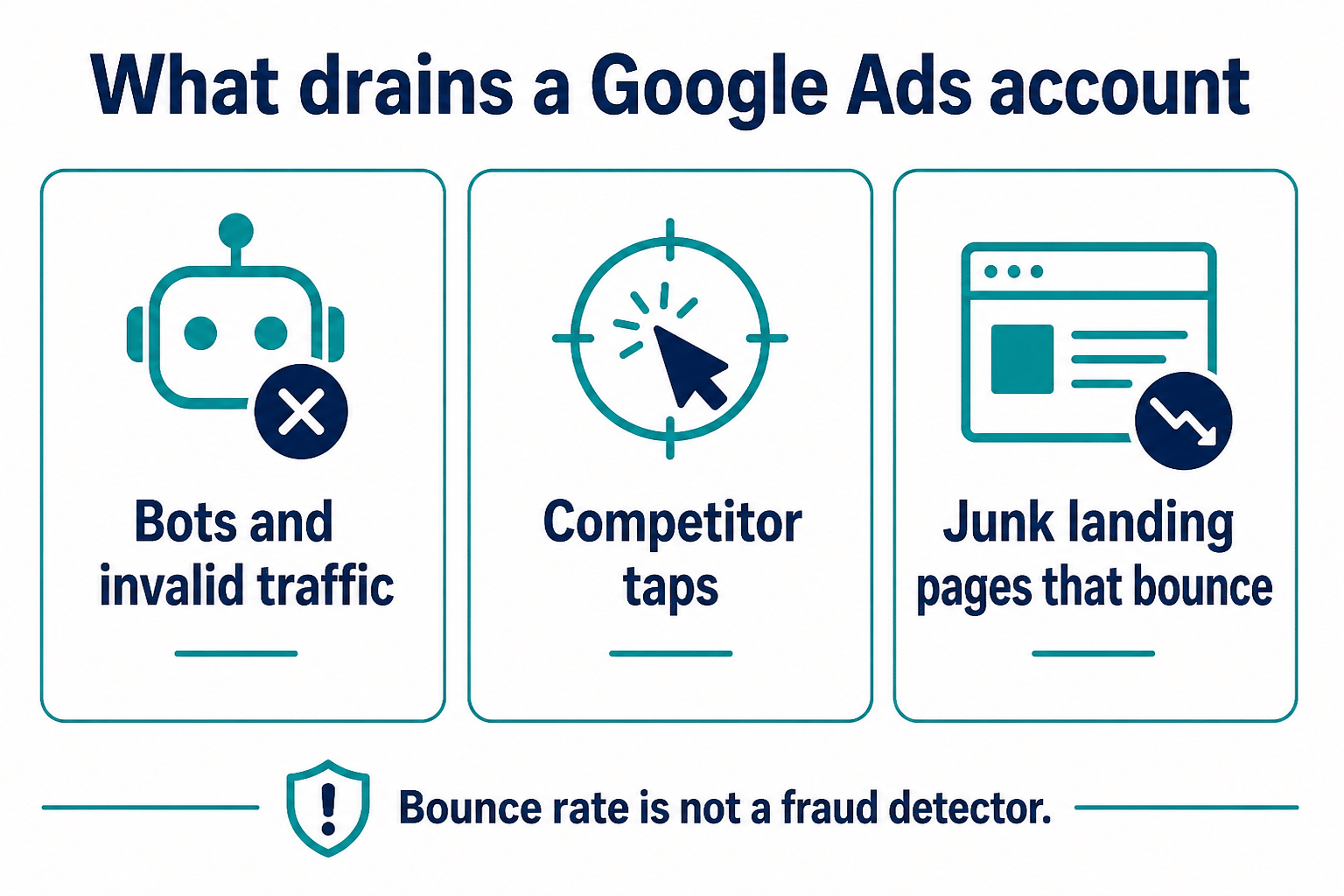
Open the last 30 days of search terms, locations, devices, bounce or engagement, and conversions.
Invalid clicks is Google’s bucket: automated hits, duplicate and accidental clicks, and deliberately fraudulent taps. Google tries to filter a lot of that before you are billed, and may credit some of it after an invoice. The “Invalid clicks” column is traffic they already caught — not a certificate that everything else was a customer.
Competitor clicks do not always look like a botnet. A rival in Richmond or a national catalogue can tap your ad from the office, a phone or a VPN. Volume is often small; cost is not. Repeat visits, near-zero time on site, no conversion.
Bots and scrapers hit the landing page, fire a session, and leave. Analytics records a visit. Google Ads records a click you paid for. Shopping and Performance Max hide junk in placement reports you never open.
Accidental taps are ordinary on mobile. A thumb hits the ad above the organic result. They bounce in a second. That is a phone, not a failed headline.
Put the reports together: spend on plan, leads not; CTR fine, conversion rate a rounding error; paid bounce much worse than organic; time on site near-zero; a handful of IPs eating clicks; “Melbourne” you do not service, or “interested in” rather than physically there; one device soaking budget; Smart Bidding “learning” junk.
Wasted spend is not only fraud. Display with no working conversion, every ad to a slow homepage, and clicking your own ads “to test” all bleed the same invoice. Preview in Ads — do not tap the live ad.
The two-bill picture — media spend versus management — sits in how much Google Ads cost in Melbourne in 2026. This post is the quality of the click, not the size of the invoice.
Why bounce rate lied
Bounce rate is a blunt instrument. A session that lands and leaves counts as a bounce whether the visitor was a gym owner who hated your freight copy, or a script that never rendered the page.
When a large share of paid clicks are not people, bounce inflates. The site looks broken. The agency “optimises the ads.” The designer rebuilds the hero. Nobody asks whether the visit was real. Genuine sessions get mixed into the same average, so you cannot see that actual shoppers were fine.
The reverse is also true. A genuine Melbourne visitor on a janky mobile page will bounce. INP (Interaction to Next Paint) is the technical gate: if “Add to cart” or “Call now” stutters, they leave and you still paid for the click. Message mismatch does the same — ad says “commercial squat rack, Melbourne delivery,” homepage says “Welcome to our blog.” High bounce is a symptom, not a diagnosis.
Segment paid vs organic, device, and landing page. If organic engagement is healthy and paid is not, the page is probably not the whole story. Smart Bidding makes the lie expensive: you told the machine a 3-second call was success, so it buys more of that junk.
That is why we treat click-fraud protection as part of Google Ads management, not an upsell. Filter the junk, then judge the lander. Do both in the same week, not in two companies who will blame each other.
NC Fitness: the published example
We are not inventing a portfolio of click-fraud case studies for this article. The bounce-and-rankings story on our homepage, and the only one we will use here, is NC Fitness Gear.
NC Fitness supplies gym equipment and flooring from Hallam, Victoria. When they came to us the store had real products and a digital mess: slow hosting, coding issues, high bounce and expensive CPAs. We fixed technical SEO and ran Google Ads properly — including click-fraud protection.
The published result: bounce went from over 50% to under 3%. Click-fraud protection removed the fake “bad” traffic. Speed work meant mobile users could actually shop. Protection without a usable page still wastes the good clicks. A fast page fed by bots still reports a bounce disaster.
Then the organic side. After the SEO strategy, NC ranks in top positions in Australia for gym equipment phrases. Paid stopped being the only door. Cleaner traffic, a site that could hold a visitor, rankings that take pressure off the auction — Ads and SEO in one office.
No invented “X% of Australian clicks are fake.” No third-party vendor logo. If someone pitches a national fraud rate as a closer, ask where it was measured and whether they have a Melbourne example they will put their name on.
What to check (and what to ask the agency)
Take this list to the next meeting. If you are hiring, make them answer it before you sign.
IP exclusions. Who reviews repeat IPs, data-centre ranges and known-competitor offices — and how often? Exclusions rot. Ask to see the list and when it last changed.
Geo. “Melbourne” is not a service area. Presence in the suburbs you actually cover — not “people interested in Melbourne” sitting in another state. Look at the user-location report, not the targeting label.
Device. Split mobile, desktop and tablet for spend, bounce or engagement, and conversions. If mobile spends the budget and desktop converts, fix the lander — do not just pause mobile.
Conversion tracking. Form submits that arrive, calls over a useful duration, purchases, booked jobs — not “clicked the button” or thank-you-page refreshes. If tracking is wrong, Smart Bidding optimises for junk. Admin access to your Google Ads, GA4, Tag Manager and Merchant Center should sit with you.
Landing page INP. Open the page on a real phone, on cellular, and tap the thing you paid for. If it janks, you are buying bounces from real people. Our landing pages start from $1,100: one offer, fast, forms, analytics.
Search terms, weekly. Broad match plus a sleeping account is how you pay for “jobs,” “DIY,” “free” and suburbs you do not cover.
Invalid clicks and credits. Add the column. Google’s credits are what they caught late — credits against spend, not a cash refund.
Click-fraud protection. Ask what they use, how it is configured, and how it shows up in the monthly report. We will not name other vendors here. “Google already handles that” is not a substitute for management.
Ask them straight: who logs in, and are they in Australia? When did IP exclusions and geo last change? What is a conversion, in one sentence? Can you see paid vs organic engagement? Have they tested INP on mobile for the ad URLs? Do you have admin access today? If bounce is high, how will they separate junk traffic from a bad page?
Agency red flags
Set-and-forget. Launched in January, opened again in June. Invalid clicks never reviewed.
CPC-only reporting. Clicks are a cost. Leads are the result.
No conversion tracking, or tracking that counts noise as success. Smart Bidding will spend the rest of the budget proving the lie.
No admin access to your own Ads account, GA4 or Tag Manager. If they will not share logins, walk.
Offshore hours with a Melbourne phone number. Fake clicks and suburb-level geo do not get fixed on a follow-the-sun farm. We do the work in-house. Never offshore.
Clicking your own ads as a “test.” You pay. You can also get the account flagged.
Every ad to the homepage. For a service, suburb or product, a dedicated lander almost always wastes less. From $1,100 is the published floor.
Guaranteed #1 SEO sold as a bundle with Ads. Paid can be live in days. Organic cannot be purchased as a ranking.
A national fraud percentage as the pitch. If the close depends on a scary industry rate they cannot source, you are being sold fear.
Silver / gold / platinum Ads packages. We quote. We have not published a public Ads retainer menu. See the cost post.
Ads plus SEO, so you are not 100% on paid
Fake clicks hurt more when paid is the only door. Every junk tap is a dollar you cannot recoup from a ranking you already own.
Ads rent the click. They can be on page one in days. They stop when the budget stops. SEO is slower and compounds. Our published SEO retainers sit at $1,500–$5,000+ per month. Initial movement typically 3–6 months; substantial results in competitive Melbourne markets 6–12 months. We do not guarantee #1.
The failure mode is two vendors: SEO trying to rank the terms Ads is paying $20 a click for, no shared negatives, bounce blamed on “the other channel.” We run SEO and Google Ads in the same Docklands team so paid and organic are one plan.
NC Fitness is the published sequence: clean the paid traffic, fix the site, then let organic carry gym-equipment demand so the auction is not the only growth lever. If you are weighing the two as an either/or, read SEO vs Google Ads in Melbourne. Most businesses that care about pipeline this quarter and next year run both.
Australian charities and non-profits: we offer free Google Ads management where they qualify. That is management, not unlimited free media from Google.
FAQ
What is click fraud on Google Ads?
Any click you pay for that was not genuine interest in buying: bots, scrapers, competitor taps, click farms, and a slice of accidental mobile hits. Google groups much of this as invalid traffic. You need reports that separate humans from noise.
Does Google refund fake clicks?
Google filters some invalid activity before you are billed, and may issue credits (not a cash refund) for some activity found after an invoice. Credits do not repair Smart Bidding that learned from junk.
How do I know if my Melbourne account has fake clicks?
Look for the cluster: spend without leads, high paid bounce next to healthier organic, near-zero time on site, repeat IPs, geo that does not match the van, one device soaking budget. Then open search terms and the invalid-clicks column.
Will click-fraud protection fix a bad landing page?
No. It removes a class of junk so you can see the page clearly. If INP is poor or the offer does not match the ad, genuine visitors will still leave. We build the pages and run the ads in-house so that job cannot bounce between two invoices.
What does Ads management cost?
We quote. There is no public Ads retainer menu. Public Melbourne guides describe monthly fees or a percentage of spend — that is the market, not our rate card. Details sit in Google Ads cost Melbourne 2026.
Should I pause Google Ads and “just do SEO”?
Only if you can wait. Pausing paid because of fake clicks, without cleaning traffic and the lander, just pauses revenue. We will say if the site is not ready — we also design it.
Do you manage Google Ads for charities?
Yes — free Google Ads management for Australian charities and non-profits, with qualification. Start on the Google Ads management page. It is not automatic.
Are you a Google Partner, and is the work done in Australia?
Yes. Official, certified Google Partner. In-house at Docklands — about us — not subcontracted offshore. I am Tristan Brunsdon. We have been doing this work for 20+ years.
Talk to us before the next invoice teaches you the same lesson
If bounce is high, leads are thin, and the report still looks “busy,” do not buy another month of the same clicks.
Call 03 9067 5679 or 1300 322 971, or start on Google Ads management. We will look at the account, the landing page, invalid traffic, and whether SEO should be carrying part of the load.
Design Box Digital
Level 10, 611 Flinders Street, Docklands
Tristan Brunsdon, CEO
In-house. Never offshore. Certified Google Partner. Click-fraud protection as part of the work, not a scare statistic on a slide.