


Featured image: Photo on Unsplash.
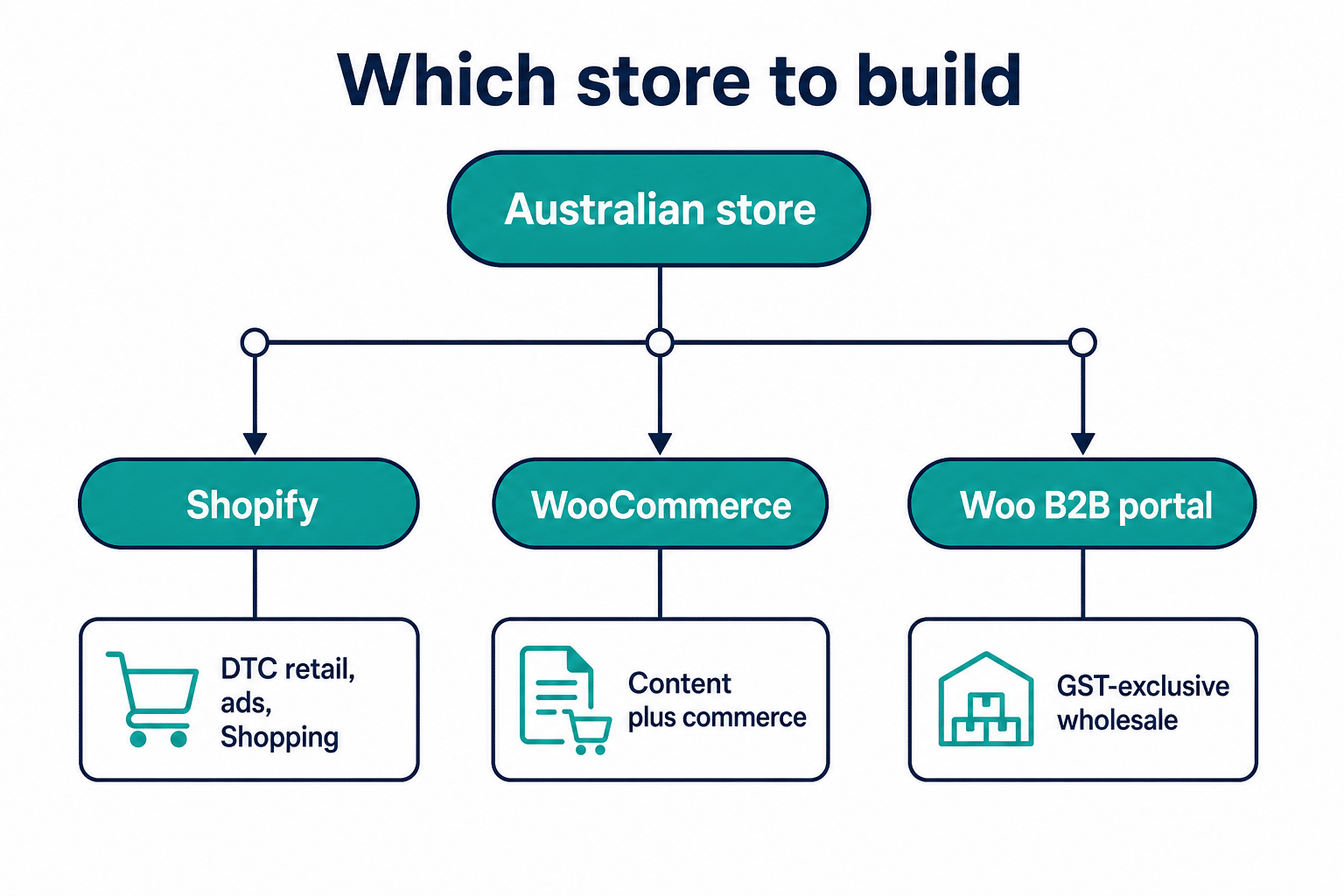
If you sell direct to Australian consumers and want a store that is live, paid and on Google Shopping without babysitting a server, build Shopify. If the site has to be a content brand and a shop — blog, guides, granular URLs — build WooCommerce on WordPress. If you are a Melbourne wholesaler who needs GST-exclusive trade pricing, pallet rates and pay-on-account, build a WooCommerce B2B portal. Not a shop with a password.
We build both from Docklands. The ecommerce floor on our web design page is from $7,000 either way — Shopify or WooCommerce — and includes the business package plus customer automations, Google Merchant Center, sales channels, a payment gateway and inventory management. GST is 10%. Those floors are not labelled inclusive or exclusive on that page; the quote will say which. The wrong platform is the expensive one.
TL;DR
- DTC retail: Shopify. Hosting is in the subscription. Channels: Google Shopping, Facebook/Instagram, Pinterest, eBay, Amazon. Shopify 2.0 themes; only lightweight apps that don’t wreck INP.
- Content + commerce: WooCommerce on WordPress. You own the CMS, URLs and data.
- Wholesale: a Woo B2B portal — tiered Gold Partner vs retailer vs guest pricing, GST-exclusive trade, pallet vs satchel, PO / pay on account, ERP, agent login. Shopify for plug-and-play / marketing; Woo for bespoke logic and no platform tax.
- Build: from $7,000 either way. Woo cPanel $20 / $44 / $60 / $184 per month. Shopify: published AU subscription (check shopify.com) plus transaction fees unless Shopify Payments. Ignore US/USD round-ups.
- 3-year TCO is often closer than blogs claim. Table below is an illustration with labelled assumptions, not a Shopify price list.
- In-house AU team, 20+ years ecommerce. 03 9067 5679 / 1300 322 971.
Quick verdict by business type
| You are | Build | Why |
|---|---|---|
| DTC retailer (fashion, home, gadgets) | Shopify | Fast to launch. Checkout Australians already trust. Channels without a plugin circus. We keep the app list short so INP stays honest. |
| Content brand (guides + catalogue) | WooCommerce | WordPress is the CMS. Granular SEO, custom taxonomies, you own the code and the data. |
| Melbourne / Australian wholesaler | B2B WooCommerce portal | Dynamic identity (Gold Partner vs retailer vs guest), GST-exclusive wholesale + GST-inclusive retail, quick-order grids / CSV, pallet vs satchel, registration and approval. Off-the-shelf shops treat this as “a password”. We don’t. |
Decision tree. Selling one price to the public, living on ads and Shopping? Shopify. Publishing as a brand and selling from the same domain? Woo. Trade accounts, net terms, ERP, mixed GST display? Woo portal. If you are still unsure, that is a scoping call, not a blog-comment poll.
Platform comparison (Australia, 2026)
Paraphrased from how we actually run the two stacks — not a feature dump from a US round-up.
| Shopify (SaaS) | WooCommerce (open source on WordPress) | |
|---|---|---|
| Hosting | Included in Shopify’s subscription | You host it. Our published cPanel: $20 / $44 / $60 / $184 per month at web hosting |
| Fees | Subscription + transaction fees unless you use Shopify Payments | No Shopify platform tax. Hosting + plugins + gateway fees |
| Ease | High. Plug-and-play, marketing-first | Moderate. WordPress familiarity; we set it up |
| SEO | Clean and automated, but rigid (you cannot change some URL structures) | Granular. Full control of technical SEO variables |
| B2B / wholesale | Possible with apps or Shopify Plus. Easy until the logic is Australian-wholesale-shaped | Built for bespoke: tiered identity, GST split, pallet rates, PO / quote, agent login |
| GST | Straightforward 10% inclusive retail | Inclusive retail and exclusive logged-in wholesale on the same catalogue |
| Maintenance | Shopify patches the platform | You (or we) update WordPress, theme and plugins |
| Ecosystem | Closed. Theme engine + App Store | Open. You own it; unlimited customisation |
| Checkout AU | Afterpay, Zip and cards are typical Australian checkout — not a Design Box product price | Same methods via extensions / gateways; more bank-facility flexibility |
Shopify if you want a closed box and 24/7 platform support. WooCommerce if you need a highly bespoke site, want to avoid recurring platform fees, or the wholesale logic will not fit a standard mould.
Real 2026 AUD costs (and a 3-year TCO illustration)
Our published ecommerce package is from $7,000 for Shopify or WooCommerce. It includes everything in the business site package plus the store, customer automations, Google Merchant Center, sales channels, payment gateway and inventory management. Business sites start from $3,300. Landing pages from $1,100. Full breakdown: How much does a website cost in Melbourne in 2026?.
Ongoing, the stacks diverge.
- Shopify: hosting is inside Shopify’s published Australian subscription (Basic / Grow / Plus — check shopify.com; we will not guess 2026 list prices) plus transaction fees unless you use Shopify Payments. Apps we mention: SEO, upselling, Instagram, shipping, inventory, Xero — lightweight only.
- WooCommerce: published cPanel $20 / $44 / $60 / $184 per month. Plugins and maintenance are extra; you own the stack.
- SEO is not in the theme. Retainers typically $1,500–$5,000+/month. A free SEO audit is normally $3,300 inc GST if you are buying the work. See SEO cost in Melbourne 2026.
Three-year TCO — illustration only, labelled assumptions
Not a quote. Not Shopify’s 2026 price list. GST is 10%; confirm exclusive vs inclusive on the quote. Afterpay/Zip are typical AU checkout, not Design Box prices.
Assumptions: same from $7,000 build; Shopify plan = whatever Shopify currently publishes in Australia; Woo on our published hosting; typical-market app/plugin bands; SEO retainer excluded (it dwarfs platform cost either way).
| Cost line (AUD) | Shopify (illustration) | WooCommerce (illustration) |
|---|---|---|
| Build (our floor) | From $7,000 | From $7,000 |
| Platform / hosting, 36 months | Shopify’s published AU subscription × 36 (check shopify.com). Hosting is inside the sub. | cPanel: $720 / $1,584 / $2,160 / $6,624 at $20 / $44 / $60 / $184 per month |
| Apps / plugins (typical market, not our SKU) | A short stack (SEO, shipping, inventory, Xero) often lands from tens to a few hundred per month — confirm each app | Paid B2B, security, backup, shipping plugins: typical market often ~$30–$200+/month depending on wholesale depth |
| Transaction fees | Extra unless Shopify Payments | Gateway fees only; no Shopify platform tax |
| Maintenance | Shopify patches core. Theme and app care still exist. | WordPress + theme + plugin updates. Budget for it or it bit-rots. |
| SEO (optional, typical) | $1,500–$5,000+/month on either platform | Same |
Worked illustration — DTC retailer, not B2B, not a quote. A typical Australian Shopify stack (plan + a handful of apps) often lands around $150–$350/month — a market band to confirm on shopify.com, not a 2026 list price we invented. × 36 months = $5,400–$12,600. Plus $7,000 floor → about $12,400–$19,600 before payment fees and ads.
Woo on our $60/month Performance plan ($2,160 / 36 months), typical-market plugins $50–$150/month ($1,800–$5,400), maintenance $100–$200/month ($3,600–$7,200): run-cost $7,560–$14,760. Plus $7,000 → about $14,560–$21,760 before fees and ads.
For a straightforward retailer, three-year TCO is often in the same neighbourhood. The fork is later: Shopify Plus and app tax as B2B gets serious, versus a Woo portal that already does GST-exclusive wholesale. US/USD tables do not answer that.
Australian checkout: GST, Afterpay, Zip, Australia Post, Merchant Center
This is where US comparison posts fall over.
GST. Retail is 10%, inclusive. Wholesale buyers expect GST-exclusive once logged in. Shopify handles standard inclusive GST cleanly. WooCommerce is where we set both on one catalogue — exclusive for verified trade, inclusive for guests — plus tax-exempt or export if you need it.
Afterpay and Zip. Typical Australian checkout on both platforms (Shopify Payments / official apps; Woo extensions). Not a Design Box product price. Most consumer verticals convert worse without BNPL.
Australia Post — satchel vs pallet. A 400 g satchel and a 200 kg pallet are not the same rule. Retail Shopify does satchels and live rates well. Wholesale needs pallet logic, account rates, sometimes “we’ll quote freight”. That is B2B work, not a theme checkbox.
Google Merchant Center is in our ecommerce floor so Shopping and Google Ads are not a surprise invoice. Both platforms feed it; neither is set-and-forget if stock actually moves.
Xero. Shopify via apps. Woo with MYOB, DEAR/Cin7 or Unleashed when wholesale invoices have to match the warehouse.
B2B: a wholesale portal is not a password
Most agencies treat B2B like a standard shop with a login. Melbourne wholesalers do not buy that way. The B2B WooCommerce build is a portal.
- Dynamic identity. A Tier 1 Gold Partner sees different pricing, shipping and availability to a Tier 3 retailer or a public guest.
- Frictionless bulk. Quick-order grids and CSV so a procurement manager can add 50+ lines in seconds. B2B buyers replenish; they don’t browse.
- Credit and quote. Pay on account, PO upload, request-a-quote for custom or high-ticket lines. Not every wholesale sale is a card.
- GST and freight. Exclusive for logged-in wholesale, inclusive for retail. Pallet rates versus satchels.
- People and systems. Registration and approval for trade accounts. Agent login for sales reps at that client’s rates. ERP (Xero, MYOB, DEAR/Cin7, Unleashed) as the source of truth so warehouse stock matches the site.
Shopify if you want plug-and-play and the marketing team owns the roadmap. Woo if the logic is bespoke, you want to avoid the platform tax, or “Plus + a pile of B2B apps” is a dearer way to fake a portal.
SEO, INP and Merchant Center (where the store actually earns)
Platform choice does not rank you. Technical SEO and the way the catalogue is built do.
Shopify is clean out of the box and rigid where it hurts: some URL structures will not move. We still rank Shopify stores. Kollab came to us with one ranking page; through SEO that is now 450+ first-page results, with organic traffic growing over 100% yearly. Shopify 2.0 themes, short app lists, sales channels set up properly.
WooCommerce gives you the URLs, schema and content model. It also gives you the chance to install twelve plugins that destroy INP. NC Fitness Gear is WooCommerce: bounce from over 50% to under 3%, and they sit in top Australian positions for gym equipment phrases. That was speed, hosting, coding and the campaign — not a platform slogan.
INP (Interaction to Next Paint) is the 2026 gate. Add-to-cart, filters and menus have to respond. We refuse heavy apps and plugin piles for that reason. Merchant Center is in the build so Shopping is not an afterthought. Rankings without a feed, or a feed on a store that stutters, waste Ads budget.
Migrating Woo ↔ Shopify without torching SEO
We migrate both directions. The non-negotiables:
- Map every ranking URL before you touch DNS. Products, collections/categories, blogs, the boring pages that actually convert.
- 301 redirects, one-to-one where the page still exists, to the closest live equivalent where it doesn’t. No homepage dump.
- Google Search Console: property for the new host/platform, sitemap submitted, 404 and redirect reports watched for weeks, not a day.
- Merchant Center and Ads retargeted to the new product IDs / URLs so Shopping does not fall off a cliff.
- Customers, orders, SKUs, reviews mapped. Wholesale price lists and tax classes are part of the migration, not a “phase two”.
You will have a ranking dip if you skip the map. You do not have to throw the domain in the bin to change platform.
FAQ
Which is cheaper in Australia — Shopify or WooCommerce?
Year one, often similar once you count a real build (from $7,000 either way). Shopify looks cheaper if you ignore the subscription, apps and transaction fees. Woo looks cheaper if you ignore hosting, plugins and maintenance. Use the TCO illustration above; then quote the actual catalogue. US dollar tables are not an Australian answer.
Can Shopify do wholesale?
Yes, with apps or Shopify Plus. It is the wrong default when you need GST-exclusive logged-in pricing, pallet vs satchel, pay on account, agent login and ERP on the same site. That is the Woo portal.
Do both support Afterpay and Zip?
Yes. Typical Australian checkout on both. Configuration differs; neither is a Design Box line-item price.
Will I lose Google rankings if I switch?
Not if 301s and Search Console are done. You will if you launch a new URL scheme and hope Google “figures it out”.
What’s in the $7,000 ecommerce floor?
Business package plus Shopify or Woo, customer automations, Google Merchant Center, sales channels, payment gateway, inventory management. Photography, copy, SEO retainers and Ads are extra. Woo monthly hosting is the cPanel page, not the build floor.
Do you host Shopify?
No. Shopify hosts Shopify. We host WordPress/Woo on the published cPanel plans. We still build and integrate the Shopify store.
Should a Melbourne wholesaler start on Shopify and “upgrade later”?
Usually no. Re-platforming a live wholesale account base costs more than building the portal once. If you are DTC-first with a few trade logins, say so in the scoping call.
Get a Shopify or WooCommerce quote
We build both. We will tell you which, and we will tell you if the cheaper logo is the wrong job.
Ecommerce stores from $7,000. Wholesale portals quoted from that floor against real B2B scope. In-house, Docklands — Level 10, 611 Flinders Street — never offshore.
Call 03 9067 5679 or 1300 322 971, or request a quote on web design, Shopify or B2B WooCommerce.