


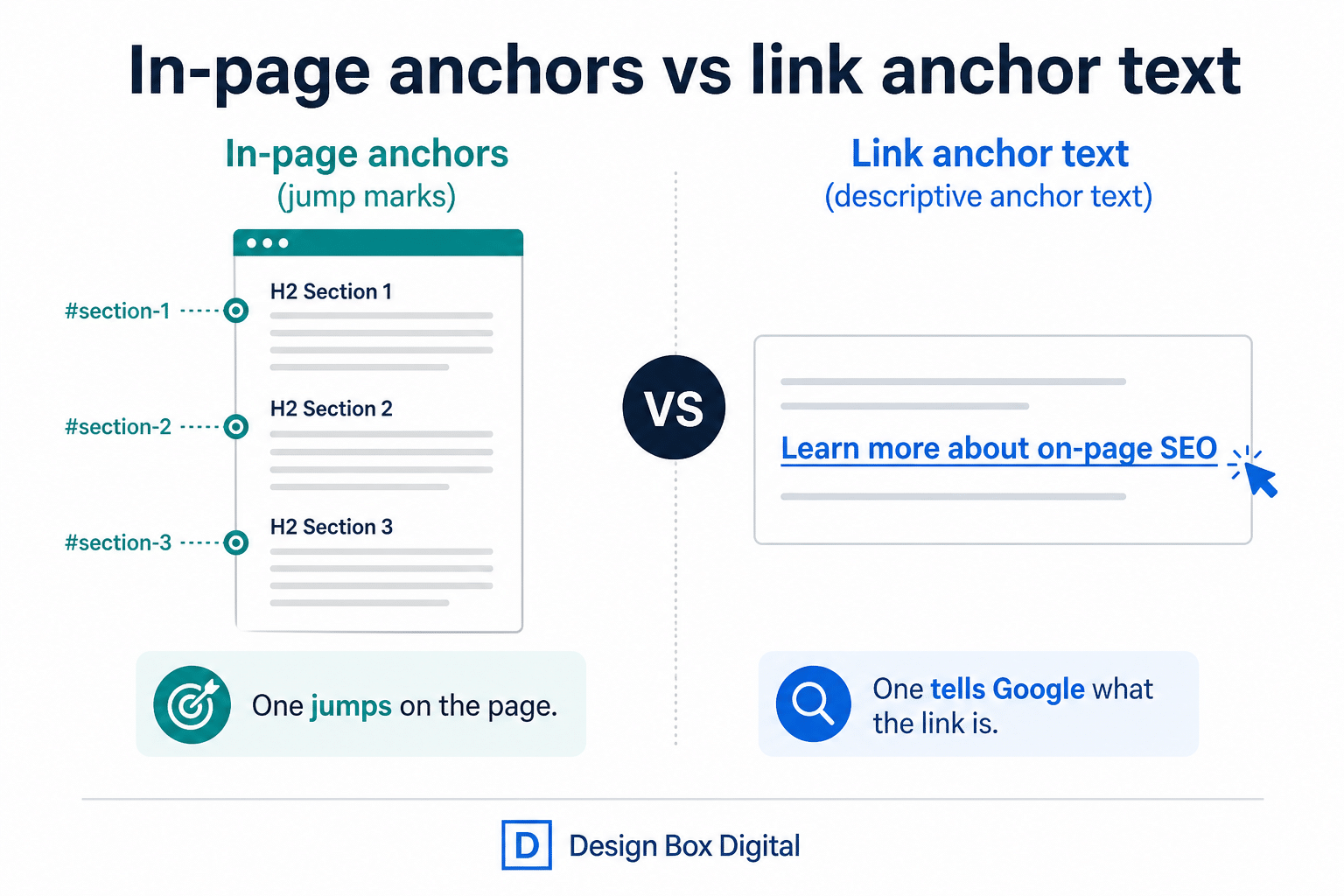
Two different things get called “anchors”. An in-page anchor jumps to a heading on the same URL. Anchor text is the clickable words of a link. Mixing them up is how you get a 2,000-word boat metaphor and a “click here” profile. This is the short version we actually use on Melbourne sites.
In-page anchors (jump links)
Use them on long service pages and this blog: a contents list, a “get a quote” jump, an FAQ. The heading needs a stable id. The link is #that-id. Keep one H1. Do not animate the scroll as the only moving thing on the page — it is a novelty, not a conversion tactic.
Good uses: table of contents, skip to the form, skip to reviews that are actually on the page. Bad uses: a whole mega-menu that only scrolls a one-pager so Google sees one thin URL for five services.
Anchor text (the words in the link)
Write what the destination is. “Melbourne SEO agency” beats “click here”. Same for internals: send people to the page that answers the next question, with words a human would tap.
Types you will hear in SEO decks — branded, exact match, naked URL, generic. A natural profile is mixed. Exact-match on every link is how Penguin-era spam looked. We still do not do that.
- Internal: descriptive, varied, useful. Point to money pages and proof, not a tag archive.
- External: you do not control the inbound mix. You do control not buying identical commercial anchors from a farm.
What we do not do
Keyword-stuffed anchors. A landing page whose entire nav is jump links pretending to be a site. Copying another clinic’s one-pager as a case study. If the page is a real service with a real URL, give it a real URL.
Talk to us
If a rebuild or a messy theme is why you are stuffing five services onto one scroller, that is a web design conversation first. Design Box Digital, Docklands. 03 9067 5679 · 1300 322 971.